When you are building a premium wardrobe or upgrading your bedding, you eventually run into two of the most common woven fabrics in the textile world: poplin and twill. Both are frequently made from high quality fibers such as organic cotton or premium bamboo, yet the way the yarns are interlaced is completely different. That single structural difference changes how a fabric feels against skin, how it drapes, how quickly it wrinkles, and how it holds up across years of washing.
At OdeSleep, we build our guides around verifiable science and the regulatory standards that actually govern textiles sold in the United States, rather than marketing language. This guide explains the real structural science behind poplin and twill, cites the federal agencies that regulate textile labeling and safety, and references peer reviewed sleep research, so you can make a confident, well informed choice for your wardrobe or your bed.
The Core Structural Difference: Plain Weave vs Diagonal Weave
Before comparing real world performance, it helps to understand what is happening at the yarn level. The difference between poplin and twill has almost nothing to do with the raw fiber itself, whether that is cotton, linen, or bamboo, and everything to do with how the weaver interlaces the threads.
Under the Textile Fiber Products Identification Act, the Federal Trade Commission requires every covered textile product sold in the United States to disclose fiber content, country of origin, and manufacturer identity on its label. Weave structure is a separate technical property that the label does not usually spell out, which is exactly why understanding weave, not just fiber, matters so much when you shop.
What Is Poplin?
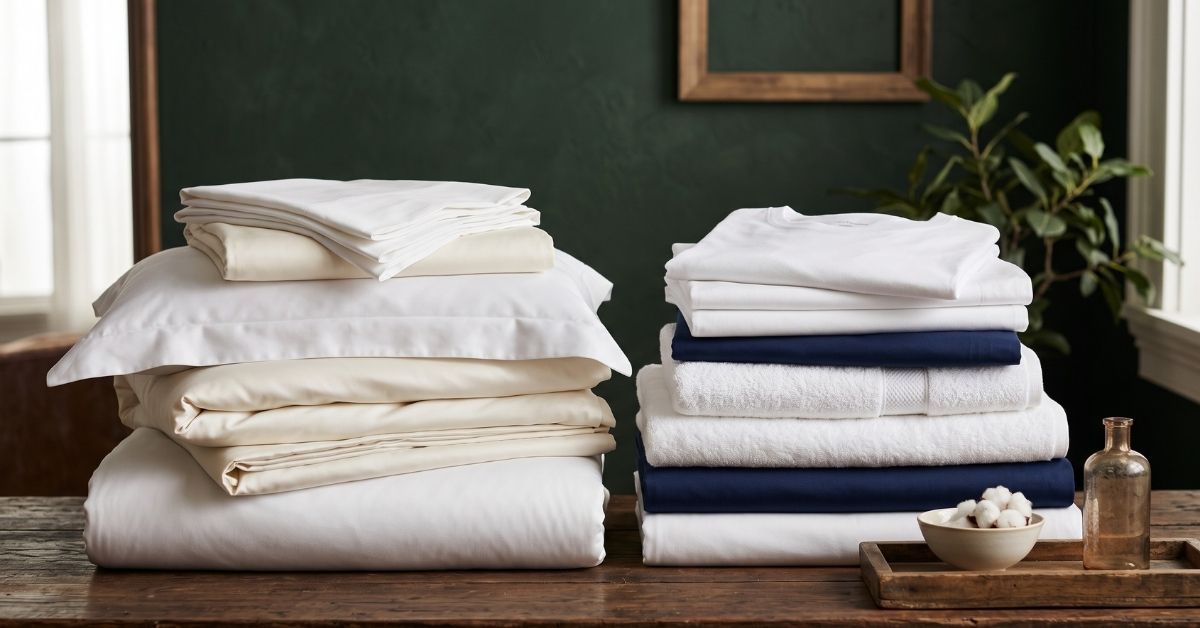
Poplin is built on a traditional plain weave. The yarns cross over and under one another in a strict, alternating pattern, one thread over and one thread under, repeated across the entire fabric.
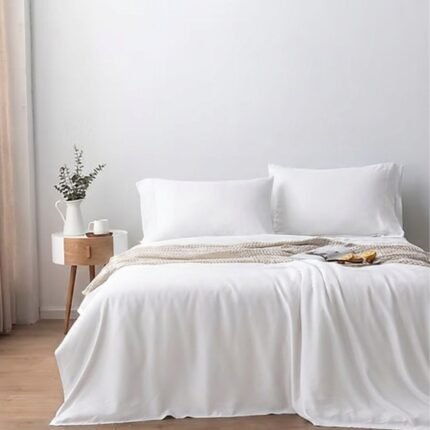
To create poplin's signature structure, weavers typically use fine warp threads, the vertical yarns, packed tightly together, then intersect them with a slightly thicker weft, the horizontal yarn. The result is a tightly woven, remarkably flat surface that feels smooth, light, and crisp against the skin.
What Is Twill?
Twill relies on a more complex, staggered interlacing method, where the weft yarn passes over two or more warp threads before going back under, commonly described as two over two under or three over one under.
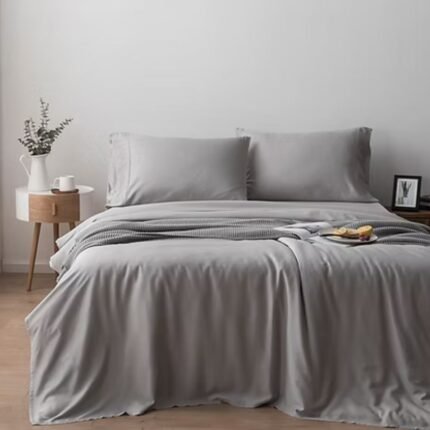
This staggered pattern creates the diagonal ribbing visible on denim, chinos, and herringbone jackets. Because the yarns float over multiple threads before interlacing, more fiber packs into the same area, producing a fabric that is heavier, softer to the touch, and more opaque than poplin.
Head to Head Comparison Table
Here is an engineering level look at how poplin and twill compare across the metrics that matter most for clothing and bedding.
| Attribute |
Poplin (Plain Weave) |
Twill (Diagonal Weave) |
| Surface Texture |
Completely smooth, flat, subtle sheen |
Textured, with visible diagonal ridges |
| Fabric Weight |
Lightweight and thin |
Medium to heavyweight |
| Breathability |
Excellent, high airflow |
Moderate to low, traps pockets of warm air |
| Wrinkle Resistance |
Low, creases easily |
High, naturally resists wrinkling |
| Drape and Fluidity |
Crisp, structured, sharp edges |
Soft, heavy, follows body contours |
| Dust and Lint Attraction |
Minimal, flat weave sheds particles |
Higher, ridges trap loose particles |
| Best Seasonal Use |
Hot summer and humid climates |
Cool autumn, winter, and climate controlled spaces |
| Regulatory Coverage |
Subject to FTC fiber labeling and CPSC flammability testing |
Subject to FTC fiber labeling and CPSC flammability testing |
What Federal Standards Say About These Fabrics
Shoppers in the United States are protected by several federal rules that apply equally to poplin and twill garments and bedding. Knowing these standards helps you read labels and marketing claims with a more critical eye.
- Fiber content labeling. Under the Textile Fiber Products Identification Act, enforced by the Federal Trade Commission, covered textile products must carry a label disclosing fiber content, country of origin, and the identity of the manufacturer or marketer, regardless of whether the item is woven as poplin or twill.
- Care instructions. The FTC's Care Labeling Rule, found at 16 CFR Part 423, requires manufacturers to provide reliable washing and drying instructions on nearly all wearing apparel, which is especially useful when comparing how poplin and twill respond to laundering over time. The Commission's own guidance on the Textile and Wool Acts explains these disclosure rules in plain language for both businesses and consumers.
- Flammability safety. Both plain weave and twill fabrics intended for clothing must meet the Standard for the Flammability of Clothing Textiles, 16 CFR Part 1610, issued by the Consumer Product Safety Commission under the Flammable Fabrics Act. The rule classifies textiles into three flammability classes and prohibits the most dangerous class from being sold as apparel.
- Organic fiber verification. If you are shopping for organic cotton poplin or twill, the USDA National Organic Program oversees certification of the raw cotton fiber itself, while finished textile processing is typically certified separately under the Global Organic Textile Standard, a distinction the USDA explicitly recognizes as compatible with use of the USDA organic seal.
- Sleep and thermal research. Peer reviewed research published through the National Institutes of Health National Library of Medicine has measured how different fabric fibers influence skin temperature, core body temperature, and sleep quality overnight, giving an evidence based foundation to the breathability claims made about lightweight, plain weave fabrics like poplin.
Which Fabric And Product Should You Buy?
Matching the weave to your actual sleeping environment and lifestyle is the fastest way to get lasting comfort out of either fabric. Use this table as a starting point, then follow the linked product for a specific recommendation.
Choose Poplin If
- You are a hot sleeper or live in a warm climate, since the thin, plain weave maximizes ventilation and keeps body temperature regulated on summer nights.
- You love a clean, crisp finish and appreciate the sharp, pressed look of quality dress clothing or bedding.
- You have shedding pets, since the flat surface plane resists pet hair and dander far better than a textured weave.
Choose Twill If
- You dislike ironing and want apparel or bedding that looks smooth and neat straight out of a standard laundry cycle.
- You want a soft, cozy drape and prefer fabric that feels substantial and traces the contours of the body.
- You need all season versatility for chilly autumn mornings, air cooled offices, and winter layering.
Final Recommendations: Which Should You Buy?
At OdeSleep, we believe the ideal fabric depends entirely on your environment, your sensory preferences, and how much maintenance you are willing to put in.
By matching your personal environment to the structural mechanics of these weaves, backed by the federal labeling, safety, and organic standards outlined above, you can choose clothing and bedding that genuinely fits your lifestyle rather than simply following a trend.
Explore More Fabric Comparisons
If you are still narrowing down the right material for your bedroom or wardrobe, these related OdeSleep guides go deeper on individual fiber comparisons.
Sources
- Federal Trade Commission. Textile Fiber Products Identification Act, 16 CFR Part 303 (eCFR). https://www.ecfr.gov/current/title-16/chapter-I/subchapter-C/part-303
- Federal Trade Commission. Care Labeling of Textile Wearing Apparel and Certain Piece Goods, 16 CFR Part 423. https://www.ftc.gov/legal-library/browse/rules/care-labeling-textile-wearing-apparel-certain-piece-goods
- Federal Trade Commission. Threading Your Way Through the Labeling Requirements Under the Textile and Wool Acts. https://www.ftc.gov/business-guidance/resources/threading-your-way-through-labeling-requirements-under-textile-wool-acts
- U.S. Consumer Product Safety Commission. Flammable Fabrics Act. https://www.cpsc.gov/Regulations-Laws--Standards/Statutes/Flammable-Fabrics-Act
- U.S. Consumer Product Safety Commission. Standard for the Flammability of Clothing Textiles, 16 CFR Part 1610. https://www.cpsc.gov/Business--Manufacturing/Business-Education/Business-Guidance/Flammable-Fabrics-Act
- U.S. Department of Agriculture, Agricultural Marketing Service. Organic Textiles, National Organic Program. https://www.ams.usda.gov/grades-standards/organic-textiles
- National Institutes of Health, National Library of Medicine. The effects of fabric for sleepwear and bedding on sleep at ambient temperatures of 17C and 22C. https://pmc.ncbi.nlm.nih.gov/articles/PMC4853167/
- National Institutes of Health, National Library of Medicine. Encasing bedding in covers made of microfine fibers reduces exposure to house mite allergens. https://www.ncbi.nlm.nih.gov/pmc/articles/PMC3829998/