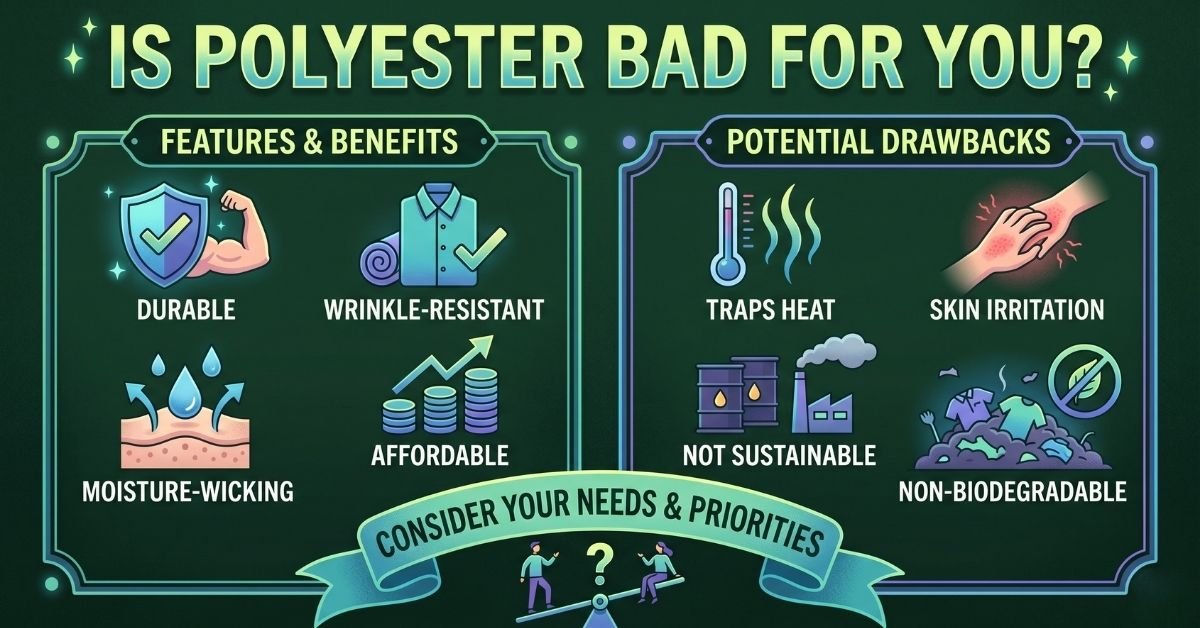
If you open your closet right now, there is a roughly 60% chance you're looking at polyester. It is the backbone of the fast fashion industry, prized by manufacturers for its durability, stretch, quick-dry properties, and ability to hold vibrant colors at a low cost. But as consumers grow more health-conscious about what they put on their bodies not just in them the question is getting louder: is polyester bad for you?
This article breaks down what peer-reviewed research, toxicology data, and environmental health authorities actually say, so you can make an informed decision for your wardrobe and your household.
What Is Polyester, Anyway?
To understand the potential health risks of polyester, it helps to understand what it is. Unlike cotton, linen, or wool — which grow from the earth or on animals — polyester is a synthetic polymer, or more simply: a form of plastic.
Most clothing-grade polyester is made from polyethylene terephthalate (PET), the same base material used to manufacture disposable water bottles and food containers. The raw material is derived from petroleum through a multi-step chemical process involving esterification and polycondensation, producing long, durable fibers that can be woven or knitted into fabric.
Because it is entirely petroleum-derived, polyester does not biodegrade in any meaningful timeframe. Fibers shed into the environment — through washing, wear, or disposal — persist for hundreds of years.
Is Polyester Toxic? What the Research Says
This is where things get nuanced. In its finished, stable fabric form, polyester is generally considered chemically inert — it does not readily react with skin under normal wearing conditions. However, the complete picture involves manufacturing residues, finishing treatments, and long-term low-dose exposure.
Antimony Trioxide
Antimony trioxide (Sb₂O₃) is widely used as a catalyst during polyester production. While most of it remains bound in the polymer matrix, trace quantities can migrate to the fiber surface. The U.S. Environmental Protection Agency (EPA) classifies antimony trioxide as a possible human carcinogen (Group C) and notes that dermal exposure, though lower risk than inhalation, warrants monitoring in occupational and consumer contexts.
Chemical Finishing Treatments
Many polyester garments receive post-production treatments that introduce additional chemical exposure:
- Flame retardants — Organophosphate and brominated compounds are commonly applied to polyester textiles, particularly children's sleepwear. The National Institute of Environmental Health Sciences (NIEHS) notes that several flame retardant chemicals are classified as endocrine disruptors, meaning they can interfere with hormonal signaling at low doses.
- Wrinkle-resistant / easy-care finishes — These often involve formaldehyde-releasing resins (e.g., DMDHEU). The National Toxicology Program (NTP) lists formaldehyde as a known human carcinogen, and while finished fabrics contain much lower concentrations than industrial settings, people with chemical sensitivities may react.
- Per- and Polyfluoroalkyl Substances (PFAS) — Often used for water and stain repellency in performance polyester. The Agency for Toxic Substances and Disease Registry (ATSDR) links PFAS exposure to immune disruption, thyroid dysfunction, and certain cancers. The EPA has recently moved to regulate PFAS in drinking water and is increasing scrutiny of textile applications.
Bottom line: A single polyester shirt worn occasionally is unlikely to cause measurable harm. The concern is cumulative, long-term, low-dose exposure — particularly for groups like infants, pregnant individuals, and people with compromised immune systems or existing skin conditions.
What Does Polyester Do to Your Body?
Beyond chemistry, there is the physical reality of wearing a fabric that is, at its core, plastic. When asking what does polyester do to your body, the answer usually starts with breathability.
Heat and Moisture Trapping
Polyester is hydrophobic — it repels water molecules rather than absorbing them. That means sweat cannot be wicked away effectively. Instead, perspiration pools against the skin, raising local skin temperature and creating a warm, humid microenvironment. This is sometimes called the greenhouse effect on skin, and it has measurable consequences:
- Elevated skin surface temperature
- Prolonged moisture contact with the stratum corneum (outer skin layer)
- Disrupted skin barrier function with extended exposure
Skin Irritation and Textile Dermatitis
For people with atopic dermatitis (eczema), rosacea, or generally sensitive skin, polyester is a known trigger. The American Academy of Dermatology (AAD) lists synthetic fabrics as a common environmental irritant for eczema patients, recommending loose-fitting, natural-fiber clothing to reduce flare-ups.
Friction from polyester fibers — especially in tight-fitting garments — can also cause mechanical irritation independent of any chemical exposure, leading to chafing and folliculitis (inflammation of hair follicles).
Bacterial Overgrowth and Odor Retention
Bacteria thrive in warm, moist conditions. Polyester's inability to absorb and release moisture creates an ideal breeding ground on the skin surface. Research published in peer-reviewed textile science journals has consistently shown that polyester garments accumulate odor-causing bacteria (particularly Micrococcus species) far more than equivalent cotton garments, even after laundering. This is not just a comfort issue — chronic disruption of the skin microbiome has been linked to inflammation and increased infection susceptibility.
Polyester and Sleep: A Special Concern
The sleep environment deserves particular attention. During sleep, the body goes through active thermoregulation — core temperature drops by approximately 1–2°F to facilitate deep, restorative sleep stages. Anything that impairs this natural cooling process can fragment sleep quality.
Polyester bedding and sleepwear trap heat and moisture, counteracting the body's natural thermoregulation. This is why health and sleep authorities consistently recommend natural-fiber bedding for both adults and children.
If you are currently sleeping on synthetic sheets and wondering about alternatives, our Polyester vs Cotton Sheets comparison breaks down the performance differences in detail — including temperature regulation data, durability, and cost over time.
For a broader comparison that includes all the top natural fiber options, see our guide to Linen vs Cotton vs Bamboo Sheets.
Fabric Comparison: Polyester vs. Natural Fibers at a Glance
| Property | 100% Polyester | Cotton Blend (80/20) | 100% Organic Cotton | Bamboo |
|---|
| Breathability | Poor | Moderate | Excellent | Excellent |
| Moisture Absorption | Very Low | Moderate | High | Very High |
| Hypoallergenic | No | Partially | Yes | Yes |
| Odor Retention | High | Low–Moderate | Low | Very Low |
| Chemical Treatments | Common | Occasional | Minimal (certified) | Minimal (certified) |
| Biodegradable | No | Yes | Yes | Yes |
| Microplastic Shedding | Yes | No | No | No |
| Recommended for Sleep | No | Partially | Yes | Yes |
| Recommended for Infants | No | Conditionally | Yes | Yes |
Is Polyester Safe to Wear? Honest Guidance
For the majority of healthy adults, polyester is not acutely dangerous — wearing a polyester blend to the gym or having a synthetic jacket will not cause immediate harm. However, "not acutely dangerous" is a low bar. Here is a more useful framework:
Lower-risk uses:
- Outerwear and rain jackets (minimal skin contact)
- Workout apparel worn for short periods followed by showering
- High-blend fabrics (e.g., 90% cotton / 10% polyester) that retain most of the natural-fiber benefits
Higher-risk uses (consider avoiding):
- Sleepwear — especially for infants and young children
- All-day clothing for people with eczema, sensitive skin, or hormonal sensitivities
- 100% polyester bedding
- Wrinkle-free or stain-resistant treated garments worn daily
The Consumer Product Safety Commission (CPSC) provides guidance on flammability standards for children's sleepwear specifically, and recommends snug-fitting natural fiber garments as a flame-safe alternative to chemical-treated synthetics.
The Microplastics Problem: It Goes Beyond Your Skin
Every time a polyester garment is machine-washed, it releases microplastic fibers into the wastewater. Estimates vary, but a single wash cycle can release between 700,000 and 7 million microplastic fibers, depending on garment type and washing conditions.
These fibers pass through most wastewater treatment systems, enter waterways, and accumulate in aquatic ecosystems — and eventually in the food chain. The National Oceanic and Atmospheric Administration (NOAA) has identified microplastics as a significant and growing threat to marine ecosystems and human health through seafood consumption.
The U.S. Geological Survey (USGS) has also detected microplastics in remote wilderness areas, rainfall, and drinking water sources — underscoring that this is not an isolated environmental concern.
Recommended Alternatives for Health-Conscious Consumers
If you are ready to reduce your household's exposure to synthetic textiles, here are practical places to start — particularly in the sleep environment where prolonged skin contact matters most:
For Bedding
- Oeko-Tex Certified Bamboo Sheets — Bamboo-derived fabric is naturally breathable, moisture-wicking, and hypoallergenic. Oeko-Tex Standard 100 certification means every component has been tested for harmful substances, giving you third-party verified confidence that the sheets meet strict human-ecological safety standards.
- Purely Organic Sheet Set — GOTS-certified organic cotton, grown without synthetic pesticides or fertilizers and processed without chemical finishes. Ideal for people with sensitive skin, eczema, or chemical sensitivities.
- Deep Pocket Sheet Sets — If you need sheets that fit a thicker mattress, deep pocket sheets in natural-fiber blends ensure you are not compromising on fit while still choosing healthier materials.
- Adjustable Bed Sheets — Designed to stay fitted on adjustable bases, available in natural-fiber options so the therapeutic benefits of your adjustable bed are not undermined by synthetic fabric.
Practical Steps to Reduce Polyester Exposure
You do not need to discard your entire wardrobe overnight. These targeted changes have the highest impact:
- Start with sleepwear and bedding. You spend roughly a third of your life in bed. Switching to natural-fiber sheets and pajamas is the single highest-impact change you can make, given duration of skin contact.
- Check the fiber content label. Look for cotton, linen, bamboo, wool, silk, or blends heavily weighted toward natural fibers (80% or higher). Labels like Oeko-Tex Standard 100 or GOTS certified provide additional assurance.
- Avoid functional finishes when possible. Labels that say "wrinkle-free," "easy care," "stain-resistant," or "moisture-wicking with permanent treatment" often indicate additional chemical coatings.
- Wash cold and use a microplastic filter bag. Cold water reduces microplastic shedding and extends fiber life. Microplastic filter bags (e.g., Guppyfriend) capture a significant proportion of released fibers before they enter the wastewater stream.
- Ventilate synthetic garments after wearing. Airing out synthetic clothing reduces bacterial buildup and odor between washes.
- Prioritize natural fibers for infants. Infant skin is significantly more permeable than adult skin, and their thermoregulatory systems are still developing. The American Academy of Pediatrics (AAP) recommends avoiding excess heat during infant sleep, which natural fiber sleepwear and bedding supports.
Sources
- National Institute of Environmental Health Sciences (NIEHS) — Endocrine Disruptors
- National Toxicology Program (NTP) — Formaldehyde Report on Carcinogens
- American Academy of Dermatology (AAD) — Eczema Causes and Triggers
- Consumer Product Safety Commission (CPSC) — Flammability Standards for Children's Sleepwear
- National Oceanic and Atmospheric Administration (NOAA) — Microplastics
- https://labs.waterdata.usgs.gov/visualizations/microplastics/index.html
- American Academy of Pediatrics (AAP) — Safe Sleep Guide for Parents