When it comes to designing dream garments, curating luxurious home textiles, or selecting the perfect romantic overlay for bedding and drapery, sheer fabrics are completely unrivaled. They introduce light, air, and an ethereal aesthetic to any textile project. However, not all sheer fabrics behave the same way. Two names dominate this specialized textile category: chiffon and organza.
Choosing between chiffon and organza is not a matter of which fabric is objectively better. It is about understanding how their contrasting structural engineering, weight, and texture change the way each one drapes, moves, and holds up over time.
This guide has been checked against current United States federal labeling and safety rules, including fiber content disclosure requirements and clothing flammability standards, so the practical claims below reflect real regulatory standards rather than marketing folklore. Whether you are designing a fluid, cascading dress, engineering dramatic bridal layers, or sourcing airy textiles for an elegant home space like OdeSleep, this guide breaks down everything you need to know about these iconic materials.
Quick Recommendation: Which Sheer Fabric Fits Your Project
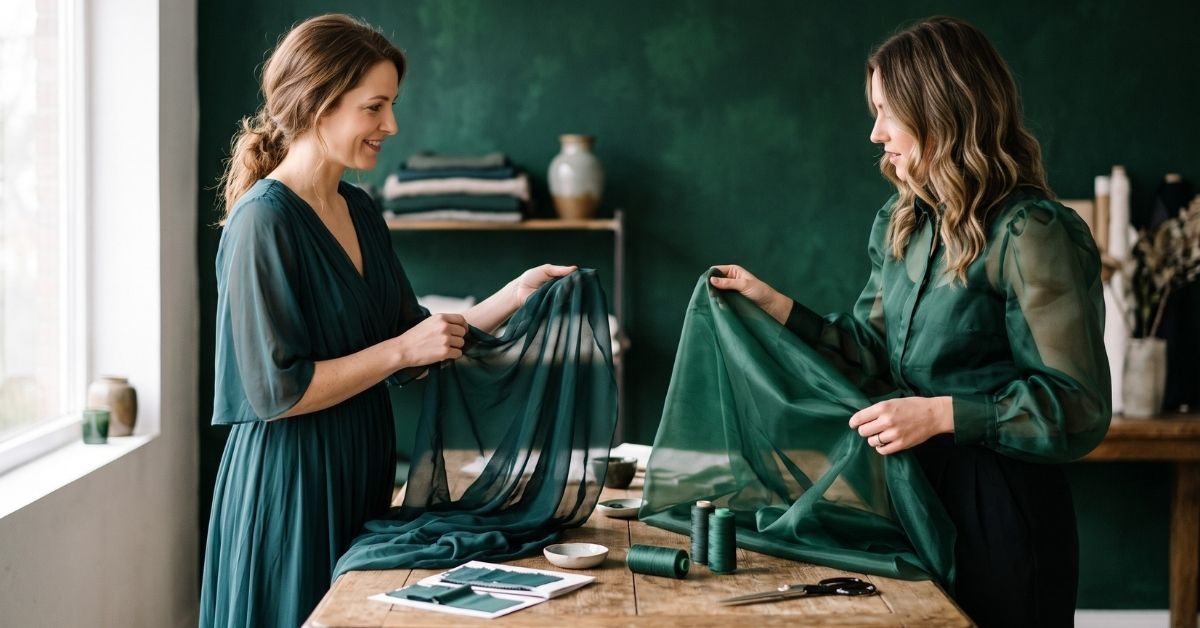
If you only remember one thing from this guide, remember this: chiffon moves, organza holds. Use the table below to match the fabric to your goal before you read the full breakdown.
| Choose Chiffon If You Want |
Choose Organza If You Want |
| Soft, romantic movement that flows with the body or catches a breeze |
Crisp architectural volume that holds its shape on its own |
| A gentle, non scratchy feel directly against the skin |
A glossy, light catching surface for a dramatic finish |
| Easy care with quick wrinkle recovery |
Sculptural bows, puffed sleeves, or tiered skirts |
What Is Organza Fabric? Structure and Silhouette
To understand how these fabrics differ, we first need to answer a core question: what is organza fabric?
Organza is a lightweight, plain weave material historically crafted almost exclusively from pure silk, though modern versions are frequently woven from synthetic fibers like polyester and nylon to increase affordability and durability. In the United States, any garment or piece good made from these fibers must disclose its exact fiber content on a label. That requirement comes from the Textile Fiber Products Identification Act, a federal law enforced by the Federal Trade Commission that governs fiber labeling, invoicing, and advertising for textile products.
What makes organza distinct is its manufacturing process. It is constructed using tightly twisted filament yarns. Before weaving, these yarns are treated with acid or specific finishing agents that give the fabric an exceptionally crisp, stiff, and springy hand feel. Even though it is transparent and thin, organza behaves like a structural wire mesh rather than a soft textile. It holds its shape, creating dramatic volume, structural folds, and a glassy surface sheen that catches the light.
What Is Chiffon Fabric? A Softer Kind of Sheer
Chiffon answers a very different design brief. It is also a plain weave fabric, but it is built from yarns that alternate in twist direction, one section twisted one way and the next twisted the opposite way. That alternating twist relaxes once the fabric is woven, giving chiffon a slightly puckered, crepe like texture at a microscopic level.
That relaxed texture is exactly why chiffon behaves so differently from organza. Instead of standing away from the body, chiffon falls in soft, liquid, body skimming drapes. It has almost no structural memory of its own, so it takes the shape of whatever it rests on, whether that is a moving body, a draped window, or a cascading bedding overlay.
The Three Sheers: Chiffon vs Tulle vs Organza
When shoppers look for airy, translucent materials, they often compare three fabrics at once: chiffon, tulle, and organza. All three offer transparency, but they are produced using completely different textile methods and offer contrasting design strengths.
- Chiffon: A plain weave fabric built from alternating twist yarns. This twisting gives chiffon a slightly rough, puckered texture on a microscopic scale, but lets the fabric fall in liquid smooth, body skimming drapes. It is completely fluid.
- Organza: A plain weave fabric using ultra tightly twisted, stiff filament yarns. Rather than draping smoothly over a silhouette, it cascades away from the body, standing outward to build a sculptural, architectural form with sharp, crisp lines.
- Tulle: Unlike chiffon and organza, tulle is not woven at all. It is a machine knitted network of open mesh with a hexagonal structure that resembles a honeycomb. Tulle is used to build explosive, cloud like volume, such as in ballet tutus, without adding heavy fabric weight.
Chiffon vs Organza: Side by Side Comparison
The mechanical attributes of both materials create distinct practical trade offs for designers, sewists, and shoppers alike.
| Feature |
Chiffon Fabric |
Organza Fabric |
| Weave structure |
Alternating twist yarns in a plain weave |
Tightly twisted, acid treated filament yarns in a plain weave |
| Drape profile |
Fluid, cascading, hugs body contours |
Rigid, architectural, stands outward from the body |
| Surface finish |
Matte, slightly crinkled or crepe like |
Shimmery, smooth, glossy reflection |
| Tensile strength |
Low to moderate, delicate and stretchy |
High, surprisingly strong and rigid |
| Wrinkle behavior |
Strong natural wrinkle recovery |
Prone to sharp, lasting creases |
| Edges and sewing |
Slippery, prone to heavy fraying |
Crisp behavior, easy to cut, frays cleanly |
| Common fiber content |
Silk, polyester, or rayon blends |
Silk, polyester, or nylon |
| Typical care label |
Often hand wash or gentle cycle |
Usually dry clean only |
| Best design use |
Flowing gowns, scarves, soft overlays, bedding canopies |
Ball gowns, structured bows, puffed sleeves, tiered skirts |
Fabric Regulations and Safety Standards You Should Know
Sheer fabrics are not just a design choice. In the United States, several federal rules shape how chiffon and organza products must be labeled, cared for, and tested before they reach a store shelf. Knowing these standards helps you shop, sew, and care for these fabrics with real confidence.
Fiber Content Labeling
Every chiffon or organza garment or home textile sold in the United States must carry a label stating its exact fiber content by percentage, under rules found in Title 16, Part 303 of the Code of Federal Regulations. This is why a garment tag will specify whether a sheer overlay is one hundred percent silk, a polyester blend, or a nylon based material rather than simply calling it chiffon or organza. The Federal Trade Commission also maintains a consumer facing explainer on apparel and textile labeling requirements that summarizes what shoppers are legally entitled to see on a tag.
Care Labeling
Manufacturers and importers of textile clothing must also attach a permanent care label describing how to safely wash, dry, bleach, or dry clean the item, under the Care Labeling Rule. This explains why so many organza garments are marked dry clean only. The manufacturer must have a reasonable, tested basis for that instruction, and organza's stiff, acid treated yarns generally cannot survive a home washing machine without losing their shape.
Flammability Testing
Clothing textiles sold in the United States, including sheer fabrics like chiffon and organza, must meet the Standard for the Flammability of Clothing Textiles, enforced by the Consumer Product Safety Commission under 16 CFR Part 1610. This standard classifies fabrics by how quickly and intensely they burn, and it prohibits the most dangerously flammable textiles from being sold for clothing use at all. Sheer, lightweight fabrics are exactly the kind of material this rule was designed to monitor, so reputable sellers should be able to confirm that their chiffon and organza products meet this classification.
Sustainability and Environmental Considerations
Because both chiffon and organza are frequently made from synthetic fibers like polyester and nylon, it is worth understanding their environmental footprint alongside their design qualities. The U.S. Environmental Protection Agency's microplastics research program notes that synthetic textiles are a recognized source of secondary microplastics, the tiny plastic particles that break off larger synthetic materials over time, including during washing. If sustainability is a priority for your project, silk chiffon or silk organza, along with lower impact fiber choices, are worth considering alongside their synthetic counterparts.
A Brief History of These Sheer Fabrics
Silk, the original fiber behind both chiffon and organza, has a documented history stretching back thousands of years in China, and it later became one of the most valuable traded commodities along the historic Silk Road. In the United States, the Smithsonian National Museum of American History documents repeated attempts, dating back to the Jamestown settlement, to establish a domestic silk industry, an effort that shaped early American textile manufacturing even though large scale sericulture never took root permanently in the country. Understanding this history helps explain why silk chiffon and silk organza are still considered the premium benchmark against which synthetic versions are measured today.
Our Recommendation: Which Should You Choose
When selecting between these two beautiful sheers for apparel or high end bedding accents, align your choice directly with your structural goal.
- Choose chiffon if: you want a design defined by effortless movement, romantic drapes, and skin contact softness. It is perfect for summer resort wear, soft overlay scarves, sweeping draperies that catch the breeze, and multi layered, dreamy bedding canopies that need a gentle, non scratchy touch.
- Choose organza if: you are executing an avant garde, high fashion statement that relies on shape, definition, and structural drama. Organza is ideal for crisp, structured bows, dramatic puffed sleeves, voluminous tiered bed skirts, or sheer table overlays that need to hold clean, geometric folds across an entire evening event.
For a masterful design setup, try layering them together. Use a structural underlayer of organza to build dynamic shape and loft, then cap it with an outer veil of chiffon to introduce fluid, liquid motion to the surface.
If your priority is everyday bedding comfort rather than a sheer overlay effect, OdeSleep's core sheet collections give you that same softness and structure trade off in fabrics built specifically for sleep. See the shopping section below for direct links.
Explore Related Fabric Guides
If you are comparing fabrics for bedding, clothing, or home textiles more broadly, these OdeSleep guides go deeper on individual fiber matchups.
Watch: Sheer Fabrics in Motion
For a closer visual look at how these sheers catch light differently in real time motion, check out this Sheer Fabric Spotlight Guide, which breaks down the side by side behavioral differences between chiffon and organza on camera.
Sources