If you have ever checked the care tag on activewear, skinny jeans, or swimwear, you have probably seen names like spandex, elastane, or Lycra. Each one promises the same thing: a comfortable, body hugging stretch. But seeing three different words on three different garments raises a fair question.
Is spandex the same as elastane, or are you paying for a genuinely different material? Below, we untangle the terminology of stretchy fabrics using definitions straight from the government agencies that regulate textile labeling, so you know exactly what is in the clothes and sheets you buy.
Is Spandex and Elastane the Same Fiber?
Short answer: yes. Spandex and elastane are the same synthetic fiber. The difference is not chemical, it is geographic and regulatory. In the United States, the Federal Trade Commission requires manufacturers to label this fiber "spandex." Under international rules, most notably the ISO 2076 standard for man made fiber names that is referenced directly inside the FTC's own labeling regulation, the identical fiber is called "elastane."
The FTC states this explicitly in its own labeling guidance: while the agency's rules use the name spandex, the ISO standard uses the name elastane for the exact same fiber, and manufacturers are permitted to use either term on a label. You can read this directly in the FTC's business guidance, Threading Your Way Through the Labeling Requirements, and in the official federal regulation text at eCFR, Title 16, Part 303, which legally defines spandex as a manufactured fiber made from at least 85 percent segmented polyurethane.
So a leggings tag that says spandex in New York and a tag that says elastane in London are not describing two different products. They are describing one fiber under two accepted names. Fun fact for label readers: the word spandex is an anagram of the word expands.
Is Elastane and Lycra the Same Thing?
Now that spandex and elastane are confirmed to be twins, a related question comes up constantly: is elastane the same as Lycra?
This is where branding enters the picture, similar to the relationship between adhesive bandages and the brand name Band Aid, or facial tissue and the brand name Kleenex.
- Elastane is the generic name of the fiber, and it is the name that regulators recognize.
- Lycra is a specific, trademarked brand of elastane, owned by The Lycra Company.
Lycra was developed by the chemical company DuPont and first sold commercially in 1958. It is a premium, branded version of elastane, prized for its stretch recovery and durability. Every thread of Lycra is elastane, but not every thread of elastane is Lycra. Under FTC rules, a trademark like Lycra can appear on a label only alongside the required generic name, which is why you will often see phrasing such as 80 percent cotton, 20 percent spandex, Lycra.
What Spandex and Elastane Fabric Is Actually Made Of
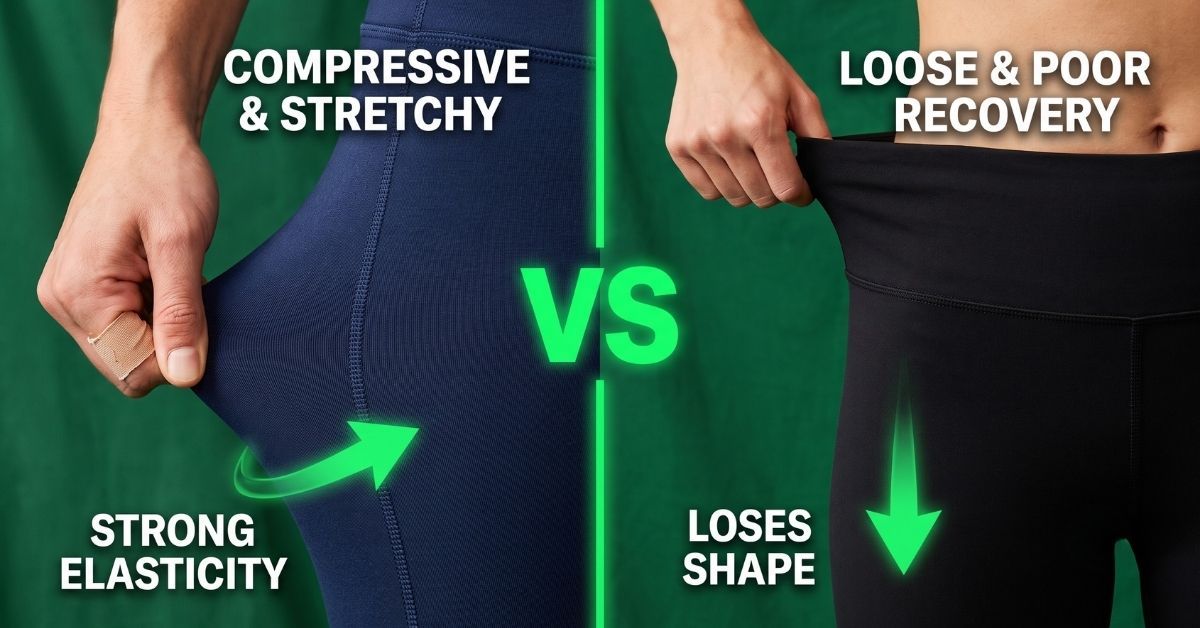
You will rarely find a garment made from 100 percent elastane. On its own, the fiber is rubbery, traps heat, and can feel tacky against skin. Instead, manufacturers wrap or blend elastane with cotton, polyester, or nylon so the finished fabric keeps the comfort of the host fiber while gaining elasticity.
Chemically, both names refer to the same class of material. Federal regulation defines it as a manufactured fiber in which the fiber forming substance is a long chain synthetic polymer composed of at least 85 percent segmented polyurethane, a definition published in full at eCFR, Title 16, Part 303.7. The U.S. Customs and Border Protection agency maintains a similar cross reference of trade names and generic fiber terms for import purposes, available at CBP, Fiber Trade Names and Generic Terms.
Even a small percentage of elastane transforms how a garment fits. Here is roughly how much you will typically find, and what it does:
| Elastane content |
Typical garment |
What it does |
| 1 to 3 percent |
Denim, dress shirts |
Adds a slight, comfortable give without changing the classic structured shape |
| 5 to 12 percent |
Athletic tees, lounge pants, casual wear |
Allows easy movement while keeping the fabric breathable |
| 15 to 30 percent |
Compression gear, swimwear, performance activewear |
Maximum stretch and body contouring support |
| 0 percent |
Bed sheets and most home textiles |
Sheets rely on weave and fiber softness rather than stretch fiber for comfort |
Is Elastane a Natural Fiber?
No. Elastane and spandex are fully synthetic, petroleum based polymers created in a laboratory, not grown or harvested. Because the fiber is petroleum derived, it does not biodegrade the way cotton or linen does.
There is also a growing body of research and government attention on what happens when synthetic stretch fabrics go through the wash. The U.S. Environmental Protection Agency now treats microplastic shedding from synthetic textiles as an active research priority, tracking how tiny synthetic fibers enter waterways during laundering. You can review the agency's ongoing work at EPA, Microplastics Research, and its 2026 announcement adding microplastics to the federal drinking water Contaminant Candidate List at EPA, Actions on Microplastics in Drinking Water. If eco friendly stretch matters to you, look for organic cotton or natural rubber blends, though these generally will not match the stretch recovery of true elastane.
How to Care for Spandex and Elastane Fabric
Because spandex and elastane are the same fiber, they respond to heat, chlorine, and washing the same way, and U.S. law actually requires manufacturers to tell you how to look after them. Under the FTC's Care Labeling Rule, in force since 1971, apparel makers must permanently attach a label with washing or dry cleaning instructions. You can read the full requirement at FTC, Complying with the Care Labeling Rule.
- High heat drying can permanently weaken both fibers, reducing stretch and shortening the garment's life.
- Chlorine exposure degrades elastane over time, causing loss of stretch, strength, and durability.
- High elastane content can reduce breathability, so the best performing activewear blends a modest percentage with a breathable base fiber.
Quick Reference: Elastane vs Spandex vs Lycra
| Term |
What it means |
Where you will see it |
| Elastane |
The generic, internationally recognized fiber name |
Care labels in Europe, Asia, and most countries outside North America |
| Spandex |
The same fiber, using the name recognized under U.S. federal law |
Care labels in the United States and Canada |
| Lycra |
A trademarked, branded version of elastane made by The Lycra Company |
Premium activewear and swimwear labels worldwide |
Where This Matters for Your Bedding
You will almost never see spandex or elastane in bed sheets, and that is by design. Stretch fiber is meant for garments that move with your body, while sheets are chosen for softness, breathability, and how they feel over hours of sleep. If you are comparing fabrics for your bedroom rather than your closet, our other guides break down the fibers that actually belong on a bed, including nylon vs polyester, Tencel vs cotton, how linen, cotton, and bamboo compare, polyester versus cotton sheets, whether polyester is bad for you, eucalyptus vs bamboo sheets, organic cotton vs conventional cotton, our full breakdown of the best fabric to sleep in, and microfiber vs polyester sheets.
Our Recommendation
If you are shopping for activewear or swimwear, do not worry about choosing between spandex and elastane, since they are the same material. Instead, look at the blend percentage: a 5 to 12 percent stretch content suits everyday wear, while 15 percent or higher suits compression and performance pieces. If a garment is labeled Lycra, expect somewhat better stretch recovery over repeated washes, at a higher price.
If you are shopping for bedding, skip stretch fiber entirely and choose a natural or breathable fiber instead. Based on comfort, breathability, and certification standards, here is what we recommend:
A Quick Cheat Sheet
- Elastane: the generic, internationally recognized name for the stretch fiber.
- Spandex: the American name for the identical fiber, spelled as an anagram of expands.
- Lycra: a premium, trademarked brand name version of elastane.
- The material: a synthetic, petroleum based fiber that must be blended with other yarns to be wearable.
Sources
- Federal Trade Commission, Textile Fiber Products Identification Act
- Federal Trade Commission, Threading Your Way Through the Labeling Requirements
- Federal Trade Commission, Clothes Captioning: Complying with the Care Labeling Rule
- eCFR, Title 16, Chapter I, Subchapter C, Part 303, Rules Under the Textile Fiber Products Identification Act
- U.S. Customs and Border Protection, Fiber Trade Names and Generic Terms
- U.S. Environmental Protection Agency, Microplastics Research
- U.S. Environmental Protection Agency, EPA and HHS Announce Historic Actions to Protect Americans from Microplastics