Editorial note: this guide is compiled from public agricultural, trade, and safety records published by the United States Department of Agriculture, the Federal Trade Commission, and the Consumer Product Safety Commission, alongside established textile science. It is reviewed periodically so the figures and regulatory references stay current.
When shoppers search for the ultimate natural, breathable sheets, two premium plant based options lead the conversation: hemp and linen. Both are ancient textiles built from bast fiber, the strong, fibrous inner bark of plant stalks, and both are prized worldwide for their rustic texture, exceptional durability, and cooling feel.
At a casual glance, hemp and linen can look and feel so similar that even seasoned textile professionals sometimes struggle to tell them apart without a microscope. Beneath the surface, though, sit real structural, manufacturing, and performance differences that shape how your sheets feel for years of nightly use.
For an ecommerce platform like OdeSleep, understanding how these differences affect thermoregulation, skin comfort, and fabric longevity is the key to choosing the right heirloom quality sheet set. This guide breaks down the science and real world behavior behind hemp and linen bedding, and points to public government sources wherever the numbers matter. If you are still comparing fabric families more broadly, our guides to Nylon vs. Polyester and Tencel vs. Cotton cover how synthetic and semisynthetic fibers compare with natural ones.
The Structural Basics: Hemp and Linen Fabric Under the Microscope
To understand why a hemp linen fabric comparison behaves the way it does, it helps to trace both materials back to their agricultural roots.
What Is Linen
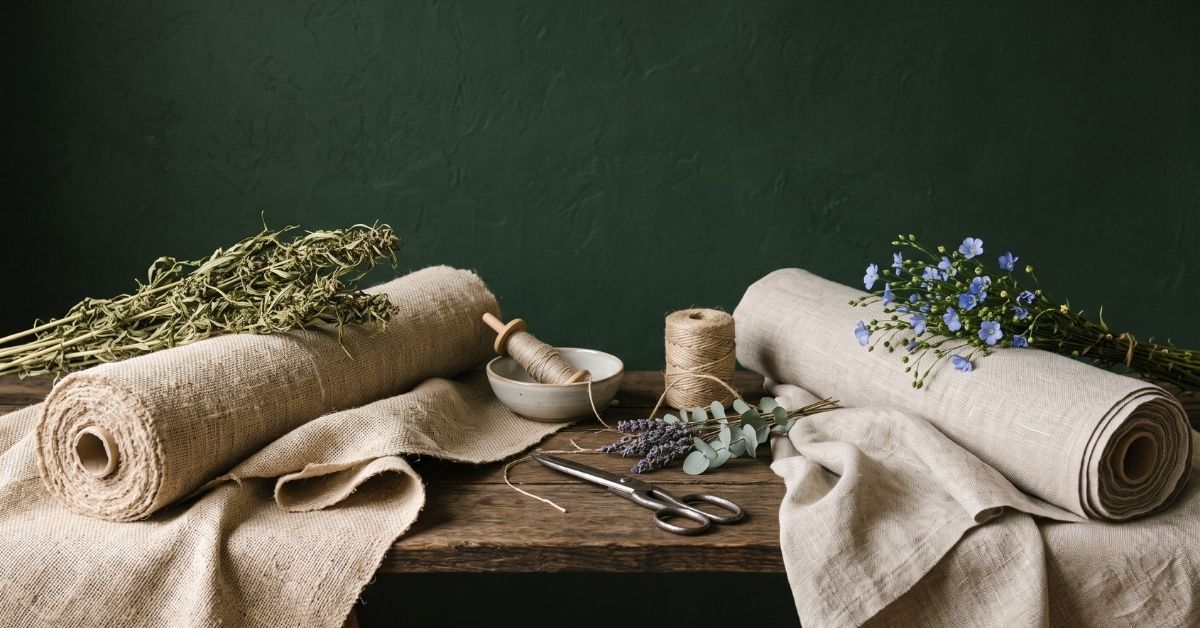
Linen is derived from the Linum usitatissimum (flax) plant. Flax needs careful agricultural management and thrives mainly in temperate climates with rich soil, such as Western Europe, including France and Belgium. Flax fibers are naturally long, fine, and smooth, giving classic linen its signature fluid drape and crisp immediate feel.
What Is Hemp Fabric
Hemp fabric is woven from the industrial stalks of the Cannabis sativa plant. Hemp is a fast growing, hardy crop that can thrive across a wide range of soils and climates without needing heavy irrigation or synthetic pesticides.
Hemp fibers are among the strongest natural fibers used in textiles. On a cellular level, hemp fibers are notably stronger than cotton and longer and more structurally rigid than flax.
Industrial hemp farming in the United States expanded quickly after the 2018 Farm Bill removed hemp from the Controlled Substances Act and authorized commercial production nationwide, a shift documented by the USDA Economic Research Service, and confirmed in annual acreage and production figures published by the USDA National Agricultural Statistics Service. Those reports show fiber hemp acreage and output climbing sharply in recent seasons as domestic processing capacity slowly catches up with flax focused regions of Europe.
Hemp vs Linen Sheets: A Full Comparison
When comparing a premium set of hemp and linen sheets for your bed, small physical variations lead to noticeably different tactile properties over years of nightly use.
1. Longevity and Structural Integrity
Both fabrics are considered generational investments that easily outlast standard cotton bedding, though hemp holds a clear technical edge in raw durability.
Because hemp fibers carry a higher concentration of natural lignin, an organic polymer that binds plant cells together, they resist abrasion, tearing, and mechanical wear extremely well. Linen sheets are highly durable too, but their fiber elasticity is slightly lower, which can make them prone to developing fine split threads if folded along the same crease lines for a decade or more. Readers comparing durability across fabric families may also want our breakdown of polyester versus cotton sheets for context on how natural fibers hold up against synthetics.
2. Thermoregulation and Airflow
Both fabrics offer excellent cooling properties thanks to wide, porous fiber paths that let heat escape the body, but they manage insulation differently.
Linen acts as a highly effective thermal conductor. It pulls heat away from the skin quickly, giving an instant contact cooling sensation the moment you climb into bed, which makes it a strong pick for hot summer months.
Hemp has a hollow core, known as a lumen, that behaves like a natural insulator. In summer it breathes open to release body heat, and during cold snaps it traps a thin layer of air for warmth, giving it more year round flexibility than linen.
3. Texture and Evolving Softness
Neither fabric delivers the immediate slipperiness of synthetic sateen on night one. Both show an organic, rustic look with characteristic slubs, the slight, uneven thickness variations that appear in the yarn.
Out of the package, linen is more supple and gentle against bare skin. Fresh hemp can feel stiff and canvas like at first, but it transforms with every wash, evolving from rigid to an exceptionally soft, heavy, velvet like drape that keeps its substantial body. For a wider view of how these two sit alongside other plant fibers, see how linen, cotton, and bamboo stack up together.
Side by Side Comparison Table
| Performance Variable |
Premium 100% Hemp Bedding |
Premium 100% Flax Linen Bedding |
| Plant Source |
Cannabis sativa (industrial hemp stalk) |
Linum usitatissimum (flax stalk) |
| Fiber Profile |
Extra long, thick, and rigid |
Long, fine, and pliable |
| Tensile Strength |
Very high; among the strongest natural fibers |
High; stronger than cotton and ages well |
| Thermoregulation |
All season adaptive; hollow core insulates or cools |
Strong summer cooling through rapid heat conduction |
| Fabric Hand Feel |
Stiff at first, then softens into a heavy drape |
Crisp and smooth from the first wash, ages gracefully |
| Wrinkle Behavior |
Relaxes into large, soft waves |
Prone to sharp, structured creases |
| UV and Microbial Resistance |
Blocks the large majority of UV rays; strong mold resistance |
Moderate UV block; natural antibacterial qualities |
| Approximate Water Use per Kilogram |
Roughly 2,700 liters |
Roughly 3,800 liters |
Government Backed Standards and Sustainability Data
Because bedding claims are easy to exaggerate, it helps to know which agencies actually regulate what goes on a hemp or linen label, and what the public data says about how these crops are grown.
Fiber content claims are not just marketing language. The FTC Textile Fiber Products Identification Act requires that labels disclose the generic fiber name and the percentage, by weight, of each fiber in a product, so a sheet set marketed as one hundred percent linen or one hundred percent hemp must actually meet that threshold.
Washing and care instructions are regulated too. The FTC Care Labeling Rule requires manufacturers to attach a permanent care label with washing, drying, and ironing instructions that are backed by real testing rather than guesswork, which is one reason the wash advice later in this guide mirrors standard industry practice.
Mattress pads and similar bedding items sold in the United States must also meet the federal flammability standard for mattresses and mattress pads, which tests a product's resistance to a smoldering ignition source. The detailed fiber labeling requirements that apply to hemp and linen specifically are set out in Title 16, Part 303 of the Code of Federal Regulations.
On the growing side, USDA's National Agricultural Statistics Service publishes an annual National Hemp Report that tracks fiber hemp acreage, yield, and value across the country, giving buyers a transparent way to see how much of the domestic hemp supply is actually grown for textiles rather than other uses. The USDA Economic Research Service report on industrial hemp adds useful historical context on why processing costs remain higher for hemp than for flax.
Explore More Natural Fabric Comparisons
If you are weighing hemp and linen against other natural or semisynthetic options, these companion guides dig deeper into specific matchups: Eucalyptus vs Bamboo Sheets, Organic Cotton vs Conventional Cotton, and a closer look at whether polyester is bad for you. For a broader starting point, see our overview of the best fabric to sleep in and our comparison of microfiber versus polyester sheets.
Shop OdeSleep Natural Bedding
The OdeSleep Final Verdict and Recommendation
Choosing between these two long standing natural fabrics depends on what matters most for your sleep setup.
| Choose This If |
Best Fit |
| You run hot at night and want instant coolness |
Linen, for its rapid heat conducting feel |
| You want softness with no break in period |
Linen, since it feels supple from the first night |
| You want one set for every season |
Hemp, thanks to its insulating hollow core |
| You want maximum durability over decades |
Hemp, given its superior tensile strength |
| You want the lowest possible water footprint |
Hemp, based on published agricultural water use data |
Choose Premium Linen Sheets If
- You run hot at night: linen's rapid heat conduction keeps you crisp and dry through humid summer months.
- You want immediate softness: linen arrives supple and ready for your skin with no real break in period.
- You love the relaxed, resort look: linen's delicate slubs and classic drape give that timeless, high end feel. Our vintage linen bed sheets are built around exactly this look and feel.
Choose Premium Hemp Sheets If
- You want all season flexibility: hemp's insulating hollow core works for both hot July nights and cold January mornings.
- You prioritize durability above all else: hemp's fiber strength is built to survive decades of weekly washing.
- You care about environmental footprint: hemp needs less water per kilogram and grows with minimal pesticide input, based on the USDA figures referenced above.
If neither hemp nor linen feels right for your budget or care routine, our organic cotton bed sheet set, purely organic sheet set, and Oeko Tex certified bamboo sheets all offer natural, well tested alternatives worth a look.
Sources