Whether you are shopping for new bed sheets, a mattress cover, or a basic t-shirt, the choice between organic and conventional cotton involves far more than thread count or price. It involves a fundamentally different approach to agriculture, human health, and environmental stewardship. This guide draws on peer-reviewed research and official government data to help you make an informed decision.
What Is Conventional Cotton? The Hidden Cost of "Standard"
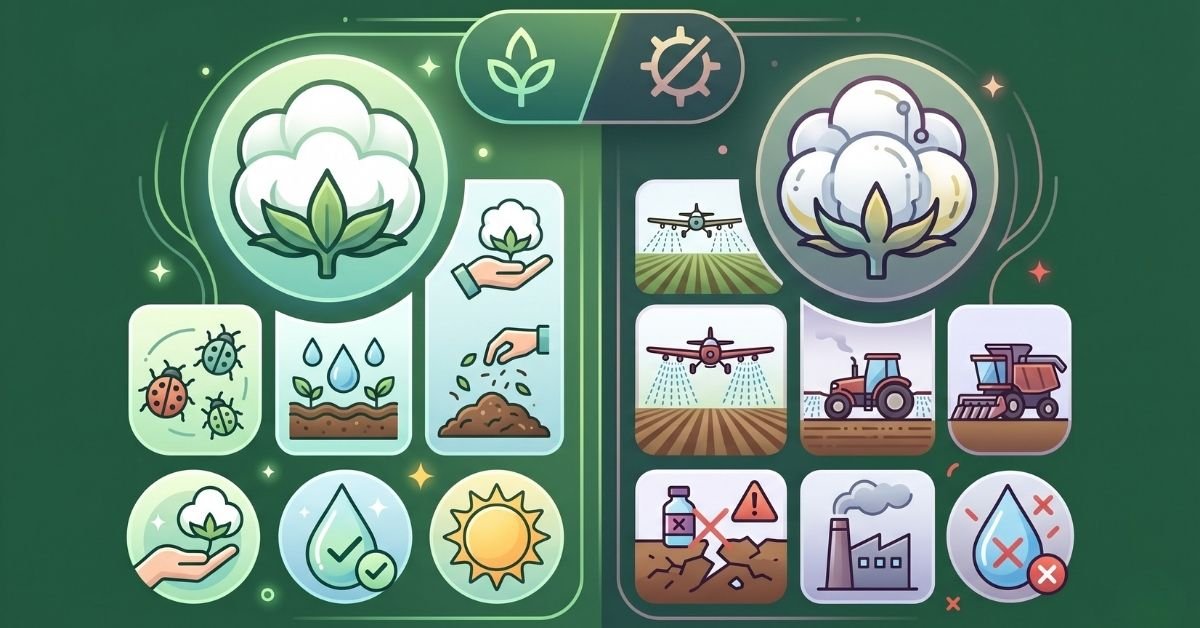
Conventional cotton is the dominant form of commercial cotton production worldwide. It relies on synthetic pesticides, herbicides, chemical fertilizers, and in many cases genetically modified (GMO) seeds engineered to tolerate heavy chemical treatment.
Cotton covers only about 2.5% of global agricultural land, yet it accounts for a disproportionate share of pesticide use globally. In the United States alone, approximately 48 million pounds of pesticides were applied to 12.6 million acres of cotton in 2017, according to USDA crop protection data roughly 3.8 pounds per acre.
The chemicals involved are not mild. Some of the most widely used pesticides in conventional cotton farming are organophosphates, pyrethroids, neonicotinoids, and glyphosate-based herbicides. The U.S. Environmental Protection Agency evaluates each of these substances for carcinogenic potential through its Cancer Assessment Review Committee, and its findings on many of them raise meaningful public health questions.
Beyond the field, conventional cotton fabrics often undergo additional chemical processing — synthetic dyes, formaldehyde-based wrinkle-resistant finishes, and bleaching agents. Research indexed by the National Institutes of Health has identified textile chemicals including formaldehyde and N-methylol compounds as established causes of allergic and irritant contact dermatitis — a concern particularly relevant for items like bed sheets that stay in prolonged contact with your skin for 7–9 hours every night.
You can learn more about these differences in our detailed breakdown of Polyester vs. Cotton Sheets.
What Is Organic Cotton? The Standard Explained
Organic cotton is grown using farming practices that prohibit synthetic pesticides, synthetic fertilizers, ionizing radiation, and GMO seeds. In the United States, these requirements are governed by the USDA National Organic Program (NOP), operating under 7 CFR Part 205. Farms must be certified by a USDA-accredited certifying agent and are subject to annual on-site inspections as well as unannounced audits.
For textiles specifically, the USDA Agricultural Marketing Service recognizes the Global Organic Textile Standard (GOTS) as the benchmark for organic fiber processing — covering not just how cotton is grown, but how it is spun, dyed, finished, and labeled throughout the entire supply chain. This means choosing a GOTS-certified bed sheet set offers traceability at every stage of production, not just at the farm gate.
Organic farming methods build rather than deplete soil. Farmers use crop rotation, composting, beneficial insect management, and natural fertilizers to maintain soil health across seasons — practices that improve the land's long-term productivity rather than mining it for short-term yield.
Explore our guide on the Best Fabric to Sleep In: Cotton vs. Bamboo vs. Linen.
The Environmental Argument: A Side-by-Side Look
Pesticide Load and Ecosystem Health
The scale of pesticide use in conventional cotton farming is staggering. According to the U.S. EPA's pesticide health risk assessments, some pesticides approved for cotton agriculture have been classified as potential carcinogens, endocrine disruptors, or nervous system toxins. Permethrin — a pyrethroid widely used on cotton — was determined by EPA toxicology reviews to be a weak carcinogen and is classified as highly toxic to fish and aquatic invertebrates.
When these chemicals leach into groundwater or run off into streams and rivers, the ecological damage extends well beyond the cotton field. Organic farming eliminates this pathway entirely: no synthetic pesticide inputs means no synthetic pesticide runoff.
Water Consumption
Conventional cotton is one of the most water-intensive crops on Earth, often relying on large-scale irrigation systems. Organic cotton, by contrast, benefits from healthier soil structure. Organic-rich soil retains moisture more effectively — functioning like a sponge — which reduces irrigation demand substantially. Some comparative analyses have estimated water use reductions of up to 91% in "blue water" (surface and groundwater) consumption for organic cotton versus conventionally irrigated crops.
Greenhouse Gas Emissions and Carbon Sequestration
The production of synthetic fertilizers is an energy-intensive industrial process that releases significant greenhouse gas emissions. Organic farming avoids this input entirely. Additionally, healthy organic soil actively sequesters carbon dioxide from the atmosphere, making certified organic farmland a potential climate asset rather than a liability. Life cycle assessments comparing the two systems have found organic cotton's carbon footprint to be substantially lower per unit of fabric produced.
Soil Health and Biodiversity
Repeated application of synthetic herbicides and pesticides disrupts the microbial ecosystems that make soil fertile. Conventional cotton monocultures are particularly vulnerable to soil degradation over time, reducing the land's future productivity. Organic systems, by promoting diverse crop rotations and natural composting, maintain and often improve soil biodiversity — creating a more resilient agricultural ecosystem.
The Human Health Argument: What Goes on Your Skin Matters
Pesticide Residues and Skin Sensitivity
Your bedding is one of the most intimate items in your home. The average adult spends roughly a third of their life in bed, meaning prolonged skin contact with whatever chemicals may be present in fabric finishes or residual from processing. Research indexed by the National Institutes of Health (NIH) has established that textile chemicals — including disperse dyes, formaldehyde resins, and finishing compounds — are among the recognized causes of allergic contact dermatitis (ACD), a T-cell mediated immune response triggered by chemical exposure.
A multi-center Italian study published on PubMed found that textile contact dermatitis was more common in individuals with pre-existing atopic dermatitis (eczema), with dyes and finishing resins the most frequent culprits in non-occupational cases. For anyone managing eczema, rosacea, psoriasis, or general skin sensitivity, eliminating chemically processed fabrics from their sleep environment is a clinically rational step.
Organic cotton certified under GOTS standards prohibits the use of toxic dyes, formaldehyde-based finishes, and other sensitizing chemicals — making it a meaningfully safer choice for reactive skin.
Occupational Risks: The Worker Perspective
The health risks of conventional cotton processing are not limited to end consumers. The CDC's National Institute for Occupational Safety and Health (NIOSH) has studied the occupational effects of cotton dust on textile workers since the 1970s. NIOSH's research identified byssinosis — an airways disease with features of both asthma and COPD — as a major occupational hazard in conventional cotton mills, with a prevalence among U.S. cotton workers estimated at approximately 20% in the early 1970s.
NIOSH-funded research, including the 30-year Shanghai Textile Worker Study, further confirmed that long-term exposure to endotoxin-containing cotton dust caused measurable chronic respiratory deterioration. Organic cotton processing environments, by eliminating chemical pesticide residues and using gentler processing methods, represent a healthier workplace as well as a healthier product.
Fiber Integrity and Durability
Chemical processing in conventional cotton production weakens individual fibers. Synthetic bleaches, harsh dyes, and formaldehyde-based wrinkle treatments break down the cellulose structure of cotton over time, accelerating pilling, thinning, and fabric degradation. Organic cotton, processed without these aggressive treatments, tends to preserve fiber integrity — producing sheets and garments that feel softer and last longer with proper care.
For a deeper dive into how these fibers perform over years of washing, see our comparison of Linen vs. Cotton vs. Bamboo sheets & Bamboo vs. Egyptian Cotton
Organic Cotton Sheets vs. Regular: What the Comparison Actually Looks Like
Feature | Conventional Cotton | Certified Organic Cotton |
Seed type | Often GMO | Non-GMO, natural |
Pesticide use | Heavy synthetic pesticide application | Natural pest management only |
Fertilizer | Synthetic chemical fertilizers | Composting, crop rotation |
Water use | High irrigation dependency | Significantly lower water demand |
Chemical processing | Synthetic dyes, formaldehyde finishes | GOTS-prohibited chemicals excluded |
Skin contact safety | May contain chemical residues | Hypoallergenic, residue-free |
Fiber durability | Weakened by chemical processing | Stronger long-fiber structure |
Worker health impact | Known occupational respiratory risks | Lower chemical exposure in processing |
Certification | No required standard | USDA NOP + GOTS certification |
Carbon footprint | Higher due to synthetic inputs | Substantially lower |
How to Buy Organic Cotton the Right Way
Not all products marketed as "natural" or even "organic" are created equal. Here is what to look for:
Look for GOTS Certification. The Global Organic Textile Standard is recognized by the USDA Agricultural Marketing Service as the benchmark for organic textiles sold in the United States. A product bearing the GOTS label has been verified to use at least 70% certified organic fibers and processed without prohibited chemicals at every stage of the supply chain.
Understand USDA Organic Labeling Rules. According to the USDA NOP organic labeling requirements, a textile product can only display the USDA Organic Seal if the finished product is certified to USDA organic regulations. Products that simply state "contains organic cotton" have not met the same threshold. Learn to read label claims critically.
Prioritize Items with Extended Skin Contact. The greatest practical return on choosing organic comes from items that stay on your skin for hours: bed sheets, pillowcases, towels, and sleepwear. These are the categories where reducing chemical exposure has the most direct health relevance, as confirmed by EPA guidance on pesticide exposure risks.
Check Thread Count Alongside Certification. Certification tells you what chemicals were not used. Thread count, weave type (percale vs. sateen), and fiber staple length tell you about feel and durability. A high-quality organic cotton sheet set will perform better across all these dimensions than a conventionally processed equivalent at similar or lower price points over a multi-year lifespan.
Sources
- U.S. Department of Agriculture – National Organic Program (NOP) Governing standards for organic crop production in the United States, including cotton. https://www.ams.usda.gov/about-ams/programs-offices/national-organic-program
- USDA Agricultural Marketing Service – Organic Textiles Official guidance on labeling, GOTS recognition, and USDA Organic Seal requirements for textile products. https://www.ams.usda.gov/grades-standards/organic-textiles
- U.S. Environmental Protection Agency – Human Health Issues Related to Pesticides EPA's overview of pesticide health effects, including carcinogenic potential, nervous system impacts, and endocrine disruption. https://www.epa.gov/pesticide-science-and-assessing-pesticide-risks/human-health-issues-related-pesticides
- U.S. EPA – Evaluating Pesticides for Carcinogenic Potential Details EPA's review methodology for assessing cancer risk from pesticide exposure, including those used in cotton agriculture. https://www.epa.gov/pesticide-science-and-assessing-pesticide-risks/evaluating-pesticides-carcinogenic-potential
- CDC / NIOSH – Lung Disease in Textile Workers NIOSH-funded research on byssinosis and chronic respiratory disease in cotton textile workers from long-term exposure to cotton dust and endotoxins. https://www.cdc.gov/niosh/bulletin/2021/textiles.html
- National Institutes of Health (NIH) / NCBI – Allergic Contact Dermatitis Peer-reviewed clinical overview of allergic contact dermatitis, including textile chemicals as recognized causative agents. https://www.ncbi.nlm.nih.gov/books/NBK532866/