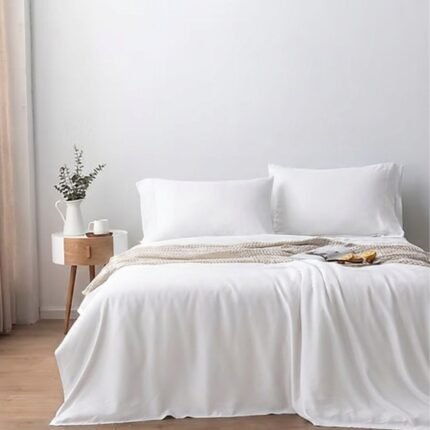
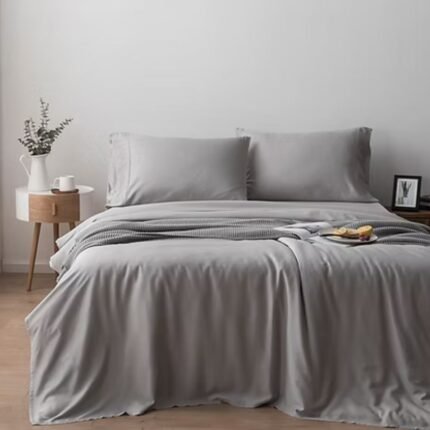
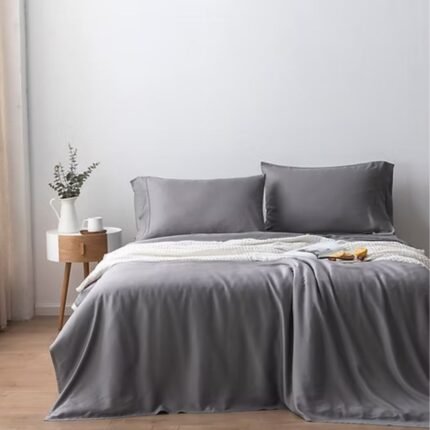
Finding the right bed sheets used to be simple you chased the highest thread count in cotton and called it done. Today, the conversation has shifted toward sustainability, skin comfort, and botanical fibers that promise a genuinely better night's sleep.
Two materials have emerged as clear frontrunners: eucalyptus sheets and bamboo sheets. Both feel luxurious. Both carry eco-friendly reputations. But they are not created equal, and the differences matter — for your skin, your sleep quality, and the planet. Here is a thorough, research-backed guide to help you decide.
Why Your Sheets Matter More Than You Think
Before diving into the fiber debate, it helps to understand why bedding material has real, measurable consequences for sleep.
Research published in the National Library of Medicine (NIH/PubMed) confirms that excessively high or low environmental temperature directly affects both the amount and quality of sleep. Your body naturally drops in core temperature as you drift into Non-REM sleep — a process so fundamental that researchers describe thermoregulation as a "sleep signalling system." The bedding microclimate you create between your sheets plays a direct role in how easily your body completes that cooling process.
In short, the fiber your sheets are made from is not a trivial cosmetic choice. It is one of the most controllable variables in your sleep environment.
Understanding Eucalyptus Sheets (Tencel™ Lyocell)
What Are Eucalyptus Sheets Made From?
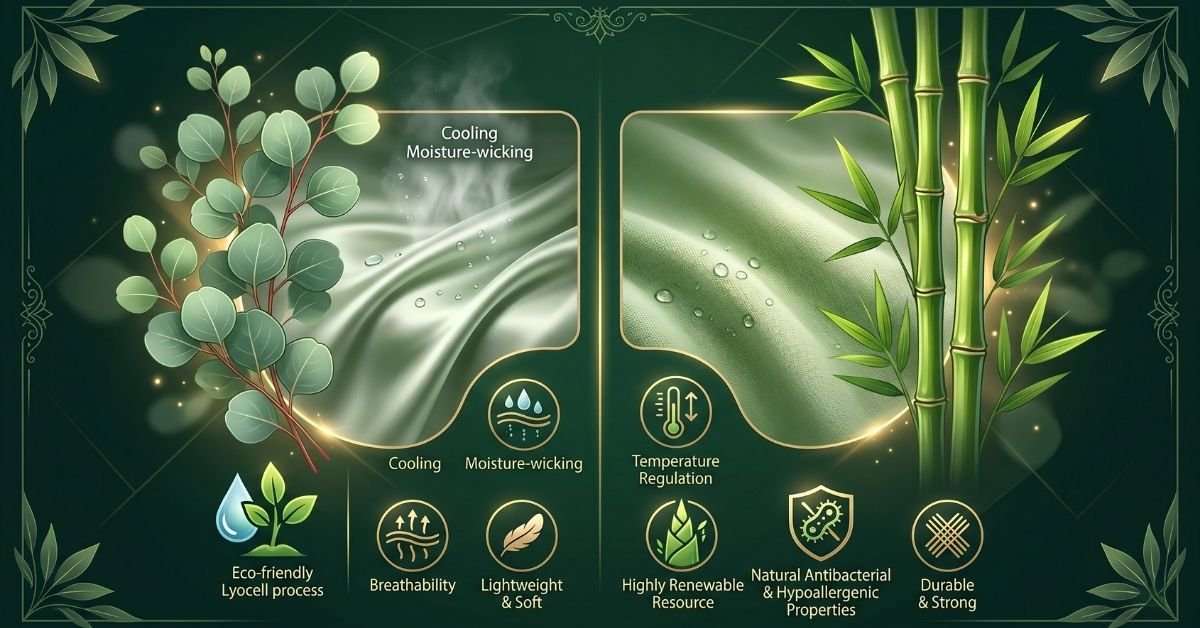
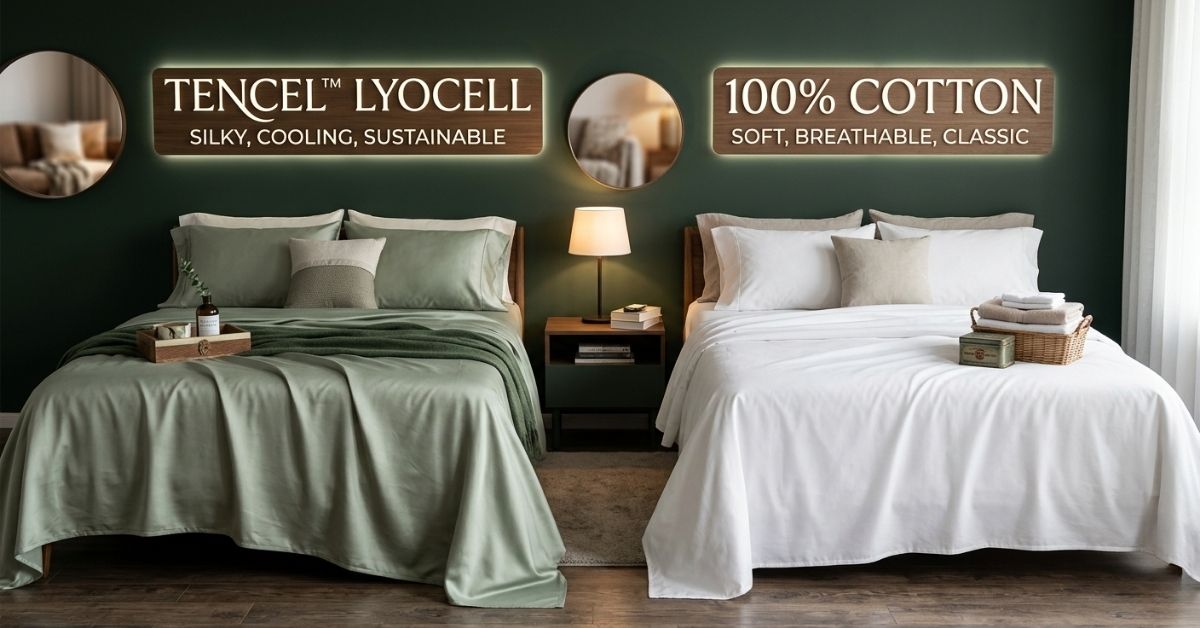
Eucalyptus sheets are crafted from the wood pulp of eucalyptus trees, most commonly sold under the brand name Tencel™ Lyocell, produced exclusively by Austrian company Lenzing AG. The manufacturing process is genuinely distinctive: eucalyptus chips are dissolved using a non-toxic solvent called amine oxide, then extruded through spinnerets to form continuous filaments. What makes this process stand out is its closed-loop system, where up to 99% of the solvent and water are recovered and reused — dramatically reducing both waste and chemical runoff compared to conventional textile production.
The wood sourced for Tencel™ is certified by the Forest Stewardship Council (FSC) and the Programme for the Endorsement of Forest Certification (PEFC), ensuring responsible reforestation practices. Tencel™ Lyocell products also hold the EU Ecolabel and are recognized as a USDA Certified Biobased Product under the USDA BioPreferred® Program, which identifies materials derived from renewable plant sources as safer for the environment.
The Feel and Performance of Eucalyptus Sheets
Eucalyptus sheets have a crisp, smooth hand feel — slightly more structured than bamboo. They are exceptionally breathable, moving moisture efficiently away from the skin rather than simply absorbing it. For hot sleepers or those experiencing night sweats, this distinction between wicking and absorbing is significant. Eucalyptus fiber releases trapped heat and moisture faster, helping your body maintain the cooler microclimate sleep science tells us is ideal.
If you're curious how thread count plays into choosing sheets, our guide on What is the Best Thread Count for Sheets? explains how to read labels without being misled by the numbers.
Pros and Cons of Eucalyptus Sheets
The Pros:
- Superior cooling and moisture-wicking: Ideal for hot sleepers and those prone to night sweats
- Hypoallergenic: The smooth fiber surface resists common allergens including dust mites; research published on PubMed (NIH) shows that reducing allergen exposure through bedding materials can meaningfully improve symptoms for those with atopic conditions
- Exceptional durability: Resists pilling, shrinking, and fiber breakdown over years of washing
- Low environmental footprint: Closed-loop manufacturing and FSC-certified sourcing
- Low-wrinkle: Comes out of the dryer looking tidy with minimal effort
The Cons:
- Premium price: High-quality Tencel™ commands a higher price point than standard cotton or entry-level bamboo
- Specific care needed: Best washed cold on a gentle cycle and dried on low heat to maintain integrity
- Can feel less buttery: The crispness that some love feels less indulgent to those who prefer ultra-soft textures
Diving Into Bamboo Sheets
What Are Bamboo Sheets Actually Made Of?
This is where bamboo bedding marketing requires careful reading — and where federal regulators have stepped in.
Bamboo is a rapidly renewable plant that grows without pesticides or irrigation. However, when it comes to soft bedding, the plant itself is almost never what ends up in your sheets. Instead, bamboo stalks are chemically dissolved and reconstituted into a regenerated cellulose fiber — a process that produces rayon (viscose). The U.S. Federal Trade Commission (FTC) is explicit about this: products described as "soft," "silky," or "cool to the touch" have almost certainly been processed into rayon using toxic chemicals, and that process is far from eco-friendly.
The FTC has taken enforcement action against major retailers — including Walmart, Kohl's, Amazon, Sears, Macy's, Nordstrom, and Bed Bath & Beyond — for mislabeling rayon products as "bamboo," resulting in civil penalties exceeding $5.5 million in settlements. Under the Textile Fiber Products Identification Act, a product can only be called "bamboo" if it is made directly from mechanically processed bamboo fiber, which is rare and generally stiffer.
The most common types of bamboo bedding you'll encounter:
- Bamboo Viscose / Bamboo Rayon: Most common; manufactured using harsh chemicals including carbon disulfide, sodium hydroxide, and other hazardous air pollutants regulated under the Code of Federal Regulations
- Bamboo Lyocell: Uses a cleaner, closed-loop process similar to eucalyptus Tencel™ — a more eco-responsible option
- Mechanically processed bamboo: True bamboo fiber, rare in bedding, and typically coarser in texture
For a deeper comparison of bamboo processing methods and eco-credentials, our full guide on Organic Cotton vs. Bamboo Lyocell breaks it down clearly.
Are Bamboo Sheets Antibacterial?
One of the most repeated marketing claims is that bamboo retains natural antimicrobial properties. The bamboo plant does contain a substance called bamboo kun that resists pests. However, the FTC has explicitly charged companies with making false and unsubstantiated claims that rayon made from bamboo retains these properties — because the heavy chemical processing required strips them away entirely. That said, because good bamboo sheets stay dry and breathe well, they are naturally less hospitable to bacteria and mold than damp cotton.
Pros and Cons of Bamboo Sheets
The Pros:
- Cloud-like softness: Bamboo viscose is generally softer and silkier straight out of the box than eucalyptus
- High absorbency: Bamboo fiber pulls moisture into the fiber, helping regulate body temperature
- Drapey, luxurious feel: The buttery weight and drape feel closer to high-end silk; see our Bamboo vs. Silk Sheets comparison for details
- Accessible price points: A wider range of options across budgets
The Cons:
- Wrinkle-prone: Bamboo sheets wrinkle easily and visibly — a frustration for those who like a neat bed
- Chemical-intensive processing: Unless specified as Bamboo Lyocell, production often involves environmentally harmful chemicals and hazardous air pollutants
- Misleading labeling risk: The FTC has documented widespread mislabeling; always read fiber content labels carefully
- Can thin over time: Quality varies widely; lower-grade bamboo sheets may pill or wear faster
If you're weighing bamboo against other natural fibers, our Bamboo vs. Egyptian Cotton guide offers a useful side-by-side.
Eucalyptus vs. Bamboo: Full Comparison Table
Feature | Eucalyptus (Tencel™ Lyocell) | Bamboo (Viscose/Rayon) | Bamboo Lyocell |
|---|
Feel | Crisp, smooth, cool | Silky, buttery, drapey | Smooth, similar to eucalyptus |
Cooling | Excellent (wicks & releases) | Good (absorbs) | Good |
Softness | Very soft | Ultra-soft | Very soft |
Eco-Footprint | Extremely low (closed-loop, FSC) | Variable to poor | Low (closed-loop) |
Durability | High; resists pilling | Moderate; can thin | High |
Wrinkle Resistance | High | Low | Moderate |
Allergen Resistance | High | Moderate | Moderate–High |
Chemical Processing | Minimal (amine oxide, recycled) | Heavy (carbon disulfide, NaOH) | Minimal |
Certifications | EU Ecolabel, FSC, USDA Biobased | OEKO-TEX® varies by brand | OEKO-TEX®, FSC possible |
Night Sweats | Excellent | Good | Good |
Typical Lifespan | 5–10 years | 3–7 years | 4–8 years |
What to Look for on the Label: A Buyer's Checklist
Federal labeling law requires textile products sold in the U.S. to disclose exact fiber content. Given the widespread mislabeling documented by the FTC, here is what to check before buying:
- Fiber content label: Should say "Lyocell," "Tencel™ Lyocell," "Rayon from Bamboo," or "Bamboo Lyocell" — not simply "bamboo" unless it is mechanically processed
- Certifications: Look for OEKO-TEX® Standard 100, which tests for harmful substances; our guide on natural and non-toxic sheets explains what these certifications actually verify
- FSC or PEFC certification: Ensures wood sourcing from responsibly managed forests
- USDA Certified Biobased Product label: Relevant for eucalyptus/Tencel™ products
For bamboo shoppers specifically, our OEKO-TEX Certified Bamboo Sheets collection has been independently verified for chemical safety.
Which Should You Choose?
Choose Eucalyptus Sheets If You:
- Sleep hot or experience night sweats regularly
- Have sensitive skin, allergies, or atopic conditions
- Prioritize environmental credentials with verified, traceable supply chains
- Prefer a crisp, low-maintenance feel and hate ironing sheets
- Want bedding that holds up well through years of washing
Choose Bamboo Sheets If You:
- Crave an ultra-soft, silky texture above all else
- Prefer a more drapey, weighted feel in bed
- Are comfortable doing extra smoothing after laundering
- Are shopping on a tighter budget (viscose options are widely available)
- Opt for Bamboo Lyocell specifically if eco-credentials also matter to you
For those who want the best of both worlds — certified organic materials with serious comfort — our Purely Organic Sheet Set offers a carefully vetted option.
Our Recommendation
For most sleepers especially those who run warm, have sensitive skin, or care about environmental traceability eucalyptus Tencel™ sheets are the stronger overall choice. The science on thermoregulation and sleep, the FTC's documented concerns about bamboo marketing, and the verifiable sustainability of the closed-loop process all point in the same direction.
That said, if buttery softness is your non-negotiable and you're an environmentally conscious shopper, Bamboo Lyocell (not standard viscose) is a worthy alternative that avoids the worst of the chemical processing concerns.
Whatever you choose, read the label, look for independent certifications, and remember that the fiber in your sheets is one of the simplest levers you have for a better night's sleep.
Sources
- U.S. Federal Trade Commission — Bamboo Textiles: consumer.ftc.gov/bamboo-fabrics
- FTC — Bamboo-zling Consumers (Enforcement Action): ftc.gov/news-events/news/press-releases/2009/08/ftc-charges-companies-bamboo-zling-consumers-false-product-claims
- FTC — Kohl's and Walmart $5.5 Million Settlement: ftc.gov/business-guidance/blog/2022/04/55-million-total-ftc-settlements
- FTC — Bamboo Textiles Resource Hub: ftc.gov/bamboo-textiles
- USDA BioPreferred® Program: biopreferred.gov
- NIH/PubMed — How Temperature Influences Sleep: pmc.ncbi.nlm.nih.gov/articles/PMC9603733
- NIH/PubMed — Temperature Dependence of Sleep: pmc.ncbi.nlm.nih.gov/articles/PMC6491889
- NIH/PubMed — Bedding and Allergen Exposure (Atopic Dermatitis Study): pubmed.ncbi.nlm.nih.gov/11167376