How to Train Yourself to Sleep on Your Back: A Complete, Evidence Based Guide

· Medically reviewed
If you consistently wake up with a stiff neck, sore shoulders, or nagging lower back pain, your sleeping posture might be the hidden culprit. Side and stomach sleeping are common habits, but back sleeping, often called the supine position, is widely regarded by orthopedic specialists and sleep researchers as one of the most spine friendly ways to rest.
Learning how to train yourself to sleep on your back takes time, intent, and the right supportive setup. In this guide we break down the health benefits of back sleeping, a practical framework for retraining your body, and the accessories that make the transition comfortable. If you want the bigger picture on building better nightly habits, our New Sleep Guide of Your Dreams is a good companion read alongside this one.
Is It Good to Sleep on Your Back?
Before covering the mechanics of how to learn to sleep on your back, it helps to understand why the switch is worth the effort. The Centers for Disease Control and Prevention explains that quality sleep depends not only on total hours but on how restorative that sleep actually is, and body posture plays a direct role in that quality. For most healthy adults, back sleeping supports several measurable benefits.
- Optimal Spinal Alignment: Sleeping flat on your back lets your head, neck, and spine settle into a neutral line. This distributes body weight evenly and reduces unnatural pressure points along the spine.
- Reduced Tension Headaches: According to MedlinePlus, a service of the National Library of Medicine, sleeping with the neck held in an abnormal position is a recognized trigger for tension headaches, and adjusting sleep position is listed among the standard ways to manage them.
- Fewer Facial Wrinkles and Skin Breakouts: When you sleep on your stomach or side, your face presses against the pillowcase for hours. Back sleeping keeps your skin untouched, which limits sleep lines and stops oils and residue from transferring back onto your face. Choosing a skin friendly bed sheet material supports this benefit further.
- Relief from Sinus Congestion: Keeping your head slightly elevated while lying on your back can promote natural drainage, which tends to keep nasal passages clearer overnight.
The Best Way to Lie Down for Lower Back Pain
One of the biggest obstacles people face when switching to their back is uncomfortable lumbar pressure. Flat back sleeping can leave a gap beneath your lower spine, which forces the surrounding muscles to strain overnight. The National Institute of Arthritis and Musculoskeletal and Skin Diseases notes that unsupported posture and weak core support are common contributors to ongoing back pain, which is exactly why proper alignment during sleep matters so much.
If you suffer from spinal discomfort, the best position to sleep for lower back pain comes down to proper weight distribution rather than the position label itself. A few adjustment rules make a meaningful difference.
- Place a Pillow Under Your Knees: A medium density pillow beneath the knees tilts the pelvis slightly backward. This softens the hollow in your lower back and takes direct pressure off the lumbar spine.
- Support the Cervical Curve: Your head pillow should support the natural curve of your neck without pushing your head too far forward.
- Keep Shoulders Flat: Let your shoulders rest naturally against the mattress rather than hunching forward.
Step by Step: How to Train Yourself to Sleep on Your Back
Retraining years of muscle memory takes patience. Here is a practical framework to help your body adapt.
1. Choose the Right Pillow for Sleeping on Your Back
Your pillow choice makes or breaks the transition. A pillow that is too thick tilts your chin toward your chest and strains the upper spine. A pillow that is too flat lets your neck arch backward. Look for an ergonomically contoured pillow made from high density memory foam or responsive latex that cradles the neck while keeping the head properly leveled.
2. Build a Pillow Fort Barrier
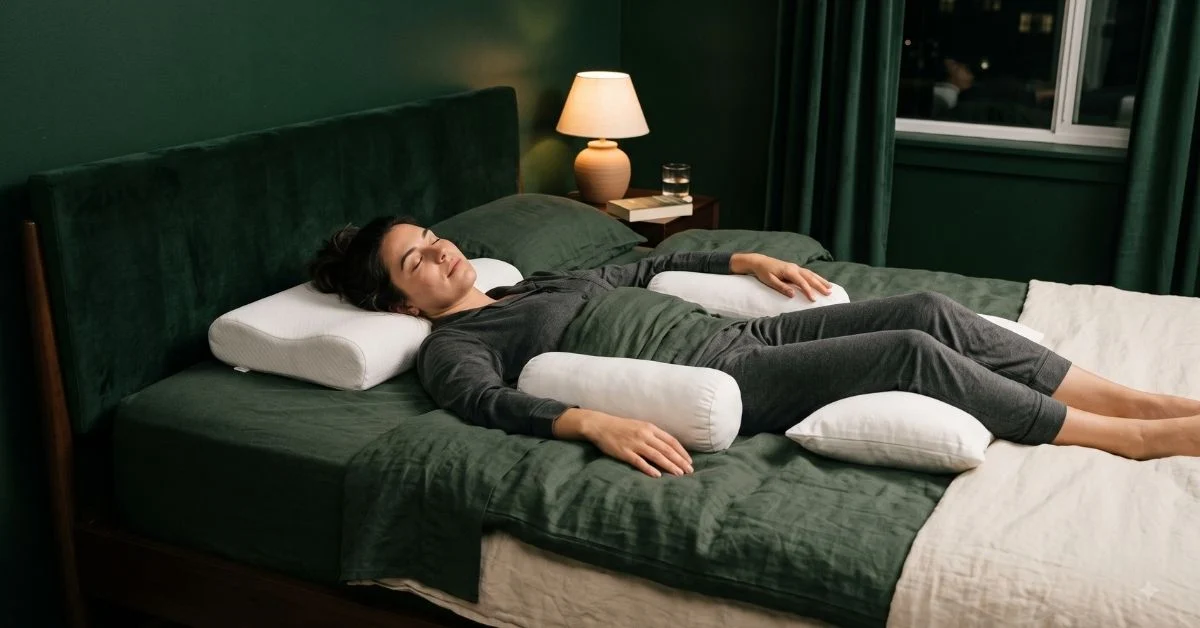
When you first start, your body will instinctively try to roll back to its accustomed side or stomach position during deep sleep cycles. Place firm pillows along both sides of your torso and hips. These physical bumpers make it much harder to turn over unconsciously.
3. Practice the Knee Pillow Technique
Never skip the knee pillow during the training phase. Keeping your hips in a neutral plane removes the lower back tugging that frequently forces sleepers to roll onto their sides for relief.
4. Practice Mindful Evening Relaxation
Before turning off the lights, lie flat on your back for ten to fifteen minutes. If your mind tends to race the moment you settle in, our guide on how to turn your brain off to sleep walks through six proven steps that pair well with this position. Progressive muscle relaxation and somatic exercises for sleep can also help you consciously release tension in your jaw, shoulders, lower back, and legs. If nighttime worry is part of the problem, it is worth reading why your stress level runs high when you sleep, since calming the nervous system before bed makes staying on your back feel natural rather than restrictive.
5. Upgrade Your Sleep Surface
A cool, breathable, well fitted sheet set removes one more reason your body might want to shift position overnight. Deep pocket sheet sets stay snugly fitted around thicker mattresses so they do not bunch up beneath you, while Oeko Tex certified bamboo sheets regulate temperature well for people who run warm at night. If you prefer natural fibers, both the Organic Sheet Set and the organic cotton bed sheet set are gentle on skin, which pairs nicely with the wrinkle reducing benefits of back sleeping. For hot sleepers specifically, our roundup of best cooling sheets for hot sleepers is worth a look, and if you have sensitive skin it is also worth reading about allergic reactions to bed sheets before you buy. A quiet room helps too. If noise keeps pulling you onto your side to bury an ear in the pillow, see whether sleeping with earplugs is a safe option for you. And if you are curious how back sleeping fits into the wider optimization trend, our explainer on what sleepmaxxing actually is and our list of five essential sleep hacks both cover simple, low effort changes that reinforce the habit.
Back Sleeping vs Side Sleeping vs Stomach Sleeping
Each position has real tradeoffs. Here is how they compare across the factors most people care about.
| Factor | Back Sleeping | Side Sleeping | Stomach Sleeping |
|---|---|---|---|
| Spinal Alignment | Excellent, when knees are supported | Good, with a pillow between the knees | Poor, tends to flatten the lumbar curve |
| Neck and Headache Risk | Low, with proper pillow support | Low to moderate | Highest, due to prolonged neck rotation |
| Snoring or Sleep Apnea | Can worsen symptoms in some people | Generally the most favorable option | Can reduce snoring but strains the neck |
| Facial Skin Contact | None, face stays off the pillow | Moderate, one side rests on the pillow | High, full facial contact for hours |
| Pregnancy Suitability | Situational, discuss timing with a provider | Generally preferred, especially the left side | Not practical after the first trimester |
| Best For | Lower back support, clear skin, sinus drainage | Snoring reduction, pregnancy, acid reflux | Occasional short term relief only |
Our Recommendation
For most healthy adults without diagnosed sleep apnea, back sleeping with a knee pillow and a properly contoured head pillow offers the best combination of spinal support and skin benefits. Pair the position with breathable, well fitted bedding, since a shifting or overheated sheet is one of the most common reasons people unconsciously roll onto their side. The Oeko Tex certified bamboo sheets or the Organic Sheet Set are both solid starting points, and either works well alongside the deep pocket sheet sets if your mattress runs thick. If you experience loud snoring, gasping, or diagnosed obstructive sleep apnea, speak with a healthcare provider before committing to back sleeping, since it can worsen airway symptoms for some people.
Final Thoughts
Learning how to sleep on your back is an investment in long term spinal health and sleep quality. By pairing proper ergonomic support, like dedicated cervical and knee pillows, with breathable bedding and a consistent evening routine, you can guide your body into healthy alignment night after night. At Ode Sleep, prioritizing deep rest starts with building sleep habits that keep your body balanced, supported, and pain free.
Sources
Centers for Disease Control and Prevention. About Sleep.
MedlinePlus, National Library of Medicine. Tension Headache.
MedlinePlus, National Library of Medicine. Obstructive Sleep Apnea, Adults.
MedlinePlus, National Library of Medicine. Snoring, Adults.
NIH MedlinePlus Magazine. Sleep Apnea, What You Need to Know.
Frequently Asked Questions (FAQs):
Is it safe to sleep on your back while pregnant?
Research funded by the Eunice Kennedy Shriver National Institute of Child Health and Human Development found that sleeping on the back or side through about the thirtieth week of pregnancy did not appear to raise the risk of stillbirth, reduced birth size, or high blood pressure disorders in that study window. Many providers still recommend left side sleeping in later pregnancy as a precaution. For a full breakdown, see our guide to best sleeping positions for pregnancy, and talk with your own provider about what is right for your pregnancy.
Can back sleeping help reduce wrinkles?
Yes. When you sleep on your side or stomach, your face presses against the pillow fabric for hours, creating friction and compression lines. Over time these temporary sleep creases can contribute to lasting fine lines. Back sleeping removes facial contact with your bedding entirely, and pairing it with a skin friendly sheet material adds an extra layer of benefit.
Does sleeping on your back help with snoring or make it worse?
For many people, back sleeping can make snoring and obstructive sleep apnea worse. MedlinePlus explains that sleeping on your back can cause the airway to become blocked or narrowed as throat tissues relax, and its guidance on snoring specifically advises against flat back sleeping for people who snore heavily. If you experience loud snoring or suspected sleep apnea, review the NIH MedlinePlus overview of sleep apnea and speak with your healthcare provider before adopting back sleeping as your primary position.
How do you stop yourself from turning over in your sleep?
The most effective method is building a barrier with supportive pillows along both sides of your waist and thighs. A body pillow on either side creates a channel that physically limits your torso from rotating mid sleep.
Is it better to sleep on your back or side?
Both positions have real benefits. Back sleeping tends to be better for overall spinal alignment, preventing facial wrinkles, and reducing certain types of neck pain. Side sleeping is generally better for digestion, pregnancy comfort, and reducing snoring or mild sleep apnea. The right choice depends on your personal health profile.
What pillow is best for training yourself to sleep on your back?
An ergonomic cervical contour pillow or a medium loft memory foam pillow tends to work best. The center cavity cradles the back of the head while the raised lower edge supports the natural curve of the neck without pushing it forward.
How can I stop rolling onto my side while sleeping?
Alongside side barrier pillows, try placing a pillow beneath your knees and a smaller one under your lower back curve. Removing discomfort points keeps your spine relaxed and reduces the physical urge to twist onto your side.
How long does it take to get used to sleeping on your back?
For most people, it takes about one to four weeks of consistent practice to fully adjust. You may wake up on your side during the first few nights. Simply roll back onto your back and reset your pillows without frustration.
Disclaimer: This article is for general informational purposes only and does not constitute medical or legal advice. Always consult a qualified professional before making any medical or legal decisions.

MBBS · PMDC registered
Registered Medical Practitioner (PMDC), Senior Medical Editor and Medical Reviewer for OdeSleep. Medical Officer in Paediatrics & NICU at Children's Hospital Lahore, combining frontline clinical experience with medical fact-checking.
View full profile →