Couples Sleeping Positions: The Psychology, Comfort, and Science of Sharing a Bed

· Medically reviewed
This guide was researched and updated using consumer health information from MedlinePlus.gov, a service of the U.S. National Library of Medicine, plus research summaries published by the National Institutes of Health (NIH) and its Eunice Kennedy Shriver National Institute of Child Health and Human Development (NICHD). Product and bedding guidance reflects Odesleep’s own catalog.
Sharing a bed is one of the most intimate parts of a relationship, yet it is often the place where physical comfort and emotional closeness quietly compete. One partner runs hot, the other steals the blanket, and somewhere around two in the morning someone ends up clinging to the edge of the mattress. Understanding common couples sleeping positions, the psychology behind them, and a few practical fixes can protect both your relationship and your rest.
This article looks at what nighttime posture tends to reveal about a relationship, walks through the most common positions couples use, and offers evidence informed ways to solve the friction points that come with sharing a mattress, from cold feet to a shared duvet that never seems to reach both people at once.
What Couples Sleep Position Psychology Reveals
Body language does not stop the moment you fall asleep. Sleep researchers and relationship therapists often look at nighttime posture as a rough gauge of emotional closeness, independence, and physical comfort within a relationship.
Physical touch and attachment. Skin to skin contact during sleep, such as spooning or resting a hand on a partner’s arm, is linked to the release of oxytocin, a hormone associated with trust and social bonding. Research reviewed by the National Institutes of Health has found that oxytocin release depends heavily on direct physical contact between familiar people, which is one reason cuddling before sleep tends to feel calming rather than merely comfortable (NIH, PMC2982050). Separate research funded by NIH’s Eunice Kennedy Shriver National Institute of Child Health and Human Development has also connected oxytocin to broader social bonding behavior (NICHD).
Independence versus distance. Sleeping apart or facing away from a partner does not automatically signal trouble. In many established relationships, sleeping back to back, especially with light contact along the spine or hips, reflects a healthy balance of intimacy and independent comfort rather than emotional distance.
Subconscious stress signals. A sudden shift in sleep habits, such as abruptly moving to the far edge of the mattress or building a pillow barrier overnight, can point to physical discomfort, an unsupportive mattress, or a temperature mismatch before it points to anything deeper in the relationship. Ruling out those practical causes first is usually worthwhile. Consistently poor sleep also affects mood, patience, and decision making, which is part of why federal health guidance treats a good sleep environment as foundational to overall wellbeing, not just a comfort issue (MedlinePlus, Healthy Sleep).
Seven Common Couples Sleeping Positions and What They Mean
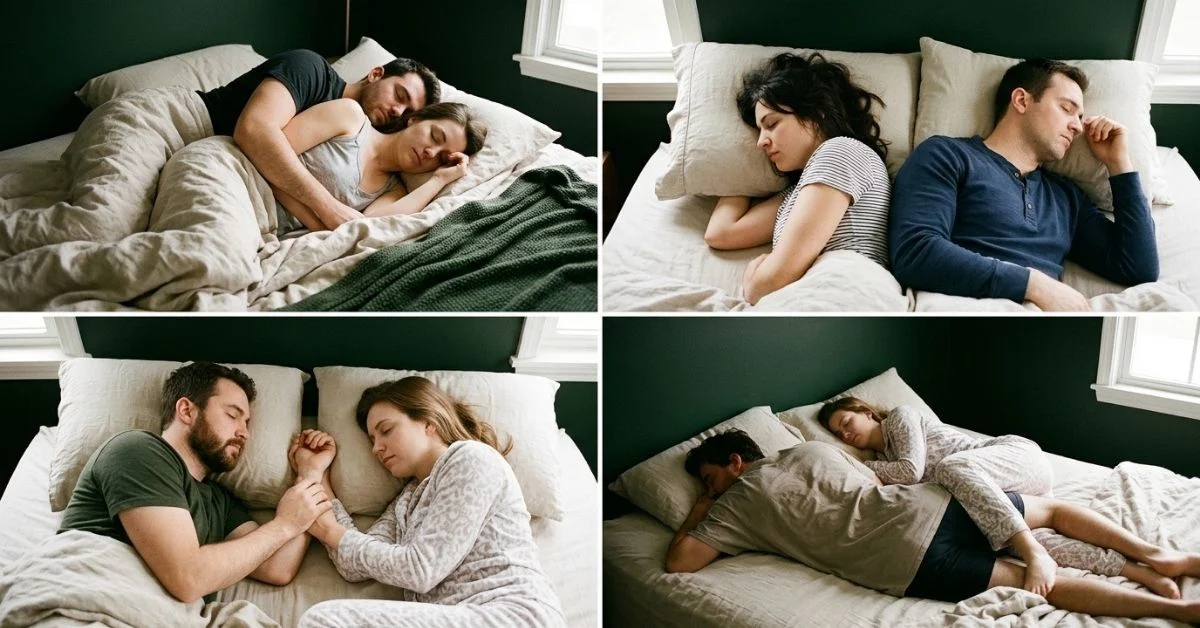
No single position is right or wrong. Most couples drift through two or three of these across a single night. The table below breaks down what each position tends to signal, along with the comfort tradeoffs worth knowing.
| Sleeping Position | What It Often Means | Comfort Benefits | Watch Out For | Best For |
|---|---|---|---|---|
| Classic Spoon | Protection, vulnerability, high emotional closeness | Full body warmth, comforting for side sleepers | Arm numbness, trapped heat, restricted movement | New couples and cold sleepers who want closeness |
| Loose Spoon | Established trust with room to breathe | Less heat buildup, easier to shift positions | Can still strain the outside partner’s shoulder | Long term couples who like contact without overheating |
| Back to Back, Touching | Intimacy combined with independence | Excellent spine support, minimal tangled limbs | Pressure points without a supportive mattress | Couples who value closeness and personal space equally |
| Back to Back, Apart | Independence or a need for physical space | Full freedom of movement, cooler sleep | Can feel distant if it is not mutually wanted | Hot sleepers or restless sleepers |
| Face to Face, Touching | Intense connection, common early in a relationship | High intimacy, reassuring before sleep | Exhaled breath, awkward neck and shoulder angles | Winding down together, not necessarily all night |
| Sweetheart Cradle | A nurturing dynamic, head resting on the chest | Deep sense of emotional safety | Neck stiffness, arm cramps for the base partner | Comfort seeking after a hard day |
| Starfish and Edge | One partner needs room, the other accommodates | The starfish sleeper gets full freedom | Edge sleeper risks poor posture and frequent waking | A signal to consider a larger mattress |
Recommendation: If you and your partner favor different positions throughout the night, that is normal and not a warning sign on its own. Aim for whatever combination lets you both wake up without numbness, a stiff neck, or a sore shoulder, even if that means starting the night entwined and finishing it back to back and a foot apart.
Romantic Poses to Try Before You Drift Off
For couples who want more closeness in their routine without sacrificing sleep quality, it helps to separate connection from posture. Try a romantic pose while you are still awake and talking, then let your bodies settle into whatever is actually comfortable once you are ready to sleep.
- The Sweetheart Hug. One partner lies on their back while the other curls into their side, resting their head near the chest or collarbone. This promotes relaxation right before winding down.
- The Leg Hug, or Tangled Ankles. If full body contact feels too warm, resting one foot or leg across a partner’s ankle offers a subtle touchpoint while leaving the upper body free to find a more ergonomic position.
- The Pillow Talk Face Off. Lying on your sides facing each other, with hands touching or resting near the pillows, allows for conversation and eye contact before rolling into your primary sleep posture.
Solving Common Shared Sleep Problems
The Dead Arm Dilemma in Spooning
The problem: the outside partner’s bottom arm gets pinned under the other person’s neck or torso, cutting off circulation.
The fix: slide the bottom arm upward under your own pillow rather than beneath your partner’s neck, or shift to a loose spoon once you start to doze off. A firmer pillow under the head can also reduce how much weight lands on that arm in the first place.
Temperature Clashes Between a Hot Sleeper and a Cold Sleeper
The problem: one partner radiates heat and kicks off the covers, while the other shivers under a heavy blanket. This is one of the most common complaints among couples, and it tracks with general sleep health guidance, since body temperature naturally drops during sleep and a bedroom that is too warm for one person is often exactly right for the other (MedlinePlus, sleep and bedroom temperature).
The fix: try the Scandinavian sleep method, which uses two separate twin duvets on one mattress instead of a single shared comforter, so each person controls their own warmth. Pair it with breathable, natural bedding rather than synthetic blends, since natural fibers move moisture away from the body more effectively.
Odesleep’s Oeko Tex certified bamboo sheets and Organic cotton bed sheet set are both built around that idea, since bamboo and organic cotton wick moisture better than most synthetic blends and are independently tested for harmful substances. If you are stacking a topper or a thicker mattress for the two duvet setup, a deep pocket sheet set keeps the fitted sheet from popping off overnight, which is one of the most common complaints once a mattress gets taller than standard.
Motion Transfer and Tossing
The problem: every time one partner shifts position or gets up, the whole bed shakes and wakes the other person.
The fix: a pocket coil or hybrid mattress with high density comfort layers isolates motion far better than an older innerspring set, so movement on one side does not disturb the other. Couples who sleep on an adjustable base, where one person likes their head raised and the other prefers to lie flat, often find that ordinary sheets bunch or shift every time the base moves. Adjustable Bed Sheets are cut and anchored differently so they move with the base instead of pulling loose overnight.
Sensitive Skin, Allergies, and Restless Nights
The problem: one partner wakes up itchy, congested, or generally uncomfortable, even when the room temperature and mattress are not the issue. Bedding is a common overlooked factor, since conventional cotton and synthetic sheets can carry pesticide residue, dye, and finishing chemicals that irritate sensitive skin. An Organic Sheet Set made from certified organic cotton reduces exposure to those residues, which is worth checking if a partner tends to wake up itchy or congested without an obvious cause.
When One Partner Has Extra Needs
Pregnancy
Many clinicians advise pregnant women to sleep on their side, particularly from the third trimester onward, because lying flat on the back can compress major blood vessels. An NIH funded analysis by NICHD found that sleeping on the back or side through 30 weeks of pregnancy did not appear to raise the risk of stillbirth, reduced fetal growth, or high blood pressure disorders, though the same research notes it did not evaluate late pregnancy, when most clinical advice still favors side sleeping (NICHD, sleep position and pregnancy). For couples adjusting to a pregnancy, our guides on Sleeping Positions for Pregnancy, Can You Sleep on Your Back While Pregnant, and How to Sleep with a Pregnancy Pillow go deeper into positioning and support.
Back Pain and Sciatica
A partner managing chronic back pain often needs a position the other person would find restrictive, such as sleeping strictly on their back with a pillow under the knees, or on their side with a pillow between the knees. See Best Position to Sleep for Lower Back Pain and Best Way to Sleep with Sciatica for setups that reduce nerve and joint pressure without forcing a couple apart all night.
Hot Sleepers
If one partner runs hot every night rather than only occasionally, it is worth ruling out simple causes before assuming it is just body chemistry. Our articles on Why Do I Get So Hot When I Sleep and Best Cooling Sheets for Hot Sleepers cover both the possible causes and practical bedding fixes.
Changing a Long Held Habit
Switching primary sleep position, for comfort, pregnancy, or a partner’s needs, takes practice and rarely sticks overnight. If your usual position is not working for either of you, How to Train Yourself to Sleep on Your Back and Muscles Tense During Sleep walk through gradual, realistic ways to retrain your body, and how to tell tension apart from a genuinely wrong sleep setup. For a broader overview of what works and what does not, our full breakdown of the Best and Worst Sleeping Positions is a useful starting point.
How Does Mattress Size Affect Couples’ Sleeping Positions?
A queen size bed gives each person roughly the width of a crib mattress. Upgrading to a king or a super king allows couples to cuddle comfortably in the center at the start of the night and spread out into more ergonomic positions once deep sleep sets in.
A Quick Nightly Checklist
- Start close if you want the emotional benefit of touch, then let your bodies settle naturally.
- Slide the bottom arm under your own pillow in a spoon to avoid the dead arm problem.
- Set the room a little cooler than feels perfect at bedtime, since body temperature drops during sleep.
- Consider two duvets instead of one if temperature mismatches are a recurring fight.
- Choose breathable, natural bedding and a motion isolating mattress if tossing or overheating disrupts either of you.
Sources
This article references the following federal government and peer reviewed sources:
- MedlinePlus.gov, Healthy Sleep (U.S. National Library of Medicine)
- MedlinePlus.gov, Sleep and Your Health (Medical Encyclopedia)
- MedlinePlus.gov, Insomnia and Bedroom Temperature Guidance
- MedlinePlus.gov, Changing Your Sleep Habits
- NICHD (National Institutes of Health), Sleep Position During Pregnancy Study
- NICHD (National Institutes of Health), Oxytocin and Social Bonding
- National Library of Medicine, PMC: Spine Alignment in Lateral Sleep Position
Frequently Asked Questions (FAQs):
Does sleeping back to back mean our relationship is in trouble?
No. Sleeping back to back, particularly with light contact along the spine or hips, is one of the most common positions among long term, secure couples. It reflects a balance of intimacy and independent comfort rather than distance.
What is the healthiest sleeping position for couples, physically speaking?
Sleeping back to back or on your sides, facing away from each other with supportive pillows, is generally best for spinal alignment, unobstructed breathing, and temperature regulation. Neither partner’s movement or body heat interferes with the other.
Why do we start the night cuddling but wake up on opposite sides?
This is completely normal. Most people shift position between ten and thirty times a night to relieve pressure points and regulate body temperature as they move through different sleep cycles, so the position you fall asleep in is rarely the one you wake up in.
What is the Scandinavian sleep method?
It involves sharing the same bed frame and mattress but using two separate duvets or blankets instead of one large shared comforter. It eliminates blanket stealing and lets each partner set their own temperature.
How can we stay physically close if full body cuddling runs too hot?
Try the leg hug, or rest a hand lightly on a partner’s hip or arm. These smaller points of contact still support the emotional benefits of touch without trapping body heat the way full contact does.
Can an incompatible sleep position lead to real sleep loss?
Yes. If one partner’s preferred position restricts the other’s space, creates excessive warmth, or leads to frequent waking, it can cause repeated brief awakenings and fragmented sleep over time. Ongoing poor sleep is worth addressing directly rather than working around indefinitely (MedlinePlus, sleep and your health).
Disclaimer: This article is for general informational purposes only and does not constitute medical or legal advice. Always consult a qualified professional before making any medical or legal decisions.

MBBS · PMDC registered
Registered Medical Practitioner (PMDC), Senior Medical Editor and Medical Reviewer for OdeSleep. Medical Officer in Paediatrics & NICU at Children's Hospital Lahore, combining frontline clinical experience with medical fact-checking.
View full profile →