Sleep Apnea vs Snoring: What Is the Difference and When Is It Dangerous

· Medically reviewed
Medically reviewed for accuracy and updated August 2026. Sources include the National Heart, Lung, and Blood Institute, the Centers for Disease Control and Prevention, and the National Library of Medicine.
It is easy to brush off snoring as nothing more than a noisy, annoying bedtime habit. Whether it is a light flutter or a rumble that wakes the entire house, millions of people snore every night. But loud or persistent snoring can sometimes be the first warning sign of a more serious underlying condition: obstructive sleep apnea, or OSA. According to the National Heart, Lung, and Blood Institute (NHLBI), part of the National Institutes of Health, obstructive sleep apnea happens when the upper airway becomes blocked repeatedly during sleep, and roughly fifty to seventy million Americans live with some form of sleep disorder.
Understanding the difference between simple snoring and sleep apnea matters for getting truly restorative rest and protecting your long term health. While the two are closely connected, they are not the same thing. Here is a clear, practical breakdown of snoring versus sleep apnea, how to spot dangerous warning signs, and what steps can help you reclaim peaceful, quiet sleep.
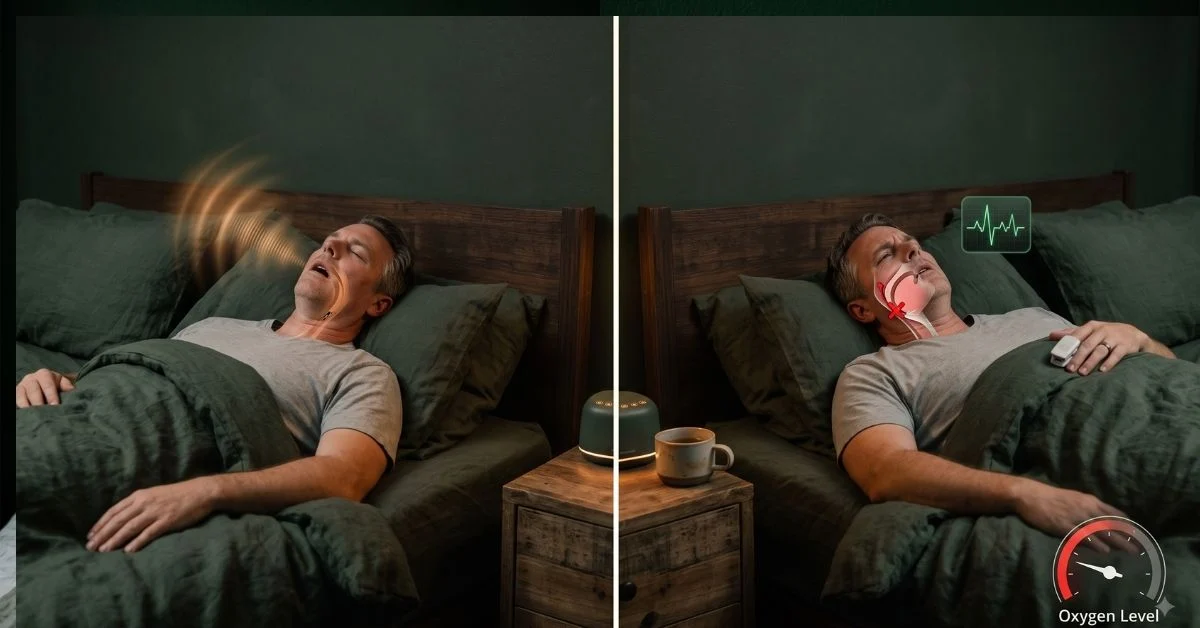
| Feature | Simple Snoring | Obstructive Sleep Apnea (OSA) |
|---|---|---|
| Airflow | Restricted, which causes tissue vibration and sound | Blocked on and off, which stops oxygen from getting through |
| Breathing pauses | None | Frequent, often ten seconds or longer, sometimes dozens of times an hour |
| Daytime fatigue | Rare or mild | Often severe and chronic |
| Health risks | Mainly disrupted sleep for a bed partner | Linked to high blood pressure, heart disease, and stroke |
| Oxygen levels | Stay within a normal range | Can drop significantly with each blocked breath |
What Is Simple Snoring
Snoring happens when air cannot flow smoothly through your throat and nasal passages while you sleep. As you drift off, the muscles in the roof of your mouth, your tongue, and your throat relax. When your airway narrows, the passing air forces those soft tissues to vibrate against one another, and that vibration is the sound we know as snoring.
Common Triggers for Snoring
- Sleeping on your back: gravity pulls the tongue and soft tissue backward toward the throat. Switching positions is one of the simplest fixes; our guide to the best and worst sleeping positions breaks down which posture supports easier breathing.
- Nasal congestion: allergies, sinus infections, or a deviated septum restrict airflow through the nose. If a stuffy nose is a nightly problem, see our tips on how to sleep with a blocked nose, and if it flares up whenever you are unwell, our guide to how to sleep while sick can help.
- Alcohol or sedatives: these relax the throat muscles far more than normal sleep does. If you rely on a muscle relaxer for tension or pain, it is worth reading whether muscle relaxers actually help you sleep before making them a habit, since the same relaxing effect that eases muscles can also loosen the throat.
- Weight and anatomy: excess tissue around the neck, enlarged tonsils, or a low, thick soft palate can narrow the breathing pathway.
What Is Obstructive Sleep Apnea (OSA)
Obstructive sleep apnea is a chronic sleep disorder marked by repeated pauses in breathing throughout the night. Unlike simple snoring, where air still reaches your lungs even if noisily, sleep apnea occurs when the airway becomes completely or partially blocked. The NIH National Library of Medicine’s MedlinePlus describes these blockages as lasting from a few seconds to minutes and occurring thirty times or more an hour in some people. When your brain senses it is not getting enough oxygen, it triggers a brief survival reflex that jolts you just awake enough to reopen the airway, often with a sudden gasp, snort, or choking sound.
Risk factors for OSA include being overweight, being male, having a family history of the condition, or having naturally small airways, according to NHLBI’s overview of sleep apnea causes and risk factors. Age plays a role too, since throat muscle tone naturally loosens over time, which is part of why older adults tend to sleep differently and more often than younger adults. Hormonal shifts can also raise risk, which is one reason snoring sometimes appears for the first time during pregnancy; our guides to safe sleeping positions during pregnancy and whether it is safe to sleep on your back while pregnant cover this in more depth.
Is Obstructive Sleep Apnea the Same as Snoring
The short answer is no. While closely related, obstructive sleep apnea is not the same as snoring. Think of snoring as a symptom and sleep apnea as the underlying condition. Nearly everyone with sleep apnea snores, but not everyone who snores has sleep apnea.
Does Snoring Mean You Have Sleep Apnea
No, snoring does not automatically mean you have sleep apnea. Primary or simple snoring is common and often harmless. Heavy, habitual snoring, however, is the primary indicator of OSA, so it is worth paying attention to how you snore and how you feel when you wake up.
What Type of Snoring Is Dangerous
While soft, rhythmic snoring is usually harmless, certain patterns point strongly toward obstructive sleep apnea. Snoring becomes a warning sign when it includes:
- Gasping, choking, or snorting sounds: if snoring is interrupted by sudden pauses followed by violent gasps, your body is struggling to breathe.
- Extremely loud, irregular snoring: snoring so loud it carries through closed doors or keeps housemates awake is a major flag.
- Silent pauses in breathing: bed partners often notice moments where breathing stops entirely before restarting with a loud snort.
- Positional intensity: snoring in every sleep position, not just on your back, that steadily worsens over time.
Beyond the sound itself, sleep apnea often leaves daytime clues: a dry mouth on waking, morning headaches, trouble concentrating, mood changes, and persistent fatigue.
Does Snoring Mean Deep Sleep
There is a widespread myth that loud snoring means someone is sleeping deeply. In reality, snoring is often a sign of fragmented, lower quality sleep. When you snore heavily or experience apnea, your body stays under constant, low grade stress. Continuous airway resistance, or repeated drops in oxygen, pulls your brain out of deep, slow wave and REM sleep into lighter stages. Even if you never fully wake up, your nervous system is repeatedly spiked with adrenaline just to keep you breathing, which is why heavy snorers so often wake up exhausted no matter how many hours they spent in bed.
Practical Steps to Stop Snoring and Improve Airway Health
If loud snoring is disrupting your rest, these targeted adjustments can help keep your airway open.
Change Your Sleep Position
Elevate your head with a supportive pillow or sleep on your side to keep your tongue from relaxing into your throat. Our guide to the best and worst sleeping positions walks through which postures help and which make snoring worse, and if back pain is what keeps pulling you onto your back, the best position to sleep for lower back pain can help you find a side sleeping setup that is comfortable enough to stick with.
Clear Nasal Passages
Use saline rinses, nasal strips, or an air purifier to reduce congestion before bed. If a stuffy nose is a recurring obstacle, revisit our guide on how to sleep with a blocked nose. Allergens trapped in bedding are a common, overlooked source of nighttime congestion. Dust mites, pet dander, and pollen can settle into pillowcases and sheets and quietly aggravate the exact tissues that swell and vibrate during snoring. Our guide to the best sheets for allergies and asthma covers fabric choices that reduce that buildup, and if you have ever woken up congested or itchy for no clear reason, it is worth reading about allergic reactions to bed sheets to rule out your bedding as the culprit. A few certified, allergen reducing options worth considering:
- Oeko Tex certified bamboo sheets for verified freedom from harmful residues that can irritate airways.
- Purely organic sheet sets for a fully organic cotton feel with fewer synthetic additives.
- Organic cotton bed sheet sets as a breathable, everyday staple that is gentler on sensitive airways.
- Deep pocket sheet sets so you can wash bedding often enough to keep allergens from building up.
Avoid Alcohol and Heavy Meals Before Bed
Skip alcohol or sedatives for at least three to four hours before sleep, since they excessively relax throat muscles. This is the same reason it is worth thinking twice about nightly muscle relaxers as a sleep aid: anything that relaxes muscles throughout the body relaxes the throat too.
Maintain a Healthy Weight
Reducing excess neck tissue decreases pressure on the upper airway and is one of the most consistently supported ways to ease mild to moderate snoring.
Consult a Sleep Specialist
If you notice any of the dangerous snoring symptoms above, ask a doctor about an at home or in lab sleep study, known as polysomnography, to get an accurate diagnosis. The NIH’s National Library of Medicine resource on sleep disorders is a reliable starting point if you want to understand what a diagnostic workup typically involves before your appointment.
Our Recommendation
Recommendation: Occasional, soft snoring with no gasping, no witnessed breathing pauses, and no daytime fatigue is usually fine to manage with simple changes such as side sleeping, a cleaner bedroom environment, and cutting back on alcohol before bed. Treat it as a signal to see a doctor if you or a partner notice gasping or choking sounds, silent pauses in breathing, snoring that has grown steadily louder over months, or if you wake up tired no matter how long you slept. A sleep study is the only reliable way to tell simple snoring apart from obstructive sleep apnea, and getting one is worthwhile given how strongly untreated OSA is linked to heart disease and stroke risk.
Sources
This article draws on guidance from the following government health agencies. Each link goes directly to the source.
- NHLBI: What Is Sleep Apnea — National Heart, Lung, and Blood Institute, National Institutes of Health
- NHLBI: Sleep Apnea, Causes and Risk Factors — National Heart, Lung, and Blood Institute, National Institutes of Health
- MedlinePlus: Sleep Apnea — National Library of Medicine, National Institutes of Health
- MedlinePlus: Sleep Disorders — National Library of Medicine, National Institutes of Health
- Obstructive Sleep Apnea, StatPearls — National Center for Biotechnology Information, National Institutes of Health
- CDC: About Sleep — Centers for Disease Control and Prevention
- CDC: Sleep Facts and Stats — Centers for Disease Control and Prevention
- Healthy People 2030: Sleep — Office of Disease Prevention and Health Promotion, U.S. Department of Health and Human Services
Frequently Asked Questions (FAQs):
How can I tell if I stop breathing while sleeping if I live alone?
Without a bed partner to observe you, pay attention to waking up suddenly with a racing heart, a dry mouth, or a choking sensation. Sleep tracking apps that record audio overnight can also help you check for loud gasps or long pauses between snores.
What happens if obstructive sleep apnea is left untreated?
Untreated OSA puts real strain on the cardiovascular system. Over time it raises the risk of high blood pressure, heart attack, stroke, type 2 diabetes, and irregular heart rhythms. It also raises the risk of fatigue related accidents; federal transportation safety data cited by the U.S. Department of Health and Human Services’ Healthy People 2030 initiative links drowsy driving, which is closely tied to untreated sleep disorders, to roughly one hundred thousand motor vehicle crashes a year in the United States.
Can simple snoring turn into sleep apnea over time?
Yes. As we age, throat muscle tone naturally decreases, and weight changes can add pressure to the airway. What starts as simple snoring in your thirties can gradually progress into obstructive sleep apnea later in life.
What are the main treatments for obstructive sleep apnea?
The most common and effective treatment for moderate to severe OSA is continuous positive airway pressure, or CPAP, therapy, which uses gentle air pressure to keep the airway open. Other options include custom oral appliances fitted by a dentist, positional therapy, lifestyle changes, and in some cases surgery. A doctor can help match the right option to the severity of your condition.
Disclaimer: This article is for general informational purposes only and does not constitute medical or legal advice. Always consult a qualified professional before making any medical or legal decisions.

MBBS · PMDC registered
Registered Medical Practitioner (PMDC), Senior Medical Editor and Medical Reviewer for OdeSleep. Medical Officer in Paediatrics & NICU at Children's Hospital Lahore, combining frontline clinical experience with medical fact-checking.
View full profile →