What Is the Best Sleeping Position for Sleep Apnea? Why Side Sleeping Works

· Medically reviewed
Last updated November 27, 2026. This article is for education and does not replace advice from your doctor or sleep specialist.
Executive Summary: Key Takeaways
- Side sleeping (the lateral position) is the position most often recommended for obstructive sleep apnea (OSA). The National Heart, Lung, and Blood Institute says your provider may recommend sleeping on your side, not on your back, because it can help keep your airway open.
- Back sleeping (the supine position) is linked with more severe OSA. A systematic review of body position studies found supine posture is consistently associated with worse OSA indices in adults.
- You may have positional OSA if your events are at least twice as frequent on your back. Reviews estimate that 56 to 80 percent of adults with OSA are positional to some degree, and the share is higher in mild cases (source).
- Left versus right side: no side has been proven better for breathing, but a meta analysis links left side sleeping with less nighttime acid reflux.
- Positional therapy supports medical treatment, it does not replace it. A sleep study is the only way to know how much your position matters.
What Is the Best Sleeping Position for Sleep Apnea?
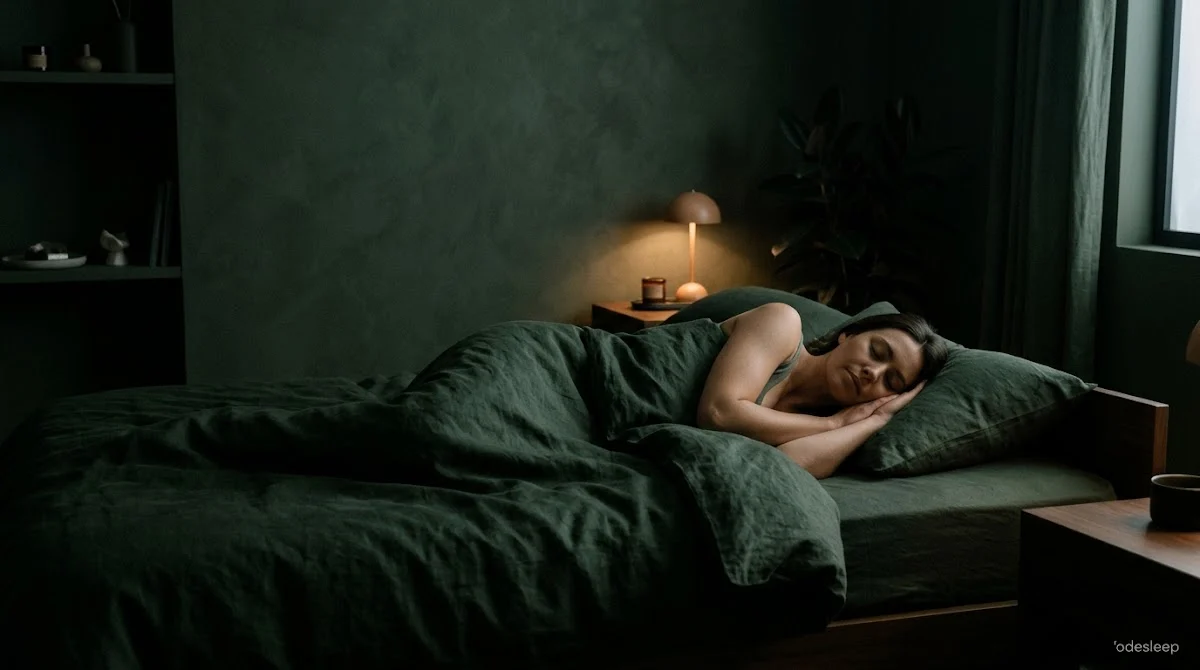
The best sleeping position for obstructive sleep apnea is on your side. Side sleeping lets gravity pull the tongue and soft tissues sideways instead of straight back into the throat, which helps keep the airway open.
This matches clinical guidance. The NHLBI notes that a provider may recommend side sleeping as part of lifestyle changes, and researchers report that people with mild OSA may improve symptoms simply by avoiding the back position (systematic review).
Note: Side sleeping is a supportive step, not a diagnosis. If you snore loudly, wake up gasping, or feel exhausted all day, ask a doctor about a sleep study. Our guide to sleep apnea vs snoring explains how the two differ.
Why Does Back Sleeping Make Sleep Apnea Worse?
On your back, gravity pulls the tongue and soft palate toward the rear wall of the throat just as your throat muscles relax in sleep. That narrows the airway and makes collapse, oxygen dips, and snoring more likely.
The tendency of the upper airway to collapse is greater supine than lateral, according to the systematic review. Researchers also study how body position changes lung volume and airway behavior, and a physiology study in PubMed Central reports that obstructive events resolve in lateral sleep in about 20 percent of patients, while others stay severe in any position.
What Is Positional Sleep Apnea, and How Do You Know If You Have It?
Positional sleep apnea means your breathing events are at least twice as frequent on your back as on your side. A sleep study (in a lab or a home test) reports your apnea hypopnea index (AHI) by body position, so your clinician can calculate that ratio.
Reviews estimate that 56 to 80 percent of adults with OSA, and 65 to 87 percent of mild cases, are positional to some degree (source). A large analysis found that roughly 20 percent of adults with OSA have exclusive supine OSA, with fewer than 5 events per hour off the back (source).
Note: A small group does worse on the side. Researchers have described a “lateral positional” phenotype in the Multi Ethnic Study of Atherosclerosis, which is another reason to base position advice on your own sleep study.
Is Left Side or Right Side Better for Sleep Apnea?
For breathing alone, neither side has been proven better, so choose the side you can hold comfortably all night. Left side sleeping has an extra advantage if you also have acid reflux.
A systematic review and meta analysis found that lying on the left side reduced esophageal acid exposure time and acid clearance time compared with the right side and the back. The same review notes that the 2022 American College of Gastroenterology guideline lists left side sleeping as a lifestyle step for GERD. The likely reason is anatomy: with the left side down, the stomach sits below the esophagus, so less acid travels upward.
Are Stomach Sleeping and Elevated Sleeping Good Options?
Stomach sleeping can keep the airway open for some people, but it forces the neck to rotate for hours and is rarely suggested as a long term fix. Raising the head and upper body is a gentler option for people who cannot tolerate side sleeping.
An adjustable base lets you raise the head of the bed gradually and test what feels sustainable. If you go this route, choose adjustable bed sheets made for the way an adjustable mattress bends, so bedding stays put as the base moves. Ask your clinician how much elevation suits your situation.
How Can You Sleep Comfortably on Your Side?
Comfortable side sleeping comes down to alignment and pressure relief at the neck, shoulder, hip, and knees. Use a pillow that fills the gap between your head and the mattress, and place a firm pillow between your knees.
- Support your neck: your chin should stay level, not tilted toward your chest.
- Relieve pressure points: a supportive mattress and breathable bedding from OdeSleep help reduce shoulder and hip pinching that sends people rolling back onto their backs.
- Square the pelvis: a knee pillow prevents hip rotation. See our guides on the best position for lower back pain and the best way to sleep with sciatica for more alignment tips.
- Stay cool: overheating wakes people and increases tossing. Read why you get so hot when you sleep.
How Do You Stay Off Your Back During Sleep?
Positional therapy trains you to avoid your back using a physical cue or a wearable device. Options range from a tennis ball sewn into a shirt to vibrating devices worn on the chest or neck.
- Tennis ball technique: sew a pocket onto the middle of the back of a sleep shirt and insert a tennis ball.
- Vibration devices: small wearables detect a supine posture and vibrate until you turn.
- Body wedge or long pillow: place it behind your back to block rolling.
Research on positional therapy is promising but limited, and sticking with it long term is a common challenge, so review your plan with your clinician. Our overview of the best and worst sleeping positions compares more options.
How Do the Sleeping Positions Compare for Sleep Apnea?
Side positions generally protect the airway best, while the back position carries the most risk. The table below summarizes the main trade offs.
| Position | Effect on the airway | Other considerations |
|---|---|---|
| Back (supine) | Greatest tendency to collapse | Linked with more severe OSA in adults |
| Left side | Airway more stable than on the back | Less nighttime acid reflux in GERD studies |
| Right side | Airway more stable than on the back | More acid exposure than left side in reflux studies |
| Stomach (prone) | May keep the airway open | Neck rotation and spinal strain make it hard to sustain |
| Elevated back | May reduce collapse for some people | Needs an adjustable base or firm wedge; ask your clinician |
Recommendations: What to Do Next
- Get tested. Ask your doctor about a sleep study and request the position breakdown of your AHI.
- Keep prescribed treatment. Use PAP therapy or an oral device as directed, and add position changes on top.
- Build a side sleeping setup. Choose a pillow that fits your shoulder width, add a knee pillow, and use breathable bedding from OdeSleep.
- Add a cue. Try a body wedge, a positional wearable, or the tennis ball method for two weeks and note how you feel.
- Consider elevation. If side sleeping is painful, ask about an adjustable base with matching adjustable bed sheets.
- Follow up. Repeat testing if your symptoms return or your weight or medications change.
References and Sources
- Sleep Apnea Treatment (National Heart, Lung, and Blood Institute, NIH)
- Influence of Body Position on Severity of Obstructive Sleep Apnea: A Systematic Review (Hindawi, indexed in PubMed Central, NIH)
- Case report on supine posture, snoring, and positional therapy with literature overview (PubMed Central, NIH)
- The Effect of Body Position on Physiological Factors that Contribute to Obstructive Sleep Apnea (Journal of Clinical Sleep Medicine, PubMed Central, NIH)
- Study of supine positional obstructive sleep apnea by age and sex (PubMed Central, NIH)
- Positional OSA phenotypes across ethnic groups in the Multi Ethnic Study of Atherosclerosis (PubMed Central, NIH)
- Left lateral decubitus sleeping position is associated with improved gastroesophageal reflux disease symptoms: A systematic review and meta analysis (World Journal of Clinical Cases, PubMed Central, NIH)
Frequently Asked Questions (FAQs):
Can side sleeping cure sleep apnea?
Not for everyone. Side sleeping can normalize breathing in some people with positional OSA, but many people need additional treatment. The NHLBI describes a PAP machine as the most common treatment, often paired with lifestyle changes, and says an oral device may be prescribed if you cannot tolerate CPAP (NHLBI). See our comparison of CPAP vs BiPAP.
Why does my CPAP mask leak when I sleep on my side?
The edge of the mask can press into the pillow and break the seal. A lower profile pillow or one designed with cutouts for CPAP masks can give the mask room, and your equipment provider can check the fit. The NHLBI also points to its Living With Sleep Apnea information for device problems.
Is sleeping on the right side harmful?
No. Right side sleeping is far better for the airway than back sleeping. If you have reflux, you may notice more nighttime symptoms on your right side than your left (meta analysis).
How do I know if I have positional sleep apnea?
A sleep study that reports AHI by position will show it. If your supine AHI is at least double your nonsupine AHI, your OSA is classified as positional (source). Better rest also helps your deep sleep.
Disclaimer: This article is for general informational purposes only and does not constitute medical or legal advice. Always consult a qualified professional before making any medical or legal decisions.

MBBS · PMDC registered
Registered Medical Practitioner (PMDC), Senior Medical Editor and Medical Reviewer for OdeSleep. Medical Officer in Paediatrics & NICU at Children's Hospital Lahore, combining frontline clinical experience with medical fact-checking.
View full profile →