CPAP vs BiPAP: Key Differences, Benefits, and Choosing the Right Machine

· Medically reviewed
Waking up gasping for air, suffering persistent morning headaches, or enduring chronic daytime exhaustion are common warning signs of sleep disordered breathing. For millions diagnosed with sleep apnea, positive airway pressure therapy, known as PAP therapy, is the definitive standard of care. The NHLBI overview of sleep apnea describes sleep apnea as a common condition in which breathing repeatedly stops and restarts during sleep, which can prevent the body from getting enough oxygen.
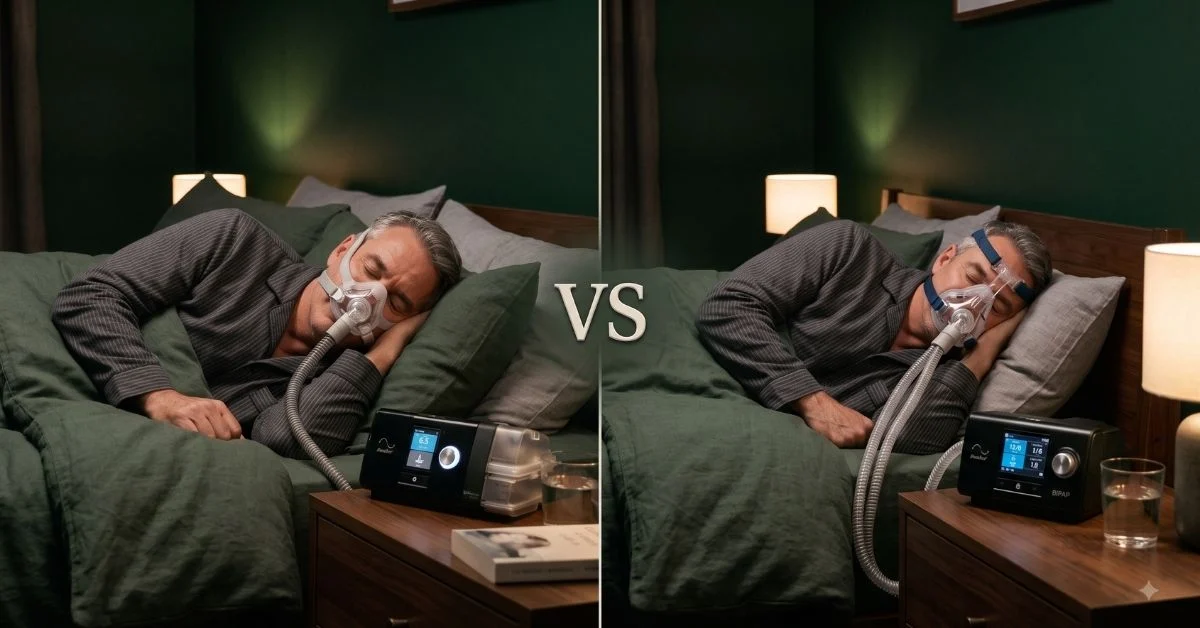
However, navigating the prescribed equipment can quickly feel confusing. If your physician recommended PAP therapy, you have likely encountered two primary machine types: CPAP and BiPAP. While both devices pump pressurized air through a hose and mask to keep your airway open while you sleep, they deliver that pressure in fundamentally different ways. Understanding the difference between CPAP and BiPAP, and how each machine addresses specific breathing challenges, is key to achieving comfortable, restorative rest.
What Is a CPAP Machine
CPAP stands for Continuous Positive Airway Pressure. It is the most widely prescribed, first line medical intervention for obstructive sleep apnea (OSA). According to the NHLBI page on CPAP, healthcare providers may prescribe CPAP to treat sleep related breathing disorders, and it is also sometimes used to support preterm infants who have underdeveloped lungs.
How CPAP Works
A CPAP machine delivers air at a single, continuous pressure setting all night long. Whether you are breathing in or breathing out, the machine maintains identical pressure to act as a pneumatic splint, preventing your upper airway tissues from collapsing inward.
- Primary indication: mild to severe obstructive sleep apnea.
- Key advantage: straightforward design, highly effective for uncomplicated OSA, and broadly covered by health insurance.
- Potential drawback: some users struggle with exhaling against constant, high pressure, describing the feeling as similar to breathing out of a car window on the highway.
What Is a BiPAP Machine
BiPAP, also written as BPAP, stands for Bilevel Positive Airway Pressure. As the name suggests, a bilevel PAP machine features two distinctly programmed pressure settings rather than one continuous stream.
How BiPAP Works
A BiPAP device monitors your breathing pattern in real time and toggles between two pressure levels:
- IPAP, or Inspiratory Positive Airway Pressure: a higher pressure delivered when you inhale to expand the lungs and hold the airway open.
- EPAP, or Expiratory Positive Airway Pressure: a lower pressure delivered when you exhale, making it easier and more natural to push air out.
- Primary indication: central sleep apnea, complex sleep apnea, high pressure CPAP intolerance, or underlying respiratory disease such as COPD or hypoventilation syndromes.
- Key advantage: significantly easier exhalation, better comfort at high pressure settings, and active ventilation assistance for clearing carbon dioxide.
- Potential drawback: higher out of pocket costs and stricter insurance approval requirements.
CPAP vs BiPAP: Direct Comparison
Choosing between a CPAP machine and a BiPAP machine is a clinical decision made by your sleep specialist based on your sleep study, known as polysomnography, along with your lung mechanics and medical history. The NHLBI explanation of sleep apnea treatment notes that a bilevel PAP machine is like a CPAP machine but delivers different pressure depending on whether you are inhaling or exhaling.
| Feature | CPAP (Continuous PAP) | BiPAP (Bilevel PAP) |
|---|---|---|
| Pressure delivery | Single fixed pressure setting for inhalation and exhalation | Dual pressure settings, high for inhalation and low for exhalation |
| Primary target condition | Uncomplicated obstructive sleep apnea | Complex or central sleep apnea, CPAP intolerance, COPD, OHS |
| Exhalation comfort | Can feel resistive at high prescribed pressures above 12 cm H2O | Effortless exhalation due to automatic pressure drops |
| Ventilation support | Maintains an open airway, does not assist breath depth | Assists lung mechanics and helps clear carbon dioxide |
| Average device cost | $500 to $1,000, widely covered by standard insurance | $1,500 to $3,000 or more, requires clinical justification for coverage |
When Do Doctors Recommend BiPAP Over CPAP
For most people diagnosed with straightforward obstructive sleep apnea, CPAP therapy provides complete relief. Clinicians typically transition a patient to BiPAP therapy under four primary scenarios.
1. High Pressure Requirements
When a patient requires high continuous pressure, such as 15 cm H2O or above, to maintain airway stability, breathing out against that resistance becomes physically tiring. A BiPAP delivers the necessary high IPAP on inhalation while lowering the EPAP on exhalation to restore comfort.
2. Aerophagia, or Swallowing Air
Some CPAP users accidentally swallow air due to high continuous pressure, waking up with severe stomach bloating, gas, and painful distension. BiPAP reduces this issue by dropping airway resistance during exhalation.
3. Central Sleep Apnea or Complex Sleep Apnea
Unlike obstructive sleep apnea, which is a physical blockage, central sleep apnea occurs when the brain briefly stops sending signals to the breathing muscles. Advanced BiPAP units can monitor time between breaths and deliver a timed breath if the user stops breathing spontaneously.
4. Co Existing Respiratory Conditions
Patients managing conditions such as chronic obstructive pulmonary disease, obesity hypoventilation syndrome, or neuromuscular disorders often struggle to exhale carbon dioxide properly. The CDC overview of COPD reports that nearly 16 million U.S. adults have COPD, and many more remain undiagnosed. BiPAP supports active air exchange for these patients, relieving respiratory muscle fatigue.
Solving Common Sleep Apnea Therapy Challenges
Regardless of whether you are prescribed a CPAP or BiPAP, adjusting to PAP therapy takes patience. Common obstacles can be resolved with simple equipment and habit adjustments.
Mouth Leaks and Dry Throat
Air escaping through an open mouth reduces therapy effectiveness and dries out tissues. Adding a heated humidifier to your unit or switching to a full face mask stabilizes humidity. If you also tend to run warm overnight, Why Do I Get So Hot When I Sleep and Best Cooling Sheets for Hot Sleepers cover ways to keep your bed cool while a heated humidifier runs beside you.
Mask Pressure Marks and Skin Irritation
Over tightening headgear straps to stop leaks damages skin. Focus on selecting proper cushion sizing or ultra soft silicone interfaces. It also helps to pair your setup with breathable, low friction bedding, since your face rests against your pillowcase for hours around the mask. An Organic Sheet Set or Oeko Tex Certified Bamboo Sheets reduce the friction and chemical exposure that can compound mask related skin irritation.
Nasal Congestion
Cold air entering nasal passages causes inflammation and makes mask therapy harder to tolerate. Using heated tubing maintains warm, comfortable air delivery throughout the night. If congestion is a recurring issue beyond your mask, How Do You Sleep With a Blocked Nose offers additional strategies, and Best Sheets for Allergies and Asthma is worth reviewing if allergens in your bedroom may be contributing to nighttime congestion.
Quick Recommendations by Situation
| If You Notice | Consider | Why It Helps |
|---|---|---|
| Trouble exhaling against pressure | Ask your provider about a BiPAP evaluation | Lower EPAP pressure makes exhalation easier |
| Morning bloating or stomach gas | Discuss aerophagia with your provider | BiPAP reduces swallowed air linked to high constant pressure |
| Dry mouth or nose overnight | Add a heated humidifier or switch to a full face mask | Restores moisture lost to pressurized airflow |
| Red marks or irritation from the mask | Refit cushion sizing and choose breathable, gentle bedding | Reduces friction and pressure on delicate facial skin |
| Ongoing fatigue despite regular use | Request a data download and follow up visit | Identifies leaks, pressure issues, or a need to change device type |
Sleep Position, Routine, and Adjusting to Therapy
Side sleeping is generally easier to combine with a mask and can reduce airway collapse, while some positions make leaks more likely. Best and Worst Sleeping Positions breaks down how different positions affect breathing and comfort, which is useful while you experiment with mask fit.
The adjustment period is often more mental than mechanical. A wind down routine that includes relaxation therapy for sleep or learning how to turn your brain off to sleep can ease the anxiety some people feel about wearing a mask, which in turn makes it easier to keep the mask on through the night. For a broader set of habits that support consistent, restorative sleep alongside PAP therapy, 5 Essential Sleep Hacks and the New Sleep Guide of Your Dreams are both practical places to start.
Consistent, uninterrupted sleep is not just about feeling rested. Does Sleeping Help You Heal Faster explains why deep, uninterrupted rest supports physical recovery, which is exactly what properly fitted PAP therapy is designed to restore for people with sleep apnea.
Rest Easy with Odesleep
Living with sleep apnea does not have to mean compromising on nighttime comfort. Once your physician helps you identify the right PAP machine, whether CPAP or BiPAP, pairing your setup with specialized sleep gear makes a real difference. A deep pocket sheet set keeps bedding snug around a thicker mattress, while an Organic Cotton Bed Sheet Set gives sensitive, mask adjacent skin a soft, breathable surface every night. At Odesleep, our products are designed to support restorative rest, helping you adapt to therapy seamlessly so you wake up feeling recharged every single morning.
Sources
This article references the following government and public health sources:
Frequently Asked Questions (FAQs):
What is the main difference between CPAP and BiPAP
The core difference is pressure delivery. CPAP delivers one single, unbroken air pressure level for both inhaling and exhaling. BiPAP delivers two separate pressure levels, a higher setting when inhaling and a lower setting when exhaling.
Can I choose a BiPAP machine over a CPAP just for comfort
No. PAP devices are medical machines requiring a detailed prescription. Insurance providers typically cover BiPAP therapy only if a sleep study proves complex breathing needs, such as central sleep apnea or COPD, or if documented clinical evidence shows a patient could not tolerate CPAP therapy.
What is APAP, and how is it different from CPAP and BiPAP
APAP automatically adjusts pressure breath by breath within a set range based on airway resistance. APAP still uses a single pressure level per breath cycle, while BiPAP alters pressure within a single breath cycle between inhalation and exhalation.
Is a BiPAP machine considered a ventilator or life support
No. BiPAP is a non invasive support machine designed to assist natural breathing. It does not take over breathing entirely or act as invasive life support, such as mechanical intubation.
How do I know if my CPAP pressure is too high and I need BiPAP
If you experience persistent smothering sensations while exhaling, severe morning bloating or gas, frequent nighttime waking, or continue feeling tired despite consistent CPAP use, contact your sleep doctor. They will review your machine data to determine whether a prescription change to BiPAP is clinically necessary.
Are CPAP and BiPAP machines safe, and are there any recalls to know about
PAP therapy is considered safe and effective when properly fitted and maintained, but like any medical device, recalls can happen. The FDA safety communication on the Philips Respironics recall covers a foam breakdown issue in certain devices, and a separate FDA safety communication on ResMed mask magnets addresses a magnet related recall affecting certain mask models. If you use an affected device, check the manufacturer’s recall list and talk with your provider before making any changes.
Disclaimer: This article is for general informational purposes only and does not constitute medical or legal advice. Always consult a qualified professional before making any medical or legal decisions.

MBBS · PMDC registered
Registered Medical Practitioner (PMDC), Senior Medical Editor and Medical Reviewer for OdeSleep. Medical Officer in Paediatrics & NICU at Children's Hospital Lahore, combining frontline clinical experience with medical fact-checking.
View full profile →