
Safe Co Sleeping: Evidence Based Guidelines, Positions, and Setups

· Medically reviewed
Medically informed guidance for tired parents who bed share, room share, or fall asleep while nursing.
Sleep deprivation during early parenthood often turns nighttime parenting into survival mode. The American Academy of Pediatrics and the NICHD Safe to Sleep campaign recommend room sharing, keeping baby in the same bedroom on a separate, firm sleep surface, as the safest arrangement for the first year of life. Even so, millions of parents ultimately bring their baby into the adult bed at some point, whether to make nighttime breastfeeding easier or to settle a fussy infant.
If you choose to bed share, or you know you might doze off while nursing, understanding how to do it safely is essential. This guide combines pediatric research, guidance from the Centers for Disease Control and Prevention, and the harm reduction framework used by lactation professionals so families can lower the risk of Sudden Infant Death Syndrome, suffocation, and entrapment as much as possible. Nothing on this page replaces the advice of your own pediatrician, and for babies younger than four months, a separate, firm sleep surface within arm’s reach remains the safest option overall.
Room Sharing vs Bed Sharing: What Is the Difference?
Before setting up a bed, it helps to separate the two core types of co sleeping:
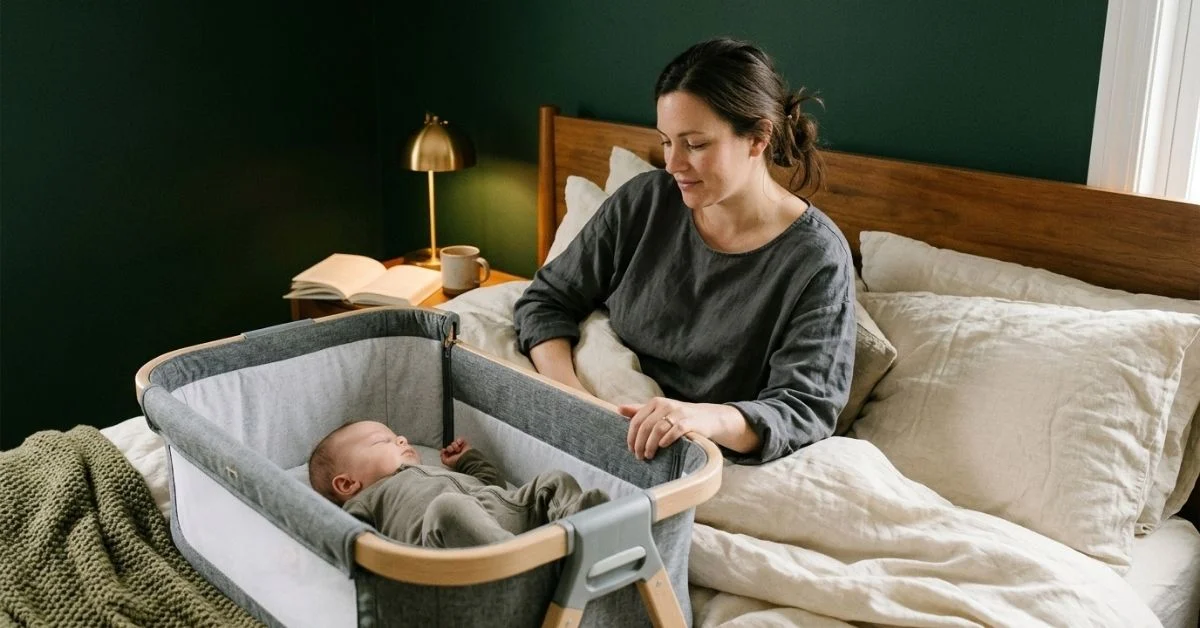
- Room Sharing: Baby sleeps in the same bedroom as the parents but on an independent, firm surface, such as a bassinet, bedside sleeper, or crib, within arm’s reach. According to NICHD guidance on reducing baby’s risk, this arrangement can lower the risk of Sudden Infant Death Syndrome by roughly half compared with a baby sleeping alone in another room.
- Bed Sharing: Baby sleeps directly on the adult mattress alongside one or both parents. Federal data reviewed by the CDC show that sleep related causes remain a leading category of infant death in the first year of life, which is why any bed sharing setup should follow strict safeguards rather than happen by accident.
Medical authorities consistently point to room sharing as the safer route, and harm reduction protocols exist precisely because families bed share anyway. The rest of this guide focuses on making that choice as safe as it can possibly be.
The Safe Sleep Seven Checklist
Developed by lactation and infant sleep specialists at La Leche League International, the Safe Sleep Seven outlines the baseline criteria that should be in place before a family considers bed sharing at all.
| Factor | Safety Requirement | Why It Matters |
|---|---|---|
| 1. Non Smoker | Neither parent smokes or vapes, indoors or outdoors. | Nicotine alters an infant’s arousal reflexes and sharply increases SIDS risk. |
| 2. Sober and Alert | Zero alcohol, recreational drugs, or sedating medication. | Intoxicants impair a parent’s awareness and physical responsiveness during sleep. |
| 3. Breastfeeding | Exclusively or primarily breastfeeding mother. | Nursing mothers instinctively adopt protective postures around their baby. |
| 4. Healthy and Full Term | Born at term, at least thirty seven weeks, at a normal birth weight. | Premature infants have underdeveloped airways and greater vulnerability. |
| 5. On Their Back | Baby is placed flat on their back to sleep. | Back sleeping keeps the airway open and unobstructed. |
| 6. Lightly Dressed | No swaddles, weighted sacks, or heavy clothing. | Prevents overheating and keeps baby’s arms free to move. |
| 7. Safe Surface | A firm, flat mattress with no loose blankets or plush pillows. | Eliminates entrapment, rolling, and suffocation hazards. |
Safe Co Sleeping Positions: The Cuddle Curl
When bed sharing, body mechanics matter just as much as mattress preparation. The most studied and protective posture is the Cuddle Curl, sometimes called the C Position. Many mothers already lean toward one side by the third trimester, a habit covered in our piece on sleeping positions for pregnancy, and the same side lying instinct carries over once baby arrives. If a wedge or body pillow made those months more comfortable, our guide on how to sleep with a pregnancy pillow walks through positioning one for support at night.
- Side Lying Position: The mother lies on her side, facing the baby.
- Arm Barrier: The lower arm extends straight above the baby’s head. This keeps the mother from rolling forward and stops pillows from drifting into the baby’s breathing zone.
- Leg Protection: The knees draw up toward the chest, with the lower thigh sitting directly under the baby’s feet, which stops the infant from sliding down under any adult sheets.
- Nipple Level Alignment: Baby sleeps flat on their back, level with the mother’s breast, rather than up near the adult pillows.
For a broader look at which adult postures support healthy alignment versus which ones strain the neck and spine, see our comparison of the best and worst sleeping positions. Never place a baby between two sleeping adults. If a partner shares the bed, baby stays on the outside next to the breastfeeding mother, provided the mattress edge is secured against falls.
How to Prepare a Safe Co Sleeping Bed
Adult beds are built for comfort, not for clearing an infant’s airway, so a few deliberate changes make a real difference.
Choose a Firm, Breathable Surface
Soft memory foam, pillow top mattresses, waterbeds, and air mattresses let an infant’s head sink in, creating pockets of trapped carbon dioxide. Pair a firm, level mattress with breathable, minimally processed bedding. An Oeko Tex certified bamboo sheet set is independently tested for harmful substances and sleeps cooler than most synthetic blends, while a purely organic sheet set keeps chemical finishes away from a baby’s sensitive skin, a topic our guide to organic cotton versus conventional cotton explores in more depth.
Strip the Excess Bedding
Remove heavy duvets, decorative shams, and top sheets. Use a single small, flat pillow for the parent and a light blanket pulled no higher than the adult’s waist. A deep pocket sheet set keeps the fitted sheet wrapped snugly around a thicker mattress so corners cannot bunch up or pull loose overnight, and an organic cotton bed sheet set is a good natural fiber option for parents who prefer a traditional, breathable feel. Families sleeping on a flexible base can also look at adjustable bed sheets designed to stay taut across a moving frame instead of sliding and exposing the mattress edge.
Eliminate Gaps and Wedges
Check for spaces between the mattress, headboard, wall, or nightstand. An infant can roll into a surprisingly narrow gap and become trapped, so pull the bed away from the wall or place the mattress in the center of the room if needed. The U.S. Consumer Product Safety Commission specifically warns against gaps, soft bedding, and loungers as leading entrapment hazards.
No Sofas, Recliners, or Armchairs
Accidentally falling asleep with a baby on a couch or recliner is one of the leading causes of sleep related infant deaths, largely because cushions and armrests trap a baby’s face against a soft surface. The CPSC’s 2022 infant sleep products safety standard exists partly because so many of these products were marketed for exactly this kind of unplanned, unsupervised sleep.
Choosing the Right Sheet for a Co Sleeping Bed
A quick reference for matching sheet material to your mattress and sleep style:
| Sheet Type | Best For | Explore |
|---|---|---|
| Oeko Tex certified bamboo sheets | Hot sleepers who want a cooler, tested for chemical residue fabric | Shop now |
| Purely organic sheet set | Parents who want the fewest possible chemical finishes near baby | Shop now |
| Organic cotton bed sheet set | A soft, classic natural fiber feel | Shop now |
| Deep pocket sheet sets | Thick or pillow top mattresses that need a secure fitted sheet | Shop now |
| Adjustable bed sheets | Adjustable bases that flex and shift overnight | Shop now |
Recommendation Note
If you plan to bed share even occasionally, start with the sheet, not the nursery decor. A fitted sheet that lifts at the corners, traps heat, or carries synthetic finishes undoes every other precaution on this page. Choose a firm mattress, add a snug, breathable, low chemical sheet sized correctly for the mattress depth, and only then think about pillows, room temperature, and sleep schedules. This single swap is the fastest, lowest effort upgrade most co sleeping setups need.
When Is It Safe to Co Sleep?
Understanding developmental milestones helps you judge risk level at each stage.
| Age Range | What To Know |
|---|---|
| 0 to 4 Months | The period of highest vulnerability. Medical organizations strongly advise room sharing with a bedside bassinet rather than bed sharing at this stage. |
| 4 to 12 Months | Neck strength, motor skills, and arousal reflexes develop significantly. SIDS risk drops, but suffocation from soft bedding remains a factor, so strict surface safety still applies. |
| 12 Months and Older | Toddlers have strong motor reflexes, turn freely, and are far less susceptible to positional suffocation. Standard adult bedding becomes safer, though basic edge protection is still wise. |
As your child moves past the co sleeping stage entirely, the challenges usually shift from safety to logistics. Our guides on getting a toddler to stop fighting bedtime and how many hours of sleep preschoolers actually need each night cover that next transition in detail.
Supporting Your Own Sleep Through It All
Safe co sleeping is largely about protecting the baby, but exhausted parents make riskier decisions in the middle of the night. Building a wind down routine of your own, such as the 10, 3, 2, 1, 0 sleep rule, can help you fall asleep faster during the short windows you actually get. For a fuller framework on rebuilding healthy sleep habits once the newborn stage eases up, see our complete sleep guide.
What Is the Safest Alternative if Our Mattress Is Too Soft?
If your mattress is memory foam or plush pillow top, attach a firm bedside bassinet, sometimes called a sidecar crib, directly to the bed frame. This keeps baby at arm’s reach for soothing while giving them a flat, medical grade sleep surface of their own.
Sources and Further Reading
Every reference below links to an official government or nonprofit health authority for verification.
- National Institute of Child Health and Human Development, Safe to Sleep campaign homepage
- NICHD, About Safe Sleep for Babies
- NICHD, Reduce Baby’s Risk of SIDS
- Centers for Disease Control and Prevention, About SUID and SIDS
- Centers for Disease Control and Prevention, Data and Statistics for SUID and SIDS
- U.S. Consumer Product Safety Commission, Safe Sleep, Cribs and Infant Products
- U.S. Consumer Product Safety Commission, New Federal Infant Sleep Products Safety Standard
Frequently Asked Questions (FAQs):
Can bottle feeding parents safely bed share?
Research shows non breastfeeding parents do not consistently hold the natural Cuddle Curl posture through the night. A dedicated bedside bassinet attached securely to the bed frame offers close proximity for formula or bottle fed babies without the direct risks of sharing an adult mattress.
Can I swaddle my baby while co sleeping?
No. Swaddling stops a baby from using their hands to push away hazards or adjust their own airway, and it raises overheating risk in a shared bed. Use a fitted, lightweight sleep sack with the arms free instead.
What should I do if my partner sleeps in the same bed?
Your partner must follow the same Safe Sleep Seven criteria, including no alcohol, sedatives, or smoking. Keep baby positioned between the mother and the protected outer edge of the bed, never between two adults.
Are in bed sleep loungers or nests safe for co sleeping?
No. Padded loungers, infant nests, and in bed docks have soft, raised sides that pose serious suffocation and rebreathing risks if a baby turns their head. The mattress surface should stay completely flat and bare.
Can pets or older siblings sleep in the bed with the baby?
No. Pets and young children move unpredictably during sleep and are not able to recognize an infant’s presence. This creates real suffocation and injury risk, so keep them in a separate sleep space.
What room temperature is ideal for safe co sleeping?
Aim for roughly 68°F to 72°F, or about 20°C to 22°C. Shared body warmth raises an infant’s temperature quickly, so dress baby in a single layer of breathable cotton and check their chest for sweating or clamminess.
Disclaimer: This article is for general informational purposes only and does not constitute medical or legal advice. Always consult a qualified professional before making any medical or legal decisions.

MBBS · PMDC registered
Registered Medical Practitioner (PMDC), Senior Medical Editor and Medical Reviewer for OdeSleep. Medical Officer in Paediatrics & NICU at Children's Hospital Lahore, combining frontline clinical experience with medical fact-checking.
View full profile →


