
What Is the Safe Sleep 7? Bed Sharing Guidelines Explained

· Medically reviewed
Last updated November, 2026. This article is for education and does not replace advice from your pediatrician.
Safety note: The American Academy of Pediatrics (AAP) does not recommend bed sharing. The safest option is room sharing, with your baby on a separate firm, flat surface in your room. This article explains harm reduction for families who bed share anyway or may fall asleep by accident.
Executive Summary: Key Takeaways
- The Safe Sleep 7 is a seven point checklist from La Leche League International (LLLI) for breastfeeding families who choose to bed share. All seven conditions must be present together.
- The AAP recommends room sharing without bed sharing, with the baby on a separate firm, noninclined surface, for at least the first 6 months (AAP, 2022).
- About 3,500 US infants die each year from sleep related causes, including SIDS and accidental suffocation (AAP, 2022).
- The Academy of Breastfeeding Medicine (ABM) takes a harm reduction view: it says bed sharing may only be a risk in hazardous circumstances, and applies its advice to breastfeeding families (ABM Protocol #6).
- Never bed share on a sofa, couch, or armchair, and avoid products that claim to make bed sharing safer (NICHD).
What Is the Safe Sleep 7?
The Safe Sleep 7 is a harm reduction checklist from La Leche League International for breastfeeding families who choose to sleep with their baby in an adult bed. It lists seven conditions that should all be true at once, because risk rises when hazards such as smoking, impairment, or soft bedding are present.
The checklist appears in LLLI’s book Sweet Sleep. It reflects a view shared by the Academy of Breastfeeding Medicine that most breastfeeding parents will sleep with their baby at some point, so preparing is safer than falling asleep by accident.
Does the American Academy of Pediatrics Recommend Bed Sharing?
No. The AAP recommends room sharing without bed sharing, with the baby close to the parents’ bed on a separate surface, for at least the first 6 months (AAP, 2022). The 2022 update shortened the earlier one year recommendation, and the AAP states it cannot recommend bed sharing.
The AAP lists situations that make bed sharing especially hazardous, including a soft surface such as a waterbed, old mattress, sofa, couch, or armchair, soft bedding, a current smoker, and an impaired parent. Both the AAP and the ABM agree on these hazards even though they differ on how to advise families who bed share anyway.
What Are the Seven Safe Sleep 7 Criteria?
All seven must be true at the same time: no smoker in the home, a sober breastfeeding parent, a breastfed baby, a healthy full term baby, a baby on their back, light clothing without swaddling, and a safe sleep surface. Having six out of seven is not considered safe under the framework.
| # | Criterion | What it means | Why it matters |
|---|---|---|---|
| 1 | No smokers | Nobody in the household smokes | Smoke exposure is a recognized hazard when bed sharing (AAP) |
| 2 | Sober parent | No alcohol, drugs, or drowsy medications, including over the counter and prescription | Impairment dulls the ability to rouse (AAP) |
| 3 | Breastfed baby | The framework is built for breastfeeding families | ABM Protocol #6 applies to breastfeeding pairs |
| 4 | Healthy, full term baby | Born at 37 weeks or later and not ill | Premature or sick infants may not rouse as easily |
| 5 | Baby on the back | Back to sleep for every sleep | Supine positioning is core AAP advice |
| 6 | Light clothing, no swaddle | Baby can move freely and is not overheated | AAP advises avoiding overheating and soft or weighted items |
| 7 | Safe sleep surface | Firm mattress, no pillows or comforters near baby, no gaps | Soft surfaces and loose bedding raise suffocation risk |
What Is the Cuddle Curl Position?
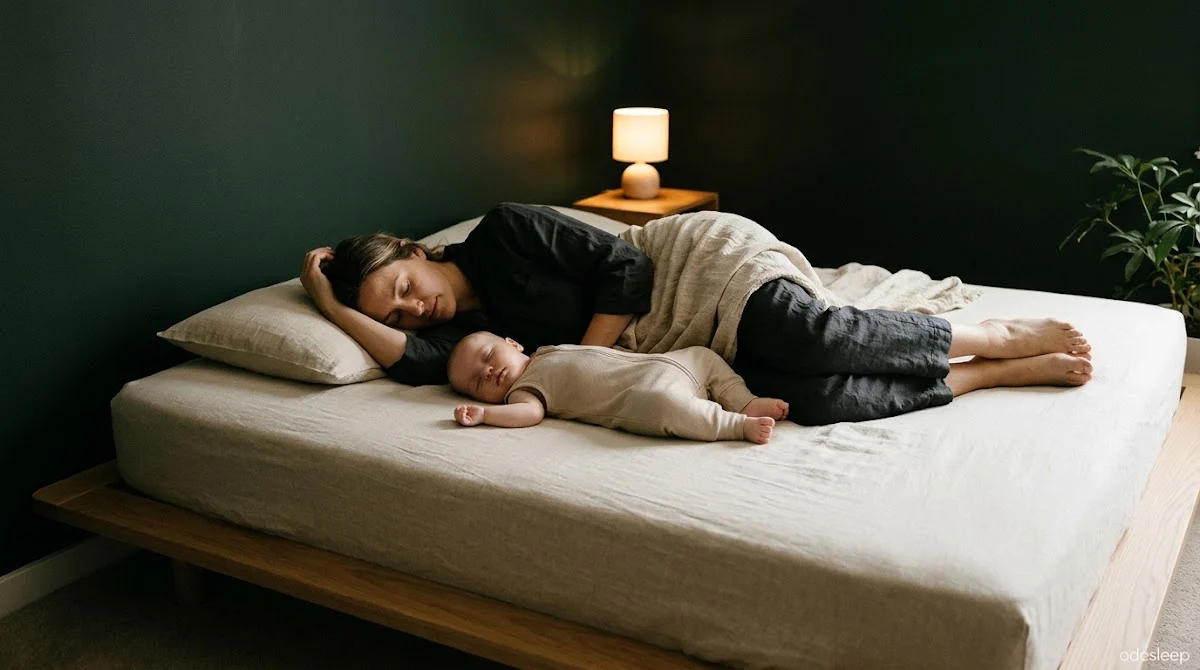
The cuddle curl is the protective side lying posture many breastfeeding parents adopt naturally when bed sharing. The parent lies on their side facing the baby, knees drawn up toward the baby’s feet, with the lower arm above the baby’s head and the baby at breast level.
This posture helps keep pillows away from the baby and prevents the baby from sliding down the bed. The ABM protocol describes it as a way to make a safe space for the baby (ABM Protocol #6). The baby still lies on their back, not their side.
When Should You Never Bed Share?
Never sleep with a baby on a sofa, couch, or armchair, and never bed share when any Safe Sleep 7 hazard is present. These situations carry the highest risk (AAP, 2022).
- On a sofa, couch, recliner, or armchair, where babies can slip into gaps or become trapped.
- With a smoker in the home.
- After alcohol, drugs, or sedating medications. Read why alcohol makes you sleepy and how to sleep while sick, since cold and allergy medicines can cause drowsiness.
- On a soft surface such as a waterbed, a sagging mattress, or one with a plush topper.
- With soft bedding near the baby, such as pillows, duvets, or stuffed toys.
- With other children or pets in the bed, which LLLI lists as hazards.
- If the baby was premature, ill, or is not breastfed, since the framework does not apply.
What Is the Safest Alternative to Bed Sharing?
The safest alternative is a crib or bassinet in your room, within arm’s reach, with a firm flat mattress covered only by a fitted sheet. Federal guidance says room sharing may lower SIDS risk by as much as 50 percent and is safer than bed sharing (CDC).
- Choose a crib or bassinet that meets standards from the Consumer Product Safety Commission.
- Keep the sleep area bare: a fitted sheet only, with no bumpers, pillows, or toys (NICHD).
- Return baby to their own space after night feeds, once you are awake enough to do so safely.
How Should You Prepare Your Own Bed If Bed Sharing Might Happen?
Prepare a firm, uncluttered adult bed with no soft items near the baby and no gaps where a baby could be trapped. The ABM protocol also lists gaps and soft surfaces among the hazards to remove (ABM Protocol #6).
- Use a firm mattress and keep the baby off any soft topper.
- Keep the baby on the parent’s side, not between two adults.
- Remove pillows, heavy comforters, and decorative items from the baby’s area, and keep your own covers at waist level.
- Close gaps between the mattress, headboard, and wall.
- Use a fitted sheet that stays tight, for example from our organic sheet sets.
Note: OdeSleep bedding is made for adult beds and is not an infant sleep surface. No bedding product makes bed sharing safe, and the NICHD advises against products that claim to (NICHD).
Recommendations: What to Do Next
- Make a plan before birth. Decide where baby will sleep and set up a bedside bassinet or crib.
- Treat room sharing as the default for at least the first 6 months.
- If you might bed share, check all seven criteria before every sleep and prepare the bed in advance.
- Never feed on a sofa or armchair if you might fall asleep.
- Protect your own rest. Sleep loss makes accidents more likely. See how to increase deep sleep, whether 4 hours of sleep is enough, and how to sleep train naps as your child grows.
- Ask your pediatrician about your family’s situation, and revisit the plan as bedtime struggles change; our guide to toddler bedtime fights can help later.
References and Sources
- Sleep Related Infant Deaths: Updated 2022 Recommendations for Reducing Infant Deaths in the Sleep Environment (American Academy of Pediatrics, Pediatrics 2022;150(1):e2022057990, via PubMed, NIH)
- Bedsharing and Breastfeeding: The Academy of Breastfeeding Medicine Protocol #6, Revision 2019 (Breastfeeding Medicine, via PubMed, NIH)
- Safe Sleep for Your Baby (infographic) (Safe to Sleep campaign, Eunice Kennedy Shriver NICHD, NIH)
- Safe Sleep: Reduce the Risk of Sudden Infant Death Syndrome and Other Sleep Related Causes of Infant Death (brochure) (Eunice Kennedy Shriver NICHD, NIH)
- Safe Sleep information and infant sleep product safety (U.S. Consumer Product Safety Commission)
- Sudden Unexpected Infant Death and Sudden Infant Death Syndrome (Centers for Disease Control and Prevention)
Frequently Asked Questions (FAQs):
Why does the AAP advise against bed sharing?
Because bed sharing carries a higher risk of SIDS, entrapment, and accidental suffocation than room sharing on a separate surface (AAP, 2022). The AAP recommends a separate firm, flat, noninclined sleep surface in the parents’ room.
Does bed sharing help breastfeeding?
Research reviewed by the ABM links bed sharing with breastfeeding initiation, duration, and exclusivity (ABM Protocol #6). That benefit must be weighed against the safety concerns the AAP raises, and a bedside bassinet still allows easy night feeds.
Can a partner be in the bed?
The Safe Sleep 7 allows a sober, nonsmoking partner only if the baby sleeps beside the breastfeeding parent and never between two adults. The AAP does not recommend bed sharing at all, and it lists sharing with anyone who is not the infant’s parent as especially hazardous.
What if I formula feed?
The Safe Sleep 7 is built around breastfeeding families and does not apply to formula fed babies. Use a separate sleep surface in your room instead.
When does bed sharing become safer as a baby grows?
Risk is highest in the early months, but the AAP does not identify an age at which it recommends bed sharing. Follow safe sleep practices for the whole first year and ask your pediatrician about your baby’s needs.
Disclaimer: This article is for general informational purposes only and does not constitute medical or legal advice. Always consult a qualified professional before making any medical or legal decisions.

MBBS · PMDC registered
Registered Medical Practitioner (PMDC), Senior Medical Editor and Medical Reviewer for OdeSleep. Medical Officer in Paediatrics & NICU at Children's Hospital Lahore, combining frontline clinical experience with medical fact-checking.
View full profile →


