How to Sleep in Hot Weather Without AC: A Research-Backed Guide to Cooler, Deeper Nights

· Medically reviewed
When a summer heatwave hits and air conditioning is not an option, whether because of high energy costs, a power outage, or a personal preference for natural cooling, falling asleep can feel almost impossible. You flip the pillow to find a cooler spot, kick off the blanket, and still wake up groggy and unrested.
Learning how to sleep in hot weather without AC is not just about comfort. Sleep is when the body repairs tissue, consolidates memory, and regulates hormones, and that process depends on the body being able to cool itself down. The good news is that a combination of smart room adjustments, simple body-cooling techniques, and the right bedding can turn a sweltering bedroom into a place where you can actually rest, even without mechanical cooling.
The Science of Sleep: Is It Better to Sleep in a Hot or Cold Room?
To understand why hot nights cause tossing and turning, it helps to look at the body’s internal clock. According to the National Institutes of Health, the sleep-wake cycle is governed by circadian rhythms that work together with a process called homeostasis to keep functions like core body temperature steady through the night.
As bedtime approaches, core body temperature naturally drops by about 1 to 2 degrees Fahrenheit, which is one of the internal signals that tells the brain it is time to rest. The National Institute of Neurological Disorders and Stroke explains that circadian rhythms direct daily changes in body temperature, hormone release, and wakefulness, which is why a bedroom that stays too warm can work directly against the body’s natural wind-down process. When the room will not cool down, the body has to fight against ambient heat, which can suppress melatonin release and interrupt the deep, slow-wave stages of sleep.
So, is it better to sleep in a hot or cold room? The research consistently points to cooler conditions. Most sleep physiologists put the ideal nighttime bedroom temperature between 60 and 67 degrees Fahrenheit (about 15.5 to 19.4 degrees Celsius). Once indoor temperatures climb well above 70 degrees Fahrenheit (21 degrees Celsius), the body has a much harder time completing the thermal drop that deep sleep depends on.
Can You Get Sick From Sleeping in a Hot Room?
Heat itself does not carry viruses or bacteria, but prolonged exposure to a hot bedroom puts real, measurable strain on the body. Here is what tends to happen over a string of hot nights:
- Dehydration and electrolyte imbalance: Sweating through the night drains fluids and minerals, which can lead to morning headaches, dry skin, and muscle cramps. MedlinePlus, a service of the National Library of Medicine lists thirst, dark urine, dry skin, and fatigue as common signs of dehydration in adults.
- Elevated nighttime heart rate: The cardiovascular system works harder to move blood toward the skin’s surface so heat can radiate away, which keeps resting heart rate higher than normal.
- Fragmented, lower-quality sleep: Repeated overheating disrupts the deep sleep stages tied to immune support and next-day alertness.
- Heat exhaustion or heat stroke: In poorly ventilated rooms during extreme heat, especially for older adults, infants, and people with chronic conditions, unrelieved heat can progress to heat exhaustion or, in severe cases, heat stroke. The Centers for Disease Control and Prevention recommends learning the warning signs of heat-related illness and checking on older relatives or neighbors during a heat wave.
If you or someone you live with shows signs of confusion, a very high body temperature, or fainting during hot weather, that is a medical emergency. The government preparedness site Ready.gov advises calling 911 immediately for suspected heat stroke and moving the person to a cooler, shaded space while help is on the way.
Environment First: How to Cool Down a Room Without Air Conditioning
Before changing your bedtime routine, it is worth optimizing the room itself. Knowing how to cool down a room without air conditioning largely comes down to controlling airflow, light, and heat sources.
1. Use cross-ventilation strategically
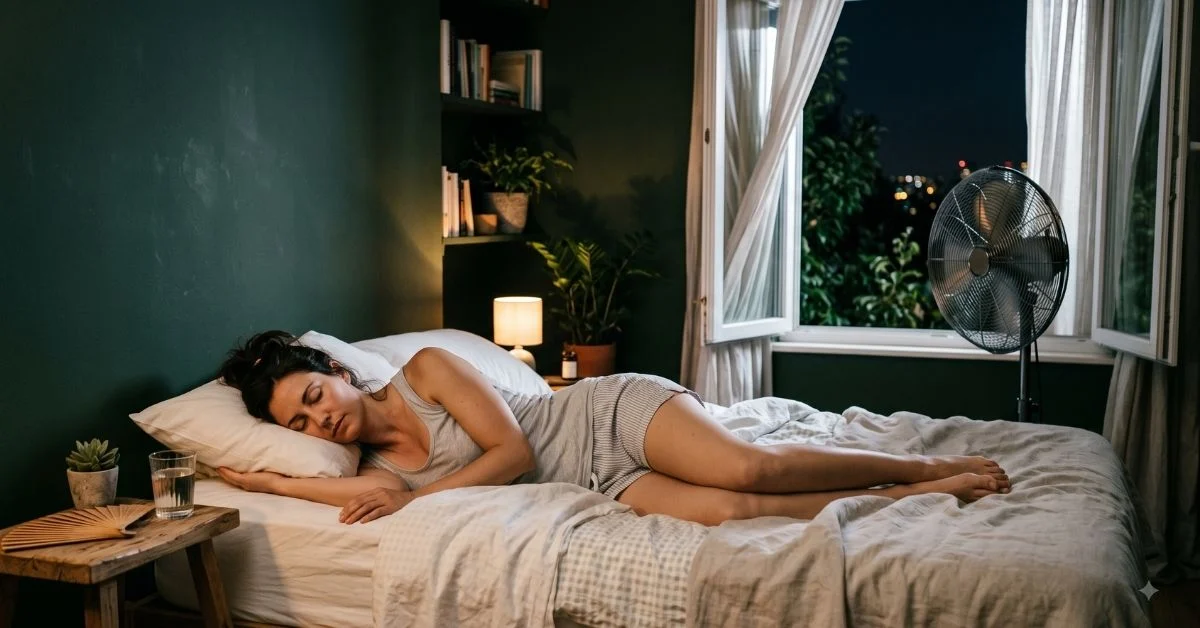
During the hottest part of the day, keep windows and blinds closed to block radiant heat. Once outdoor temperatures drop after sunset, create a cross-breeze by opening windows on opposite sides of the room and, if you have one, placing a fan in a window facing outward to pull warm air out while cooler night air is drawn in through the opposite side. The U.S. Department of Energy recommends this kind of night-time ventilation as one of the most effective no-cost ways to cool a home before the heat builds back up the next morning, and the National Weather Service likewise encourages people to plan around the coolest hours of the day when a heat advisory is in effect.
2. Try the ice-bowl fan hack
Place a wide, shallow bowl of ice cubes directly in front of an oscillating fan. As air passes over the melting ice, it creates a light, chilled mist effect that can make the space right around your bed noticeably more comfortable.
3. Unplug heat-generating electronics
Laptops, gaming consoles, chargers, and incandescent bulbs all give off ambient heat even when idle. Switching them off, or unplugging them, before bed can shave a few extra degrees off a small bedroom.
Cooling Techniques at a Glance
| Technique | How It Works | Best For |
|---|---|---|
| Cross-ventilation | Opposite-facing windows and a fan pull cool night air through the room and push warm air out | Homes with cooler nights |
| Ice-bowl fan | A fan blowing across melting ice creates a light, chilled mist toward the bed | Quick, short-term relief |
| Cool water pulse points | Dampening wrists, neck, and ankles cools blood near major arteries | Falling asleep faster |
| Moisture-wicking bedding | Breathable natural fibers pull sweat away from skin instead of trapping it | Sleeping through the night |
| Lukewarm shower before bed | Evaporating water draws heat from the skin without triggering a cold-shock response | Winding down before sleep |
| Sleeping lower in the home | Heat rises, so a lower floor or a mattress moved closer to the floor stays cooler | Multi-story homes |
Body-Cooling Techniques You Can Use Tonight
When the room itself will not cool down any further, the next lever is your own microclimate, the thin layer of air between your skin and your bedding. A few physiological tricks can help:
- Cool water on pulse points: Dampening your wrists, neck, and ankles with cold water helps lower the temperature of blood near major arteries, which cools the whole body faster than you might expect.
- Lukewarm, not ice-cold, showers: A shower that is warm-to-cool rather than freezing encourages blood vessels near the skin to open up, so heat escapes more efficiently. An icy-cold shower can backfire, since the body senses a sudden temperature drop and constricts blood vessels to conserve heat.
- Ice pack near the feet: A wrapped, cold gel pack placed near the feet cools nerve endings that are closely tied to core temperature regulation.
- Light, breathable sleepwear: Loose, natural-fiber sleepwear allows heat to escape instead of trapping it against the skin overnight.
Choosing the Right Sleep Surface: Why Fabric Matters
Your sheets are in direct contact with your skin for seven to nine hours a night, so the fabric they are made from has an outsized effect on how hot or cool you feel. Synthetic materials such as polyester and low-density memory foam tend to trap heat and moisture rather than releasing them, which is part of why some people get so hot when they sleep even in a reasonably cool room. If you are trying to understand why your own sheets feel warm, it is worth reading about the difference between polyester and cotton sheets and whether polyester is worth avoiding for sleep in the first place.
Organic bamboo viscose is one of the most breathable options available, thanks to microscopic gaps in the fiber that let body heat dissipate instead of staying trapped under the covers. It also tends to absorb and release moisture faster than standard cotton, which keeps skin drier through the night. If you are comparing options, these guides break down the details further: the benefits of bamboo bed sheets, how bamboo compares with Egyptian cotton, and the best cooling sheets for hot sleepers. Thread count matters too, and higher is not always cooler, so it helps to understand what thread count actually means for comfort before choosing a set.
Hot, sweaty nights also mean sheets pick up body oils and moisture faster, so wash them more often than you would in cooler months. If you tend to stretch the laundry schedule, it is worth knowing what actually happens if you do not wash your bed sheets, and how to care for bamboo sheets properly so they keep their cooling properties wash after wash.
Recommendation: If your current sheets feel warm no matter what you try with the room, upgrading your sleep surface is usually the fastest fix. Look for organic, breathable weaves rather than synthetic blends. A few options worth comparing are deep pocket sheet sets for thicker mattresses, Oeko-Tex certified bamboo sheets for verified low-chemical bedding, the purely organic sheet set for an all-natural fiber choice, and the organic cotton bed sheet set if you prefer a traditional cotton feel with a lower environmental footprint.
Building a Cool-Sleep Routine
None of these tips work in isolation as well as they do together. Pairing a cooler room with breathable bedding and a short wind-down routine gives your body the best chance at completing its natural temperature drop. For more ways to fall asleep faster in general, not just in summer, this roundup of simple, effective sleep hacks is a useful next read.
Final Thoughts
Beating the heat without air conditioning does not have to mean sleepless, sweaty nights. Optimizing airflow after sunset, using a few body-cooling tricks before bed, and switching to breathable, moisture-wicking bedding all work together to help your body complete the natural temperature drop that good sleep depends on. Small, consistent changes to your room and your routine can make a real difference the next time the thermometer climbs.
Sources
- Centers for Disease Control and Prevention — Preventing Heat-Related Illness
- Ready.gov (U.S. Department of Homeland Security / FEMA) — Extreme Heat
- National Weather Service — Heat Safety
- U.S. Department of Energy — Keeping Cool Without Air Conditioning
- National Heart, Lung, and Blood Institute (NIH) — How Sleep Works: Your Sleep/Wake Cycle
- National Institute of Neurological Disorders and Stroke (NIH) — Brain Basics: Understanding Sleep
- MedlinePlus (National Library of Medicine, NIH) — Dehydration
Frequently Asked Questions (FAQs):
What is the fastest way to cool down right before bed?
A lukewarm, not ice-cold, shower taken 30 to 45 minutes before lying down works well. As water evaporates from the skin, it carries heat away with it. Following up with a cool, damp cloth on the feet or neck adds an extra boost.
Why does a cold shower sometimes make you feel hotter afterward?
An icy-cold shower can trigger a survival response in which the body constricts blood vessels near the skin and generates internal heat to stay warm. A lukewarm or warm-to-cool shower avoids that response and lets heat escape more easily.
Are bamboo sheets better than cotton for summer sleeping?
Bamboo viscose generally outperforms standard cotton on moisture-wicking and breathability, which is why it is a common recommendation for hot sleepers. For a side-by-side look, see this comparison of linen, cotton, and bamboo sheets.
Does sleeping on the floor help in hot weather?
It can. Heat naturally rises, so moving a mattress to a lower level of the home, or even onto the floor, can reduce the temperature around your body by several degrees.
Disclaimer: This article is for general informational purposes only and does not constitute medical or legal advice. Always consult a qualified professional before making any medical or legal decisions.

MBBS · PMDC registered
Registered Medical Practitioner (PMDC), Senior Medical Editor and Medical Reviewer for OdeSleep. Medical Officer in Paediatrics & NICU at Children's Hospital Lahore, combining frontline clinical experience with medical fact-checking.
View full profile →