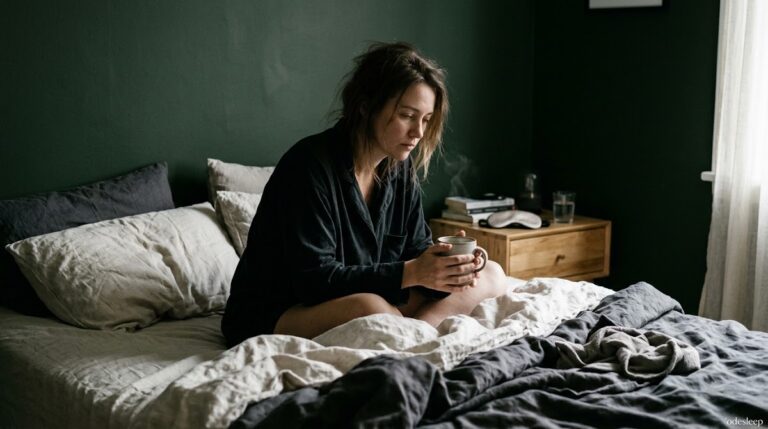
Does Alcohol Help You Sleep?


· Medically reviewed
Last updated: October 27, 2026. This guide is educational and does not replace advice from your doctor or pharmacist.
Key Takeaways
- Faster, not better. In healthy people who are not dependent on alcohol, acute alcohol shortens the time to fall asleep and increases deep NREM sleep early in the night, but sleep is severely disrupted in the second half (Alcohol journal, PubMed Central).
- Even small amounts count. In 4,098 workers, low alcohol intake lowered a heart rate variability recovery measure by 9.3 percentage units, moderate by 24.0 and high by 39.2 (JMIR Mental Health, 2018).
- Breathing risk. In a meta analysis, alcohol raised the Apnea Hypopnea Index (AHI) by 7.10 events per hour in people with obstructive sleep apnea (PubMed Central).
- Drug mixing is risky. The National Institute on Alcohol Abuse and Alcoholism (NIAAA) warns that alcohol can intensify drowsiness and breathing problems with many medicines (NIAAA).
- Best move: avoid alcohol close to bedtime and do not use it as a sleep aid.
Does Alcohol Actually Help You Sleep?
Alcohol helps you fall asleep faster but lowers the quality of the rest of your night. A review published in the journal Alcohol found that acute alcohol decreases sleep latency and consolidates and increases NREM sleep during the first half of the night, but that this sleep promotion is short lived and sleep is severely disrupted during the second half (PubMed Central).
That pattern explains why a drink can feel helpful at 11 p.m. and harmful at 3 a.m. The table contrasts what happens in each half of the night in adults.
| Night phase | What alcohol tends to do | What you may notice |
|---|---|---|
| Falling asleep | Shortens sleep latency (PubMed Central) | You drift off faster |
| First half of the night | Increases slow wave sleep and decreases REM sleep in adults (PubMed Central) | Heavy, dreamless early sleep |
| Second half of the night | Lowers sleep efficiency, increases time awake, and shifts stages the opposite way (PubMed Central) | Waking, restlessness, vivid dreams |
| Heart during sleep | Reduces a physiological recovery measure in a dose related way (JMIR Mental Health) | Waking up unrefreshed |
| Breathing | Raises AHI, especially in people with sleep apnea (PubMed Central) | More snoring and pauses |
How Does Alcohol Change Your Sleep Stages Through the Night?
In adults, alcohol increases slow wave sleep and decreases REM sleep in the first half of the night, and the opposite pattern appears in the second half. A research paper on alcohol and sleep architecture summarizes it this way: alcohol decreases sleep onset latency and sleep efficiency, increases wake after sleep onset, and raises slow wave sleep while cutting REM in the first half (PubMed Central).
Researchers often describe the second half as a REM rebound, but the evidence is not uniform. In the same paper’s late adolescent sample, alcohol did not reduce sleep onset latency and did not produce a REM rebound, which suggests that effects depend on age and development. The reliable finding across studies is that sleep becomes more fragmented once alcohol wears off.
Note: More deep sleep sounds like a benefit, but it is not the same as restorative sleep. The extra deep sleep comes with disruption later, and the REM that supports memory and mood is reduced early in the night.
How Does Alcohol Affect Your Heart During Sleep?
Alcohol keeps your body in a more stressed, less recovered state while you sleep. A study of 4,098 Finnish employees tracked beat to beat heart intervals and self reported drinking, and found that alcohol intake was dose dependently linked to increased sympathetic activity, decreased parasympathetic activity and insufficient recovery. Heart rate variability based recovery fell by an average of 9.3, 24.0 and 39.2 percentage units with low, moderate and high intake (JMIR Mental Health, 2018).
Notably, the effect appeared even with low intake and was not prevented by being young or physically active. The study was observational and used wearable data, so it shows an association rather than proof, but it fits the laboratory picture of disturbed sleep. To protect deep recovery, see our guide on how to increase deep sleep.
Can Alcohol Make Snoring and Sleep Apnea Worse?
Yes. A meta analysis of 14 studies and 422 participants found that alcohol raised AHI by 2.33 events per hour overall, by 4.20 in snorers and by 7.10 in people diagnosed with obstructive sleep apnea, while average oxygen levels fell (PubMed Central). MedlinePlus also lists alcohol, sleeping pills and antihistamines at bedtime among the factors that relax throat muscles and contribute to snoring (MedlinePlus).
Note: If you snore loudly, gasp, or wake with headaches, avoid drinking close to bed and ask about a sleep study. Our comparison of sleep apnea vs snoring explains the warning signs.
Why Do You Wake Up at 3 A.M. After Drinking?
Waking in the early hours is consistent with the second half disruption seen in sleep studies. After the sedating effect fades, sleep efficiency drops and time awake rises (PubMed Central). Many drinkers also report needing the bathroom or feeling hot and sweaty, which can fragment sleep further.
You cannot control every factor, but you can control your bed environment. If you wake hot, read why you get so hot when you sleep, and consider breathable bedding such as cooling sheets for hot sleepers or Oeko Tex certified bamboo sheets from OdeSleep.
Is It Safe to Mix Alcohol With Sleep Aids?
No, mixing alcohol with sleep aids and many other medicines can be dangerous. NIAAA explains that alcohol, like some medicines, can make you sleepy, drowsy or lightheaded, and that combining them intensifies these effects. Its medication table lists drowsiness, dizziness and increased risk of overdose for common antihistamines such as diphenhydramine, and slowed or difficult breathing for some anxiety and sleep related drugs (NIAAA, Harmful Interactions).
NIAAA also notes that alcohol and medicines can interact harmfully even when they are not taken at the same time, and that older adults face higher risk. Ask your pharmacist before combining any sleep product, including supplements, with alcohol. If you are comparing supplements, our guide to melatonin vs magnesium for sleep is a place to start, but it does not replace pharmacist advice.
Does the Type of Drink Matter for Sleep?
The amount of alcohol matters more than the type of drink. A standard drink is roughly a 12 ounce beer, a 5 ounce glass of wine or a 1.5 ounce shot of spirits, and each contains about the same amount of alcohol (Massachusetts state guide). The sleep effects in the studies above are dose related, so a large glass of wine can disturb sleep as much as several beers.
How Can You Protect Your Sleep If You Drink? (Recommendations)
The safest choice for sleep is not to drink close to bedtime. If you do drink, these steps reduce the damage.
| Step | Why it helps |
|---|---|
| Stop drinking several hours before bed | CDC advises avoiding alcohol, caffeine and large meals before bedtime (CDC). The 10 3 2 1 0 sleep rule suggests a 3 hour buffer. |
| Count standard drinks | Dose drives the effect on recovery and sleep quality (JMIR Mental Health) |
| Alternate with water | Slows your pace and helps you avoid dehydration, a practical tip from public health guidance (Massachusetts guide) |
| Do not combine with sleep aids | Drowsiness and breathing risks rise (NIAAA) |
| Sleep on your side if you snore | Reduces the chance of airway collapse; see the best and worst sleeping positions |
| Keep the bedroom cool and comfortable | Helps limit heat related awakenings |
Instead of a nightcap, build a relaxing routine. Our list of things to do at night offers screen free ideas for winding down.
When Should You Talk to a Doctor About Alcohol and Sleep?
Talk to a clinician if you rely on alcohol to fall asleep, if you drink more to get the same effect, or if your sleep is poor despite cutting back. Persistent insomnia, loud snoring with gasping, and daytime sleepiness all deserve evaluation. Sleep specialists generally do not recommend alcohol as a sleep aid because its benefit is short lived and its costs build.
References
- Alcohol and sleep: effects of acute and chronic alcohol exposure on sleep and wakefulness. Alcohol, 2014. PubMed Central, NIH.
- Alcohol and sleep architecture in late adolescents and mature adults, sleep onset latency and REM rebound. PubMed Central, NIH.
- The Impact of Alcohol on Breathing Parameters during Sleep: A Systematic Review and Meta analysis. PubMed Central, NIH.
- Pietilä J, et al. Acute Effect of Alcohol Intake on Cardiovascular Autonomic Regulation During the First Hours of Sleep. JMIR Mental Health, 2018. PubMed Central, NIH.
- National Institute on Alcohol Abuse and Alcoholism (NIH). Harmful Interactions: Mixing Alcohol With Medicines.
- Massachusetts Executive Office of Elder Affairs. Safer Drinking as You Age, guide with standard drink sizes.
- CDC. Tips for Good Sleep. National Center for Chronic Disease Prevention and Health Promotion.
- MedlinePlus, National Library of Medicine (NIH). Snoring, adults.
Frequently Asked Questions (FAQs):
Is one drink before bed bad for sleep?
It can be. In the Finnish study, even low alcohol intake lowered the heart recovery measure by 9.3 percentage units on average (JMIR Mental Health). Effects grow with dose.
Is wine better for sleep than beer or liquor?
No evidence shows that wine is gentler. The sleep effects depend on the dose of alcohol, and standard servings of each drink contain similar amounts.
Can alcohol cause permanent sleep problems?
Regular use as a sleep aid can create dependence and tolerance, and sleep that depends on alcohol is fragile. If you have trouble sleeping without it, talk to your doctor. For why alcohol feels sleepy at first, see why alcohol makes you sleepy.
Does alcohol make sleep apnea worse?
Yes. A meta analysis found that alcohol raised the Apnea Hypopnea Index by 7.10 events per hour in people with obstructive sleep apnea, and average oxygen levels fell.
Is it safe to take sleep aids with alcohol?
No. NIAAA warns that combining alcohol with sleep aids and many other medicines intensifies drowsiness and can slow breathing. Ask your pharmacist before combining any sleep product with alcohol.
Disclaimer: This article is for general informational purposes only and does not constitute medical or legal advice. Always consult a qualified professional before making any medical or legal decisions.

MBBS · PMDC registered
Registered Medical Practitioner (PMDC), Senior Medical Editor and Medical Reviewer for OdeSleep. Medical Officer in Paediatrics & NICU at Children's Hospital Lahore, combining frontline clinical experience with medical fact-checking.
View full profile →