A dedicated researcher and author for OdeSleep who specializes in bridging the gap between complex medical insights and practical, non-medical wellness strategies for our global audience.
If you have ever stood in a bedding aisle wondering what the actual difference is between a duvet and a comforter — or whether a quilt is just a fancier blanket — you are not alone. These three products serve the same primary purpose: keeping you warm while you sleep. But their construction, fill materials, thermal properties, and care requirements differ significantly.
This guide breaks down each option clearly, anchored in sleep science and health guidance, so you can make a confident, well-informed choice.
Why Your Bedding Choice Matters for Sleep Health
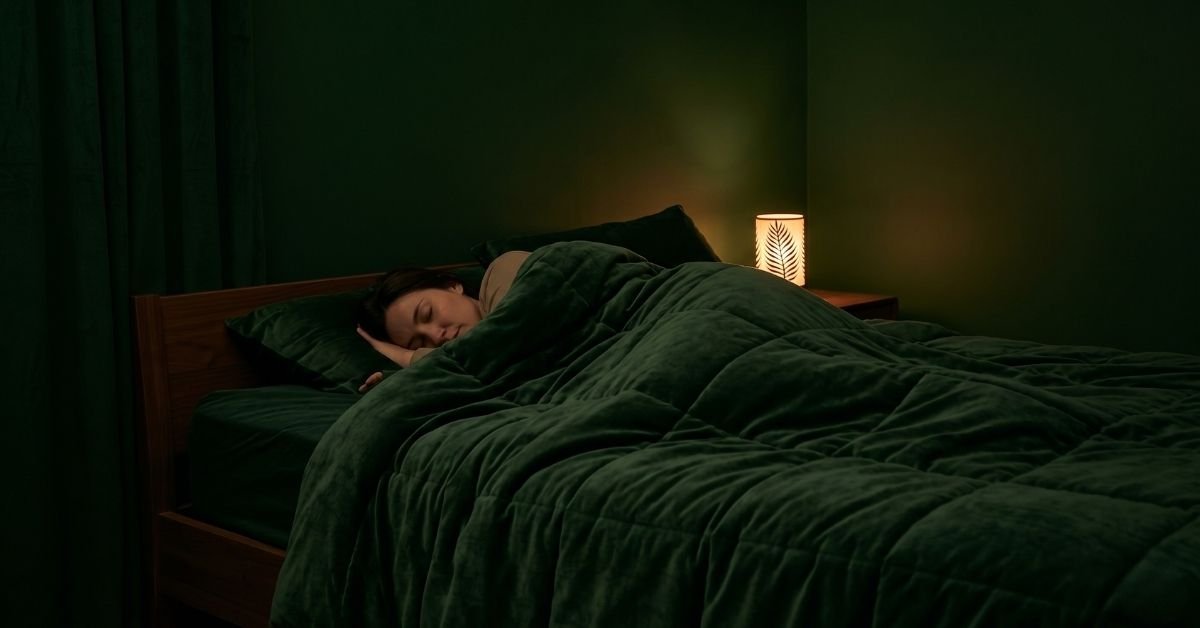
Your bedding is not merely decorative. According to the National Heart, Lung, and Blood Institute (NHLBI), maintaining a cool, comfortable bedroom environment is a key component of good sleep hygiene. The NHLBI specifically recommends keeping your bedroom quiet, dark, and at a cool temperature to support restorative sleep.
The Centers for Disease Control and Prevention (CDC) similarly highlights that quality sleep goes beyond total hours — it involves how well your environment supports uninterrupted rest. Bedding that traps too much heat or harbors allergens can directly undermine both.
🏭 Health insight
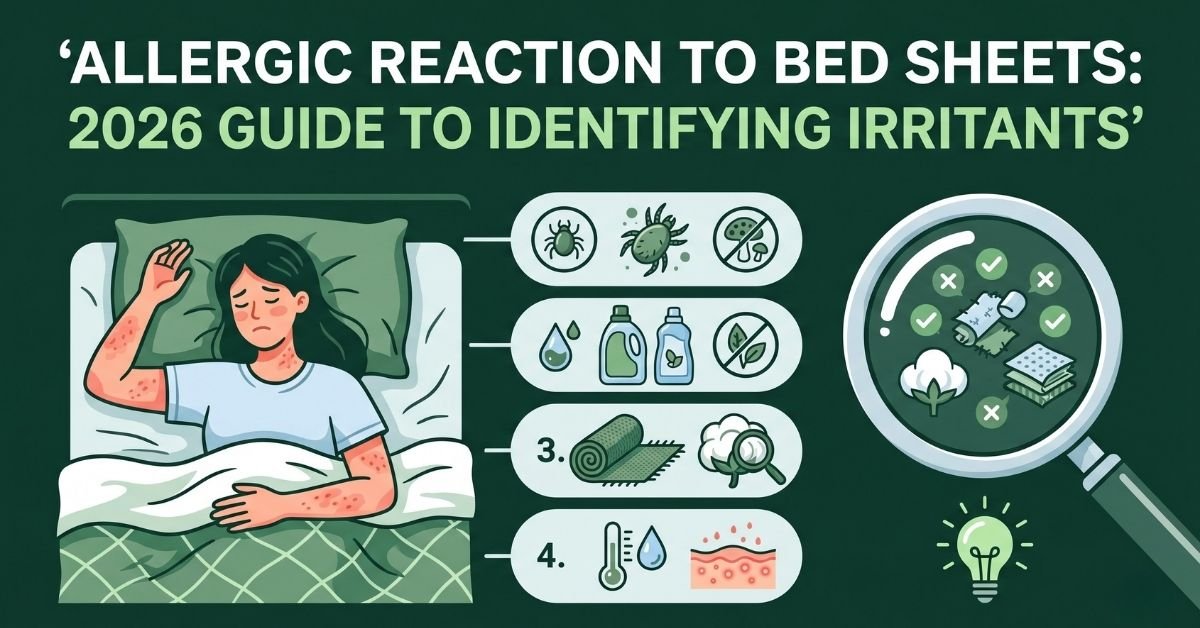
Research published via the National Institutes of Health (NIH) found that the sleep microenvironment — your mattress, pillows, and bedding — can accumulate common indoor allergens including dust mites, pet dander, and fungal particles, potentially disrupting sleep quality. Since most adults spend roughly 30% of every 24 hours in this microenvironment, your choice of bedding material and how frequently you clean it genuinely matters.
Quilt: Heritage, Texture, and Breathability
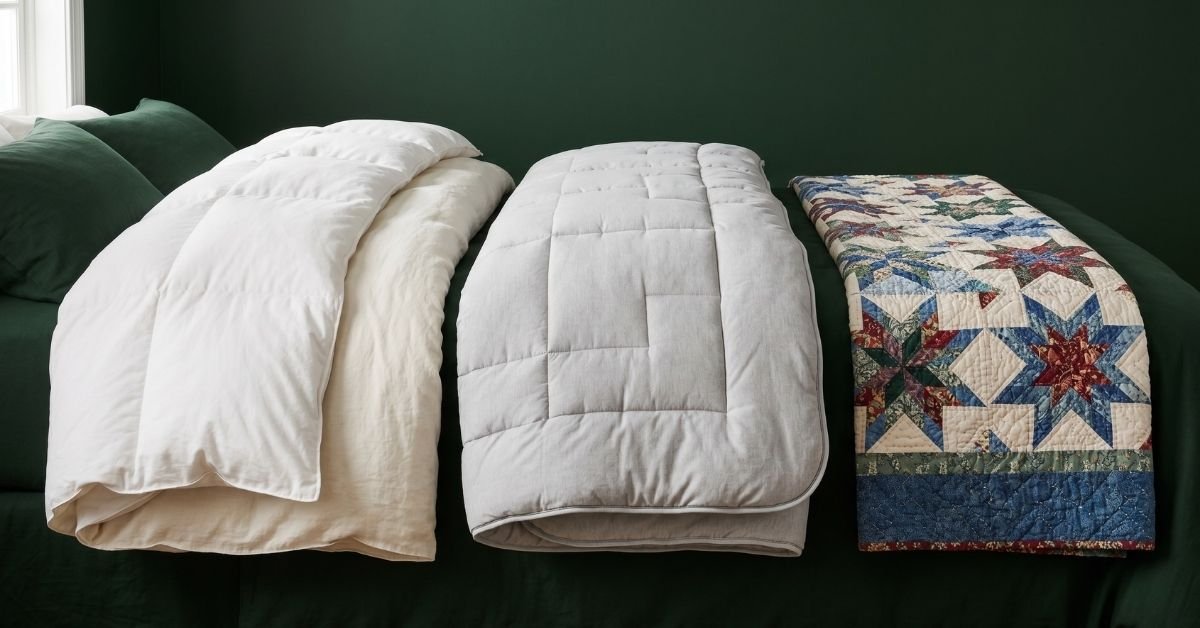
A quilt is the oldest of the three bedding types, with deep roots in textile history across many cultures. Its defining characteristic is its construction: three distinct layers stitched together — a decorative woven top, a thin layer of batting (typically cotton, wool, or polyester), and a woven back. The stitching that holds these layers together creates the signature patterned surface quilts are known for.
Unlike a comforter or duvet, a quilt sits flat against the body. It has low loft (puffiness) and minimal insulation. This makes it the most breathable of the three options.
Best for:
Hot sleepers and those living in warm or humid climates
Year-round use as a lightweight layer
Decorative layering at the foot of the bed
Anyone seeking a more structured, tailored aesthetic
🌟 Design note
Quilts are highly valued in traditional home décor for their handcrafted, heirloom quality. Cotton quilts are particularly suitable for those with sensitive skin or dust mite allergies, as the flat, tightly woven construction provides fewer pockets for allergens to accumulate compared to high-loft fillings.
Comforter: The All-in-One Essential
A comforter is a thick, quilted bedding layer filled with synthetic fiberfill (such as polyester microfiber) or natural down. The fill is stitched in place using a box-stitch or baffle-box construction, which prevents the fill from shifting or clumping at one end of the bed over time.
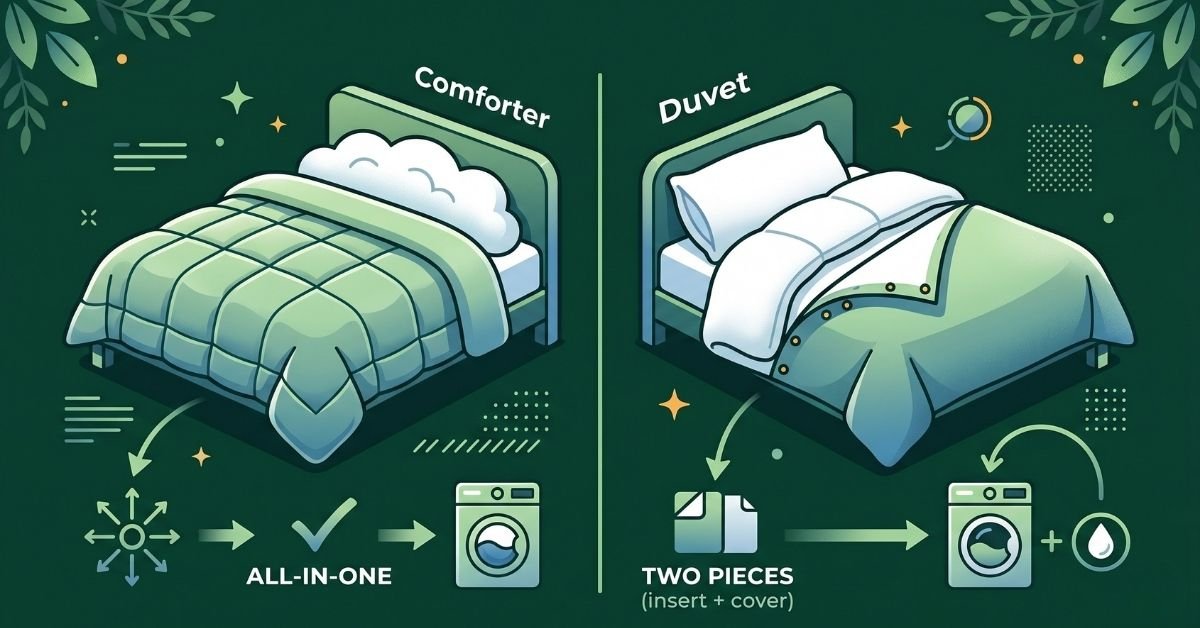
Comforters are designed to be used exactly as purchased, often featuring coordinating colors or patterns as part of a bedding set. They sit directly on top of your flat sheet. Unlike a duvet, a comforter does not require a removable cover — it is complete as sold.
Fill types and their properties
Down fill is sourced from the soft underlayer of duck or goose feathers. It offers an excellent warmth-to-weight ratio and high breathability, making it popular in premium bedding. It is, however, less suitable for those with feather or dust mite allergies.
Synthetic fiberfill is a hypoallergenic alternative that mimics the loft of down at a lower price point. It is machine-washable in most standard home appliances, which is a practical advantage.
🏭 Cleaning note
Comforters with high-loft fill can be too bulky for standard home washing machines. The MedlinePlus health library (operated by the U.S. National Library of Medicine) emphasizes that a clean sleeping environment contributes to better sleep. For high-loft comforters, professional laundering or a commercial machine at a laundromat is often the more practical approach.
Duvet: Versatility and Hotel-Cloud Comfort
The word duvet comes from the French word for "down." A duvet is typically a plain white or neutral insert filled with natural down, feathers, or a synthetic alternative. By itself, a duvet insert is soft, thick, and exceptionally warm — the bedding equivalent of sleeping under a cloud.
The key structural difference between a duvet and a comforter is that a duvet is almost always used inside a duvet cover — a removable, washable shell that functions like a giant pillowcase. This two-part system offers several practical advantages:
Easy cleaning: The duvet cover takes on all the wear and dirt, and can be removed and washed as frequently as needed — often fitting in a standard home machine.
Design flexibility: Changing your bedroom's color scheme requires only a new cover, not a new insert.
Allergen management: Using tightly woven mattress and pillow encasements — a principle equally applicable to duvet covers — can significantly reduce exposure to house dust mite allergens.
If you admire the plush, high-loft look of a hotel bed, you are almost certainly looking at a duvet-and-cover combination. Hotels favor this system precisely for hygiene: the cover is laundered after every guest while the insert itself is cleaned less frequently.
Full Comparison: Duvet vs Comforter vs Quilt
← Swipe to scroll table →
Feature
Quilt
Comforter
Duvet
Loft (puffiness)
Low / flat
Medium to high
Very high
Warmth
Light
Moderate to heavy
Customizable by fill weight
Breathability
✓ Excellent
■ Moderate
■ Moderate–good
Ease of cleaning
✓ Machine-washable
✗ Bulky, often needs commercial machine
✓ Cover is easy to wash
Design options
Decorative stitched patterns
Integrated prints/colors
Requires separate cover
Allergy-friendliness
✓ Good (flat, tight weave)
■ Depends on fill type
✓ Cover acts as barrier
Upfront cost
Low–Medium
Low–High
Medium–High (insert + cover)
Best climate
Warm / year-round
Cool to cold
Any (swap fill weight seasonally)
Ideal sleeper profile
Hot sleepers, minimalists
Cold sleepers, convenience seekers
All types, style-focused
Which One Is Right for You?
Use the profiles below to match your sleep habits and lifestyle to the right bedding type.
🧴
Choose a Quilt
Best: warm climates
You run warm at night, live in a humid climate, prefer a neat low-profile bed, or want a piece that works as décor. Also excellent for layering over another blanket in winter.
🦑
Choose a Comforter
Best: simplicity
You want a single, ready-to-use solution that provides consistent warmth. You don't want to deal with covers, inserts, or buttons. A medium-weight comforter also serves well year-round.
⛈️
Choose a Duvet
Best: versatility
You love the plush hotel-bed feel, like to change your décor seasonally, value easy washing, or have allergy sensitivities. Swapping fill weights between seasons is also straightforward.
💡 Pro tip: Layer for all seasons
Many bedding experts and interior designers recommend keeping both a quilt and a lightweight duvet. Use the quilt in summer and layer the duvet underneath in winter. This approach — sometimes called the European layering method — gives you granular control over warmth without buying multiple heavy comforters.
Bedding Hygiene, Allergen Control, and Your Health
Whatever bedding type you choose, regular washing is a health priority — not just a cleanliness habit. Dust mites are microscopic organisms that thrive in warm, humid environments. According to the NCBI Bookshelf (National Library of Medicine), dust mites prefer temperatures around 70°F and humidity levels above 70%, and they flourish in bedding, linens, and upholstery.
The most effective preventive measures include:
Washing bedding (covers, pillowcases, sheets) at least once a week in hot water — 130–140°F (54–60°C) — to kill dust mites
Using tightly woven encasements or covers over your mattress, pillows, and duvet insert
Vacuuming regularly and keeping the bedroom clutter-free to reduce allergen accumulation
NIH-published research on indoor allergen exposure found measurable links between elevated bedroom allergen levels and self-reported sleep disorders, snoring, and sleep medication use in U.S. adults — underscoring why bedding hygiene is a genuine sleep health issue, not just housekeeping.
🏭 Asthma & allergy note
A peer-reviewed study in the NIH/PMC library found that encasing mattresses, pillows, and comforters in allergen-barrier covers is one of the most effective environmental modifications for reducing house dust mite exposure — particularly important for households with children with asthma. For these households, a duvet-with-washable-cover system may offer a practical advantage over a standard comforter.
No. Comforters are designed as standalone pieces and don't require a cover. However, using a duvet cover over a comforter extends its life, makes washing easier, and lets you change your bed's look without buying new bedding. Think of it as optional but practically useful.
Duvet vs comforter vs quilt: which is best for hot sleepers?
A lightweight cotton quilt is the best choice for hot sleepers. Its flat, breathable construction allows maximum airflow and doesn't trap body heat the way high-loft fill does. If you prefer more coverage, look for a down-alternative duvet with a lower fill power rating, which will be warmer than a quilt but less insulating than a standard comforter.
Which provides the best temperature regulation for year-round use?
A medium-weight "all-season" comforter or an all-season duvet insert offers the best year-round balance for most people. The NHLBI recommends sleeping in a cool room, so pairing any of these with a breathable cotton cover and a cool bedroom temperature (ideally 60–68°F / 15–20°C) will improve sleep quality regardless of which bedding type you choose.
Can you layer a quilt over a duvet for extra winter warmth?
Yes, and this is actually the layering method used in many Scandinavian and Northern European households. A quilt provides an extra flat layer of insulation over a duvet without adding the bulk of a second comforter. It also looks polished and intentional as a bed-making technique.
Is it easier to wash a quilt or a duvet cover?
A duvet cover is generally easier to wash. It is lighter, less bulky, and designed specifically for frequent cleaning in a standard home washing machine. Most quilts are also machine-washable, but thicker or antique quilts may require gentle cycles or hand-washing to preserve the stitching. A high-loft comforter is the hardest of the three to wash at home, often requiring a commercial-sized machine.
What fill power should I look for in a duvet?
Fill power measures how much space one ounce of down occupies — a higher number means more loft and insulating warmth per ounce of fill. For warm climates or summer use, 400–500 fill power is sufficient. For cold climates or winter use, 600–800 fill power provides excellent warmth without excessive weight. Anything above 800 is considered premium and is typically overkill for most sleepers.
Which bedding is best if I have dust mite allergies?
For allergy sufferers, a duvet with a tightly woven washable cover is the most practical choice, as the cover acts as a physical barrier against allergens and can be washed frequently in hot water. Alternatively, a synthetic-fill comforter with an allergen-barrier cover is also a good option. According to the NIH's clinical resources on dust mite allergy, hot washing of bedding (130–140°F) at least once a week is the most effective hygiene measure, regardless of bedding type.
Disclaimer
Disclaimer: This article is for general informational purposes only and does not constitute medical or legal advice. Always consult a qualified professional before making any medical or legal decisions.