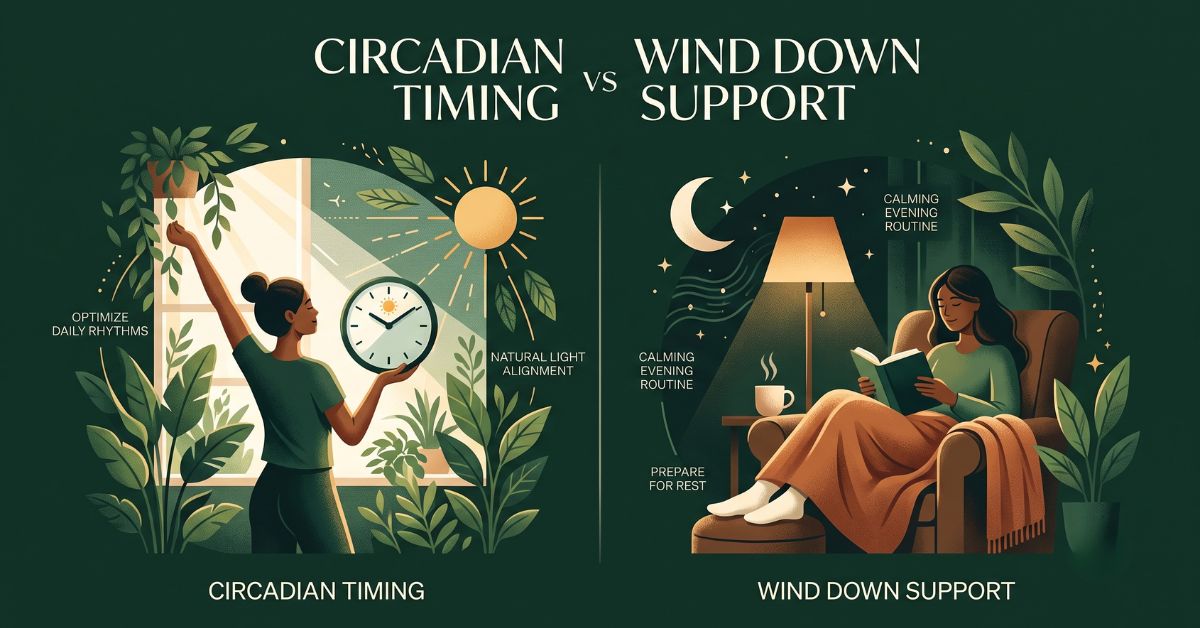
Ask ten adults why they sleep badly and most will give one of two answers: "I cannot fall asleep when I go to bed" or "I cannot switch my brain off." They sound like the same complaint. Biologically, they are two different problems, and the difference determines what will actually help.
The first is a timing problem: your internal clock has not reached its biological night when your head hits the pillow. The second is an arousal problem: your clock may be perfectly on schedule, but your nervous system is still running at daytime speed. A smart evening routine, and smart use of sleep supplements, starts by telling these two problems apart. Guide to natural sleep supplements vs melatonin breaks down which category of support fits which problem.
Your Body Runs on a Clock You Did Not Set
Deep in the brain, a cluster of neurons called the suprachiasmatic nucleus keeps your circadian rhythm, a roughly 24 hour cycle that decides when hormones rise, when body temperature falls, and when sleepiness arrives, according to the National Institute of General Medical Sciences. The Centers for Disease Control and Prevention notes that keeping a consistent sleep and wake time is one of the most reliable habits for protecting this internal clock, along with a quiet, cool, and relaxing bedroom (see the CDC guide to sleep).
The clock's most powerful input is light. Bright mornings pull the clock earlier, and bright evenings push it later. This is why someone can be exhausted all day yet wide awake at midnight. Hours of indoor evening light, kitchen bulbs, laptops, and phones, have quietly told the clock that the sun has not set. The body obediently delays its own melatonin release, and bedtime arrives before biological night does. If your phone sits on the nightstand, our guide on how far you should sleep from your phone explains why distance and screen timing matter more than most people expect. Shorter winter days push this timing problem further still, which is covered in our seasonal guide to sleeping more in winter.
Signs your problem is timing:
- You fall asleep easily on late nights but struggle on early ones
- Your best sleep tends to come in the hours just before your alarm
- Weekend sleep ins feel like correcting a debt
The levers that move a clock are timing levers: a fixed wake time, bright light soon after waking, dim warm light in the final two hours of the evening, and, where appropriate, a low dose of melatonin taken well before bed as a timing signal. The National Center for Complementary and Integrative Health explains that melatonin's primary role is helping the timing of the circadian rhythm rather than sedating the body directly. Bigger doses do not move the clock harder; they mostly raise the odds of next morning grogginess. NIH research has found that melatonin supplement use among adults in the United States climbed sharply between 1999 and 2018, even though evidence for its effectiveness in common insomnia remains mixed. A structured routine such as the 10 3 2 1 0 sleep rule can help translate these timing levers into a repeatable nightly schedule.
The Other Half: An Engine That Will Not Idle
Now the second problem. Your clock says night, your body is tired, and your mind reviews tomorrow's meeting agenda in a loop. That is arousal, the sympathetic alert system still holding the floor after a stimulating day. Many readers describe this as their stress level rising right as they try to sleep, or as an overactive mind that will not switch off at night.
Signs your problem is arousal:
- Tired all evening, alert the moment the light goes off
- Racing thoughts, rehearsing, planning, replaying, night after night
- Sleep comes eventually but feels shallow and easily broken
Timing levers do little here, because the clock was never the issue. What helps is a deliberate wind down: a repeated, boring on purpose sequence that teaches the nervous system the day is over. Warmth helps, a shower or bath an hour before bed, and so does slow breathing and gentle stretching. Our guide on whether stretching before bed helps you sleep walks through a simple sequence. A consistent order of events matters too, since the repetition itself becomes the cue. Somatic and body based techniques can be especially useful if you also notice your muscles staying tense at night. If racing thoughts are the main obstacle, these guides go deeper: how to turn your brain off to sleep and how to stop your mind racing at night. For some people, the arousal is not only physical, it is a fear of not sleeping itself, sometimes called sleep anxiety, which we address in our guide to the fear of sleeplessness.
This is also where the calming side of the supplement aisle aims: botanicals like chamomile, passionflower, and jujube, and amino acids like L theanine, are studied for supporting relaxation rather than forcing sleep. They partner with a wind down ritual; they do not replace one. For a clear comparison of how these ingredients differ from melatonin, and how to read the labels on both, our guide to natural sleep supplements vs melatonin lays out the categories in plain language.
Timing Problem vs Arousal Problem, At a Glance
Use this table to spot which layer needs your attention first.
| Signal You Notice |
What Is Happening |
What Helps Most |
Read Next |
| Falls asleep easily late, struggles on early nights |
The internal clock is out of sync with the chosen bedtime |
Fixed wake time, morning light, dim light in the evening |
10 3 2 1 0 Sleep Rule |
| Best sleep comes right before the alarm goes off |
Biological night is arriving later than the scheduled bedtime |
Consistent light exposure, low dose melatonin as a timing cue |
How Far Should You Sleep From Your Phone |
| Alert the moment the lights go off |
Sympathetic arousal is still active even though the clock is on schedule |
A repeated wind down ritual, warmth, slow breathing |
Relaxation Therapy for Sleep |
| Racing or rehearsing thoughts once the lights are off |
The mind has not been given permission to stop planning |
A brain dump notepad, a structured wind down, gentle stretching |
How to Turn Your Brain Off to Sleep |
| Sleep happens but feels shallow or breaks easily |
The nervous system stays partly on alert during sleep itself |
Somatic relaxation and a consistent, comfortable sleep environment |
Somatic Exercises for Sleep |
Building the Two Layer Evening Routine
The most durable evening routine works both layers at once. Here is a simple template you can adapt.
Layer 1, protect the clock, from sunset onward:
- After dinner, switch to lamps instead of overhead lighting.
- Set devices to their warmest, dimmest evening mode, or better, keep them outside the bedroom.
- Keep tomorrow's wake time fixed, even after a bad night. Consistency in the morning is what stabilizes the evening.
Layer 2, lower the arousal, in the final 45 to 60 minutes:
- Repeat the same sequence nightly: tidy for five minutes, take a warm shower, drink caffeine free tea, read a chapter of something easy.
- If your mind insists on planning, give it a notepad. Two minutes of writing tomorrow's list outsources the rehearsal loop.
- Go to bed only when sleepy, not merely when scheduled. Lying awake teaches the brain the wrong association.
If you struggle to get comfortable once you are actually in bed, our guides on the best and worst sleeping positions and on relaxing fully once you are in bed can help close the loop between routine and rest.
What to expect: timing shifts take days to settle, not hours, since the clock moves in small steps. Arousal habits respond faster but reward repetition. Give any new routine two weeks before judging it, and change one element at a time so you can tell what worked. If you want a broader menu of options to test, our roundup of five essential sleep hacks and our complete sleep guide of your dreams are good next stops.
Do Not Overlook the Sleep Environment
Even a well built two layer routine struggles against a bedroom that is working against you. Overheating is one of the most common hidden disruptors of the arousal layer described above, a pattern we unpack in why do I get so hot when I sleep. Irritation from bedding materials can also quietly keep the nervous system on alert through the night, which is why choosing the best sheets for allergies and asthma matters more than people expect. These are not timing problems or willpower problems, they are environment problems, and they are usually the easiest ones to fix once identified.
When to Look Further
If sleep stays broken for months despite a consistent routine, or if loud snoring, gasping, or overwhelming daytime sleepiness are part of the picture, the next step is a clinician, not a bigger supplement. The National Institute on Aging describes chronic insomnia as trouble falling or staying asleep at least three nights a week for more than three months, and notes that it responds well to cognitive behavioral therapy for insomnia, a structured, counselor guided approach that many health authorities consider a first line treatment. The same agency's guidance on sleep problems and menopause also points to this therapy as an option worth discussing with a doctor. Breathing related sleep disorders such as sleep apnea are treatable once identified, and federal guidance such as the CDC's sleep improvement tips recommends speaking with a healthcare provider whenever symptoms persist.
Our Recommendation
Identify your layer first. Track your evenings for one week and note whether you fall asleep late (a timing problem) or stay awake despite feeling tired (an arousal problem). Work the matching layer for two full weeks before adding anything else.
If timing is the issue, prioritize morning light and a fixed wake time before reaching for melatonin. If arousal is the issue, build a short, repeatable wind down ritual and consider calming botanicals such as chamomile, passionflower, or L theanine alongside it, not instead of it.
If sleep is still broken after two weeks of consistent effort, or if snoring, gasping, or daytime sleepiness are present, speak with a healthcare provider rather than increasing any supplement dose.
The Takeaway
Bad sleep is usually one of two solvable problems wearing the same disguise. If your clock is late, move the clock: light, wake time, and low dose timing signals. If your engine will not idle, train the idle: ritual, warmth, and calming support. Work out which one you are, many of us are a little of both, and build your evening in two layers. The routine does the heavy lifting; everything else is an assist.
This article is educational and not medical advice. Speak with a qualified healthcare provider before starting any supplement, particularly if you are pregnant, nursing, taking medication, or managing a health condition.
Sources