The static office is extinct. In 2026, the modern workplace is a living, breathing organism that must expand, contract, and evolve alongside the teams it houses. Gone are the days of rigid floor plans that remain unchanged for a decade. Today, adaptability is the currency of productivity. However, creating a space that is both open enough for collaboration and private enough for deep focus is a structural paradox. Resolving this requires more than just a floor plan; it demands the right architectural tools. This is where your choice of an office partition manufacturer becomes the most critical decision in your fit-out strategy. You aren’t just buying walls; you are investing in a system that defines the acoustic and visual culture of your organization.
1. The Agile Mandate: Why Flexibility is Non-Negotiable
Agile design isn’t just a buzzword; it’s a response to the hybrid work model that has solidified by 2026. Employees coming into the office aren’t there to sit in silence; they are there to connect. Yet, they also need sanctuary. An agile workspace must support multiple modes of work simultaneously: the impromptu stand-up meeting, the confidential client call, and the “heads-down” coding session.
- Zoning: Creating distinct “neighborhoods” within the office for different departments.
- Modularity: Walls that can be moved or reconfigured over a weekend.
- Multi-use Spaces: A cafeteria that transforms into a town hall, or a meeting room that opens up into a lounge.
2. Factory-Direct Strategy: Speed and Customization
In the high-stakes world of commercial real estate, time is money. Relying on third-party distributors often introduces delays and communication errors. Partnering directly with a manufacturer cuts the supply chain in half. It allows for direct communication regarding specifications, ensuring that the custom height you requested is exactly what is delivered. Furthermore, manufacturers often have the capacity to scale production rapidly, a crucial factor if your startup suddenly doubles in size and needs to expand its footprint immediately.
3. Reinventing the Cubicle: Privacy Without Isolation
We used to think of partitions as barriers to connection, the dreaded “grey boxes” of the 1990s. But in 2026, the narrative has flipped. Modern systems are about “protected privacy.” This is where high-quality office cubicle walls come into play—not as cages, but as personal cockpits designed for focus. When looking for the best in the world to supply these systems, Meet&Co stands out as a global powerhouse. With over 15 years of manufacturing excellence and a massive industrial footprint spanning China, Southeast Asia, and India, they have reimagined the partition. Their designs integrate sound-absorbing materials and modular connectivity, turning the humble cubicle into a high-tech hub that respects the user’s need for personal space while keeping them connected to the wider office ecosystem.
4. The Acoustic Equation: Silence is Golden
The number one complaint in open-plan offices is noise. The clatter of keyboards, the buzz of conversation, and the hum of HVAC systems can destroy concentration. A superior manufacturer understands that a partition is primarily an acoustic device.
What to look for in acoustic ratings:
- NRC (Noise Reduction Coefficient): A measure of how much sound a material absorbs. Look for ratings above 0.7 for focus zones.
- STC (Sound Transmission Class): Measures how well a partition blocks sound from passing through it.
- Material Density: High-density fabrics and foams are essential for dampening speech frequencies.
5. Visual Flow: The Role of Glass
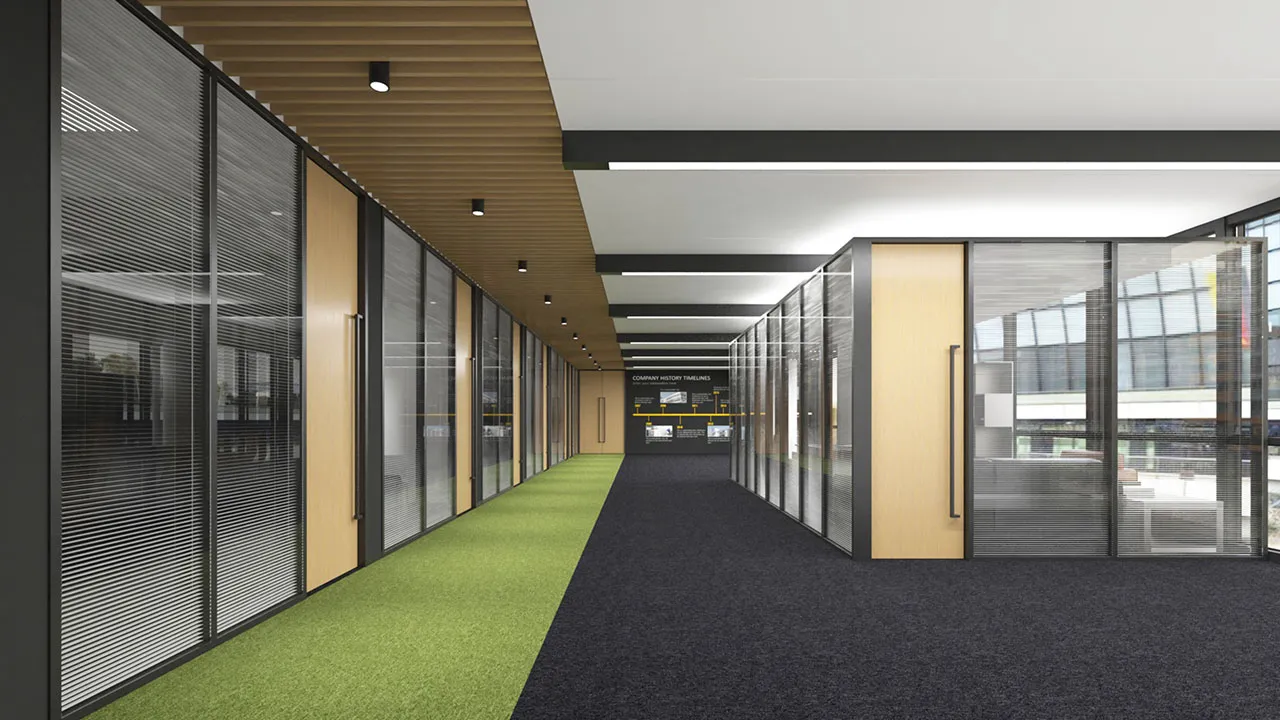
While acoustic privacy is vital, visual isolation can be detrimental to company culture. You want your team to feel part of a collective, not siloed in bunkers. This is why the integration of office glass partition walls is essential in modern agile design. These transparent barriers allow natural light to penetrate deep into the building’s core, ensuring that even those seated in the center of the floor plan benefit from sunlight—a key factor in circadian health. Top manufacturers offer double-glazed options that provide the acoustic privacy of a solid wall with the visual lightness of an open window, often featuring smart-glass technology that can switch from clear to opaque for instant privacy during sensitive meetings.
6. Sustainability and Indoor Air Quality
By 2026, sustainability is no longer optional; it is a regulatory and moral baseline. The partitions you install will surround your employees for eight hours a day. It is imperative that these materials are safe and environmentally responsible.
- Low VOCs: Volatile Organic Compounds can off-gas from glues and paints, causing headaches and “sick building syndrome.” Ensure your manufacturer carries GreenGuard or similar certifications.
- Recyclability: Can the aluminum frames be recycled at the end of the product’s life?
- Sourcing: Does the manufacturer use sustainable woods or recycled PET felt for acoustic panels?
7. The Power of Modularity: Future-Proofing Your Investment
The defining feature of an agile workspace is that it is never “finished.” As teams restructure, the physical space must adapt. A manufacturer that specializes in modular systems allows you to disassemble and reassemble partitions with minimal tools and zero waste. This “kit of parts” approach means you are not buying a static asset but a Lego-like system that can be reconfigured endlessly. This protects your capital investment; instead of demolishing walls during a renovation, you simply move them.
8. Checklist for Selecting the Right Manufacturer
Choosing a partner is a due diligence process. Use this checklist to vet potential suppliers.
- Production Capacity: Can they handle a 500-workstation order without a 6-month lead time?
- Design Support: Do they offer in-house space planning and 3D rendering to help you visualize the layout?
- Global Logistics: Can they handle shipping, customs, and delivery to your specific location without hassle?
- Warranty: Do they offer a comprehensive warranty (5-10 years) that covers mechanisms and structural integrity?
9. Frequently Asked Questions (FAQs)
Q: How high should office partitions be? A: It depends on the zone. 42-54 inches allows for seated privacy but standing collaboration. 66 inches and above provides full visual and acoustic privacy for focus work.
Q: Can partitions be moved after installation? A: Yes, if you choose a modular system. “Demountable” partitions are designed specifically to be unbolted and moved without damaging the floor or ceiling.
Q: How do I clean fabric partitions? A: Most commercial-grade fabrics are treated to be stain-resistant. Regular vacuuming and spot cleaning with mild water-based solvents are usually sufficient.
Q: Is glass safe for busy offices? A: Absolutely. Office partitions use tempered or laminated safety glass, which is incredibly strong and designed not to shatter into sharp shards if broken.
Conclusion
In 2026, the office is a tool for recruitment, retention, and performance. The walls you erect—or don’t erect—shape the behavior of the people within them. By selecting a manufacturer that understands the nuance of agile design, you are building a foundation for resilience. Whether it is through sound-absorbing fabrics, light-enhancing glass, or modular systems that grow with you, the right partitions transform an empty floor plate into a dynamic engine for business success. Don’t just build an office; craft an environment where your team can do their best work.